#Tawheed, #KitabatTawheed, #Bismillah School #Oath #Allah’s Name
Abu Huraira reported: The Messenger of Allah, peace and blessings be upon him, said, “Do not swear an oath by your father, nor your mothers, nor by rivals to Allah. Do not swear an oath unless it is by Allah and you are honest.” Source: Sunan Abī Dāwūd 3248
In the name of Allah, Most Merciful, the Bestower of Mercy. “The One Who is not Satisfied with an Oath being Taken in Allah’s Name.” (al-Half حلف) – i.e., to swear by Allah. The Text of the Chapter: Shaikhul-Islam Muhammad Ibn Abdul-Wahhāb said: ‘Abdullah ibn ‘Umar (radiyallahu ‘anhumā) said that the Prophet (salallāhu ‘alaihi wasallam) said: لاَ تَحْلِفُوا بِآبَائِكُمْ مَنْ حَلَفَ بِاللَّهِ فَلْيَصْدُقْ وَمَنْ حُلِفَ لَهُ بِاللَّهِ فَلْيَرْضَ وَمَنْ لَمْ يَرْضَ بِاللَّهِ فَلَيْسَ مِنَ اللَّهِ “Do not swear by your fathers, and whoever swears by Allah, then let him speak truthfully, and whoever is given an oath by Allah’s Name, then let him be pleased with it, and whoever is not pleased with it – and whoever is not content with Allah has nothing to do with Allah.” (Ibn Mājah, 2101, graded saheeh by Al-Albāni in Saheeh al-Jāmi’, 7247)
Tawheed means worshipping Allah Alone/ God AllMightyAlone and setting No one as a Partner with Him;
Tawheed in the Bible : Exodus 20 –
The Ten Commandments
20 And God spoke all these words:
2 “I am the Lord your God, who brought you out of Egypt, out of the land of slavery.
4 “You shall not make for yourself an image in the form of anything in heaven above or on the earth beneath or in the waters below. 5 You shall not bow down to them or worship them; for I, the Lord your God, am a jealous God, punishing the children for the sin of the parents to the third and fourth generation of those who hate me, 6 but showing love to a thousand generations of those who love me and keep my commandments.
SURAH NABA/ THE GREAT NEWS (Monotheism, Prophet Muhammad -s aw- Resurrection):
1. What are they asking (one another)?
2. About the great news, (i.e. Islamic Monotheism, the Qur’an, which Prophet Muhammad () brought and the Day of Resurrection, etc.),
3. About which they are in disagreement.
4. Nay, they will come to know!
5. Nay, again, they will come to know!
6. Have We not made the earth as a bed,
7. And the mountains as pegs?
8. And We have created you in pairs (male and female, tall and short, good and bad, etc.).
9. And have made your sleep as a thing for rest.
10. And have made the night as a covering (through its darkness),
11. And have made the day for livelihood.
12. And We have built above you seven strong (heavens),
13. And have made (therein) a shining lamp (sun).
14. And have sent down from the rainy clouds abundant water.
15. That We may produce therewith corn and vegetations,
16. And gardens of thick growth.
17. Verily, the Day of Decision is a fixed time,
18. The Day when the Trumpet will be blown, and you shall come forth in crowds (groups);
19. And the heaven shall be opened, and it will become as gates,
20. And the mountains shall be moved away from their places and they will be as if they were a mirage.
21. Truly, Hell is a place of ambush,
22. A dwelling place for the Taghun (those who transgress the boundry limits set by Allah like polytheists, disbelievers in the Oneness of Allah, hyprocrites, sinners, criminals, etc.),
23. They will abide therein for ages,
24. Nothing cool shall they taste therein, nor any drink.
25. Except boiling water, and dirty wound discharges.
26. An exact recompense (according to their evil crimes).
27. For verily, they used not to look for a reckoning.
28. But they belied Our Ayat (proofs, evidences, verses, lessons, signs, revelations, and that which Our Prophet (Peace be upon him) brought) completely.
29. And all things We have recorded in a Book.
30. So taste you (the results of your evil actions); no increase shall We give you, except in torment.
31. Verily, for the Muttaqun, there will be a success (Paradise);
32. Gardens and grapeyards;
33. And young full-breasted (mature) maidens of equal age;
34. And a full cup (of wine).
35. No Laghw (dirty, false, evil talk) shall they hear therein, nor lying;
36. A reward from your Lord, an ample calculated gift (according to the best of their good deeds).
37. (From) the Lord of the heavens and the earth, and whatsoever is in between them, the Most Beneficent, none can dare to speak with Him (on the Day of Resurrection except after His Leave).
38. The Day that Ar-Ruh [Jibrael (Gabriel) or another angel] and the angels will stand forth in rows, none shall speak except him whom the Most Beneficent (Allah) allows, and he will speak what is right.
39. That is without doubt the True Day, so, whosoever wills, let him seek a place with (or a way to) His Lord (by obeying Him in this worldly life)!
Old Gospel saved and Hidden int he Catholic Library for Hundreds of years– and published later on;
has passages which would amaze most Christians – such as agreeing with Quran Kareem in the fact that Jesus was Nor crucified, but raised to the Heavens by 4 Angels;
Barnabas mentions Judas being crucified (as God changed Juda’s Face to look like Jesus – but in Quran Kareem Allah does not specify who exactly was crucified; except that it was not Jesus;
214. Gospel of Barnabas ch 214 –
Having gone forth from the house, Jesus retired into the garden to pray, according as his custom was to pray, bowing his knees an hundred times and prostrating himself upon his face. Judas, accordingly, knowing the place where Jesus was with his disciples, went to the high priest, and said: ‘If ye will give me what was promised, this night will I give into your hand Jesus whom ye seek: for he is alone with eleven companions.’
The high priest answered: ‘How much seekest thou?’
Said Judas, ‘Thirty pieces of gold.’
Then straightway the high priest counted unto him the money, and sent a Pharisee to the governor to fetch soldiers, and to Herod, and they gave a legion of them, because they feared the people; wherefore they took their arms, and with torches and lanterns upon staves went out of Jerusalem.
215. -Gospel of Barnabas ch 215
When the soldiers with Judas drew near to the place where Jesus was, Jesus heard the approach of many people, wherefore in fear he withdrew into the house. And the eleven were sleeping.
Then God, seeing the danger of his servant, commanded Gabriel, Michael, Rafael, and Uriel, his ministers, to take Jesus out of the world.
The holy angels came and took Jesus out by the window that looketh toward the South. They bare him and placed him in the third heaven in the company of angels blessing God for evermore.
216. Gospel of Barnabas ch 216
Judas entered impetuously before all into the chamber whence Jesus had been taken up. And the disciples were sleeping. Whereupon the wonderful God acted wonderfully, insomuch that Judas was so changed in speech and in face to be like Jesus that we believed him to be Jesus. And he, having awakened us, was seeking where the Master was. Whereupon we marvelled, and answered: ‘Thou, Lord, art our master; hast thou now forgotten us?’
And he, smiling, said: ‘Now are ye foolish, that know not me to be Judas Iscariot!’
And as he was saying this the soldiery entered, and laid their hands upon Judas, because he was in every way like to Jesus.
We having heard Judas’ saying, and seeing the multitude of soldiers, fled as beside ourselves.
And John, who was wrapped in a linen cloth, awoke and fled, and when a soldier seized him by the linen cloth he left the linen cloth and fled naked. For God heard the prayer of Jesus, and saved the eleven from evil.
217. – Gospel of Barnabas ch 217
The soldiers took Judas and bound him, not without derision. For he truthfully denied that he was Jesus; and the soldiers, mocking him, said: ‘Sir, fear not, for we are come to make thee king of Israel, and we have bound thee because we know that thou dost refuse the kingdom.’
Judas answered: ‘Now have ye lost your senses! Ye are come to take Jesus of Nazareth, with arms and lanterns as [against] a robber; and ye have bound me that have guided you, to make me king!’
Then the soldiers lost their patience, and with blows and kicks they began to flout Judas, and they led him with fury into Jerusalem.
John and Peter followed the soldiers afar off; and they affirmed to him who writeth that they saw all the examination that was made of Judas by the high priest, and by the council of the Pharisees, who were assembled to put Jesus to death. Whereupon Judas spake many words of madness, insomuch that every one was filled with laughter, believing that he was really Jesus, and that for fear of death he was feigning madness. Whereupon the scribes bound his eyes with a bandage, and mocking him said: ‘Jesus, prophet of the Nazarenes,’ (for so they called them who believed in Jesus), ‘tell us, who was it that smote thee?’ And they buffeted him and spat in his face.
When it was morning there assembled the great council of scribes and elders of the people; and the high priest with the Pharisees sought false witness against Judas, believing him to be Jesus: and they found not that which they sought. And why say I that the chief priests believed Judas to be Jesus? Nay, all the disciples, with him who writeth, believed it; and more, the poor virgin mother of Jesus, with his kinsfolk and friends, believed it, insomuch that the sorrow of every one was incredible. As God liveth, he who writeth forgot all that Jesus had said: how that he should be taken up from the world, and that he should suffer in a third person, and bthat he should not die until near the end of the world. Wherefore he went with the mother of Jesus and with John to the cross.
The high priest caused Judas to be brought before him bound, and asked him of his disciples and his doctrine.
Surah Nisa 4: 156; and their boast, “Behold, we have slain the Christ Jesus, son of Mary, [who claimed to be] an apostle of God!” However, they did not slay him, and neither did they crucify him, but it only seemed to them [as if it had been] so; and, verily, those who hold conflicting views thereon are indeed confused, having no [real] knowledge thereof, and following mere conjecture. For, of a certainty, they did not slay him
Based on Mistranslations of the Hebrew texts and Aramaic or Modifications of the Church; – Deutronomy 6 (NIV Translation)
Love the Lord Your God
1These are the commands, decrees and laws the Lord your God directed me to teach you to observe in the land that you are crossing the Jordan to possess, 2so that you, your children and their children after them may fear the Lord your God as long as you live by keeping all his decrees and commands that I give you, and so that you may enjoy long life. 3Hear, Israel, and be careful to obey so that it may go well with you and that you may increase greatly in a land flowing with milk and honey, just as the Lord, the God of your ancestors, promised you.
4Hear, O Israel: The Lord our God, the Lord is one. a5Love the Lord your God with all your heart and with all your soul and with all your strength. 6These commandments that I give you today are to be on your hearts. 7Impress them on your children. Talk about them when you sit at home and when you walk along the road, when you lie down and when you get up. 8Tie them as symbols on your hands and bind them on your foreheads. 9Write them on the doorframes of your houses and on your gates.
Islamically speaking – monotheism means worshipping The only One God/ Creator (of the Heavens and the earth and everything that exists) – called Allah (God Allmighty) is the Arabic language, as well as Allah in the Aramaic language, which is the language Jesus spoke;
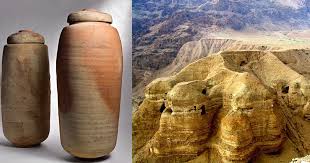
Different Formats of Early Scripture Scroll:a rolled piece of papyrus or parchment. of original scriptures were written on scrolls. Codex: a book made up of paper,parchment,or papyrus, with one end bound. Palimpsest:a manuscript page that has been washed off so that it can be reused. Hebrew Scriptures Great Isaiah Scroll,202-107 B.C., facsimile The Great Isaiah Scroll is one of the original Dead Sea Scrolls discovered in1947and is the most complete of the Hebrew Scriptures Dead Sea Scrolls found in the Qumran Caves. The scroll was written on seventeen sheets of
parchment,connected into a scroll. Differences between this scroll and the late
Jesus spoke Aramaic – and there is No Original 100percent Aramaic Text; however we will try to extract some passages which Logically correspond with each other
throughoutthe“BiblicalConnection”;
What is a Manuscript? A manuscript is a hand-written document. The word has its origin in Latin: manu (hand)and scriptum (written). There are approximately 5,800Greek manuscripts of the New Testament. In addition,there are 10,000 Latin Manuscripts,and9,300manuscripts in otherlanguages. The New Testament
Biblical Studies Christian Ministry Theological Studies Graduate Degrees ApologeticsBiblical Languages Classics and Early Christianity Theological Studies Master ofDivinity Doctor of Ministry Browse All Degrees » Early manuscripts were written oneither: Parchment:writing material made from animal skin(might be lamb,goat,
deer, or cow),or Papyrus: a reed plant that grows along the banks of the Nile. Thereare 1,276 New Testament papyri,the earliest copies of portions of the New Testament.
Different Formats of Early Scripture Scroll: a rolled piece of papyrus or parchment. Allof the original scriptures were written on scrolls. Codex: a book made up of paper,parchment, or papyrus, with one end bound. Palimpsest: a manuscript page that hasbeen washed off so that it can be reused. Hebrew Scriptures Great Isaiah Scroll, 202-107 B.C., facsimile The Great Isaiah Scroll is one of the original Dead Sea Scrollsdiscovered in 1947 and is the most complete of the Hebrew Scriptures Dead SeaScrolls found in the Qumran Caves. The scroll was written on seventeen sheets ofparchment, connected into a scroll. Differences between this scroll and the laterMasoretic text are mostly grammatical and spelling differences.
Why Most Christians got the Wrong Concept of GodWhy Most Christians got the Wrong Concept of God – Monotheism vs. Idolatry
Jesus spoke Aramaic – and there is No Original 100 percent Aramaic Text; however
we will try to extract some passages which Logiacally correspond with each other
Exodus20-TheTenCommandments-Monotheism 20 And God spoke all these words:
2 “I am the Lord your God, who brought you out of Egypt, out of the land of slavery. 3 “Youshallhavenoothergodsbefore[a] me. 4 “Youshallnotmakeforyourselfanimageintheformofanythinginheavenaboveorontheearthbeneathorinthewatersbelow.5 You shall not bow down to them or worship them; for I, the Lord your God, am a jealous God, punishing the children for the sin of the parents to the third and fourth generation of those who hate me, 6 but showing love to a thousand generations of those who love me and keep my commandments. (do most Christians worship Jesus along/ with God … or take his name in Prayer instead of God) Numbers 23:19 – GodisNotHuman,thatheshouldlie,notahumanbeing,thatheshouldchangehismind.Does he speak and then not act? Does he promise and not fulfill? *The Origins of Trinity in Greek or Roman Idolatry;
Depression Cause mostly from Not Remembering Allah azza wa Jal;
Surah Taha 124 -127 Sahih International And whoever turns away from My remembrance – indeed, he will have a depressed life, and We will gather him on the Day of Resurrection blind.” Sahih International He will say, “My Lord, why have you raised me blind while I was [once] seeing?” Sahih International [ Allah ] will say, “Thus did Our signs come to you, and you forgot them; and thus will you this Day be forgotten.” 127 And thus do We recompense he who transgressed and did not believe in the signs of his Lord. And the punishment of the Hereafter is more severe and more enduring.
Abu Hurairah (May Allah be pleased with him) reported:The Messenger of Allah (ﷺ) said, “He who utters a hundred times in a day these words: ‘La ilaha illallahu, wahdahu la sharika lahu, lahul-mulku wa lahul-hamdu, wa Huwa ‘ala kulli sha’in Qadir (there is no true god except Allah. He is One and He has no partner with Him; His is the sovereignty and His is the praise, and He is Omnipotent),’ he will have a reward equivalent to that for emancipating ten slaves, a hundred good deeds will be recorded to his credit, hundred of his sins will be blotted out from his scroll, and he will be safeguarded against the devil on that day till the evening; and no one will exceed him in doing more excellent good deeds except someone who has recited these words more often than him. And he who utters: ‘Subhan-Allahi wa bihamdihi (Allah is free from imperfection and His is the praise)’ one hundred times a day, his sins will be obliterated even if they are equal to the extent of the foam of the ocean.”
[Al-Bukhari and Muslim].rophet Muhammad said: “Whoever says, `La ilaha illallah wahdahu la sharika lah, lahu’l-mulk wa lahu’l-hamd wa huwa `ala kulli shay`in qadir’ one hundred times in a day, will have (a reward) equivalent to freeing 10 slaves, 100 good deeds will be recorded for him and 100 bad deeds will be erased from him, and he will be protected from the devil for that day until evening comes. No one can do anything better than what he has done except one who says it more than that.”
On the authority of Abu Dharr (radiAllahu anhu), that the Prophet (sallAllahu alayhi wasallam) said –
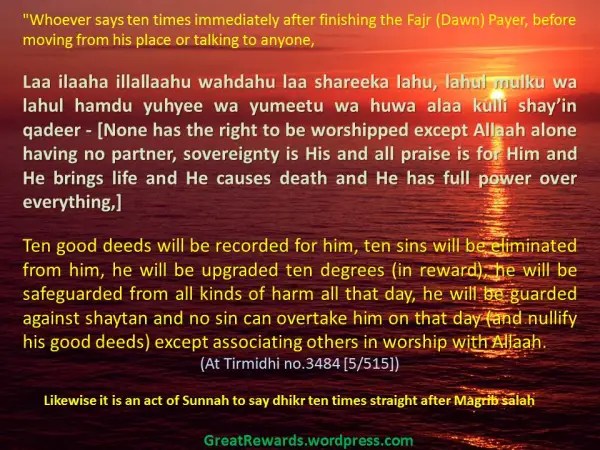
“Whoever says ten times immediately after finishing the Fajr (Dawn) Payer, before moving from his place or talking to anyone,
“laa ilaaha illallaahu wahdahu laa shareeka lahu, lahul mulku wa lahul hamdu yuhyee wa yumeetu wa huwa alaa kulli shay’in qadeer – [ none has the right to be worshipped except Allaah alone having no partner, sovereignty is His and all praise is for Him and He brings life and He causes death and He has full power over everything,]”
ten good deeds will be recorded for him, ten sins will be eliminated from him, he will be upgraded ten degrees (in reward), he will be safeguarded from all kinds of harm all that day, he will be guarded against shaytan and no sin can overtake him on that day (and nullify his good deeds) except associating others in worship with Allaah. (At Tirmidhi no.3484 [5/515])
At-Tirmidhi commented on this hadeeth saying, “This is a hasan, saheeh hadeeth (i.e a good and authentic hadeeth)”.
Likewise it is an act of Sunnah to say dhikr ten times straight after Magrib salah too, according to a hadith related by Imaam Ahmad Hanbal (rahimahullah) on the authority of Umm Salamah (radiAllahu anha), hadith number 26430. Also stated in Sahih Ibn Hibban no. 2023.
Source : A Summary of Islamic Jurisprudence – Dr. Salih al-Fawzaan, Volume 1 , Chapter 10
Which means: « Allāh existed [eternally] and nothing else existed with Him. He created the ^Arsh (Throne) [and placed it] above the water. Then He [ordered the Pen to] write in the (Guarded) Tablet everything that would happen. Then Allāh created the heavens and Earth. » [Related by al-Bukhariyy] The Prophet answered this question by first stating that Allāh’s Existence does not have a beginning, i.e., He is Eternal. There is no one attributed with eternity other than Him. In other words, nothing existed eternally except Allāh, and Allāh created everything, i.e., He brought all the creation from non-existence into existence. Allâh, ta`âlâ, did not create all the creations at one time. Had He willed for this, it would have occurred. Rather, in six days, He created the heavens and Earth ; and for Earth Allāh created rivers, mountains, and valleys. The wisdom of this is to teach us not to be hasty in doing things. The first creation is water. The Prophet, sallallahu `alayhi wa sallam, said: إِنَّ اللهَ تَعَالَى خَلَقَ كُلَّ شَيْءٍ مِنَ الْمَاءِ Innallâha ta^âlâ khalaqa kulla shay’in mina l-mâ’ Which means: « Allāh created everything from water. » [Related by Ibn Hibban];
When Prophet Muhammad, sallallahu ^alayhi wa sallam, was asked how this universe started to exist, he said:
“Allah existed [eternally] and nothing else existed with Him. He created the ^Arsh (Throne) [and was positioned] above the water. Then He ordered the Pen to write in the (Guarded) Tablet everything that would happen. Then Allah created the heavens and Earth.” (Related by al-Bukhariyy.)
Quranic Evidence: Allah’s Throne on Water before Creation
Allah, may He be Exalted, says (interpretation of the meaning): {And He it is Who has created the heavens and the earth in six Days and His Throne was on the water, that He might try you, which of you is the best in deeds.} [Hud 11:7]
This is a statement by Allah, may He be Glorified and Exalted, that His Throne was above the water before He created the heavens and earth and what is in them. Qatadah said: Your Lord, may He be Blessed and Exalted, is telling you how His creation began before He created the heavens and the earth. (End quote from Tafsir At-Tabari, 15/246)
Hadith Narrations on the Position of The Throne of Allah
Al-Bukhari (2953) narrated from `Imran ibn Husayn (may Allah be pleased with him) that some of the people of Yemen asked the Prophet (blessings and peace of Allah be upon him) this and said: We have come to you to ask you about this matter. He said: “There was Allah, and there was nothing else besides Him, and His Throne was over the water. He wrote all things in the Book (in heaven) and He created the heavens and the earth.”
Then Pen wrote the Qadr/ Destiny in Lawhul Mahfuth (Book of Destinies in the Heavens)
Abdullah b. ‘Amr b. al-‘As reported: I heard Allah’s Messenger (ﷺ) as saying: Allah ordained the measures (of quality) of the creation fifty thousand years before He created the heavens and the earth, as His Throne was upon water.
The first thing Allah Almighty created was a pen, and instructed the pen to write. The pen asked Him, what should it write, and Allah said, write everything that was and would be. This took place 50,000 years before the creation of the world as the Prophet (peace be upon him) mentioned.
[Source: Reported by Ahmad 23197. Abu Daawood, 4700. At-Tirmidhee, 2155]
Both the verse and the Hadith are speaking of the beginning of creation, and say that the Throne of Allah, may He be Glorified and Exalted, was over the water before the creation of heaven and earth.
This does not mean that the Throne is not still over the water.
Al-Bukhari (6869) and Muslim (1659) narrated that Abu Hurayrah (may Allah be pleased with him) said: “The Right Hand of Allah is full and (its fullness) is not decreased by any spending; it is overflowing by night and day. Think of what He has spent since He created the heavens and the earth, but all this spending has not decreased what is in His Right Hand.” He said: “And his Throne is over the water, and in His other Hand is the power to bring about death, and He raises some people and brings others low.”
Scholarly Interpretations on the Throne and Its Significance
Al-Hafidh Ibn Hajar (may Allah have mercy on him) said:
In the report of Is-haq ibn Rahawayh it says “and the Throne is over the water.” The apparent meaning is that it was like that when the Prophet (blessings and peace of Allah be upon him) spoke these words. The apparent meaning of the Hadith which comes before it is that the Throne was over the water before the creation of the heavens and earth, and the two Hadith when taken together indicate that it is still over the water. (End quote from Fat-h Al-Bari, 20/496)
What It Means for The Throne of Allah to Be Over Water
The meaning of the word Kana (was) in the verse refers to what happened in the past, before the creation of the heavens and the earth. From his saying in the other Hadith, “His Throne is over the water,” it may be understood that it is still like that.
‘Ubādah ibn As-Sāmit (may Allah be pleased with him) said to his son: “O Son, you will not taste true faith until you know that whatever has come to you would never have missed you, and that whatever has missed you would never have come to you. I heard the Messenger of Allah (may Allah’s peace and blessings be upon him) say: ‘The first thing Allah created was the Pen. He commanded it to write. It said: ‘My Lord, what shall I write?’ He said: ‘Write down what has been ordained for all things until the establishment of the Hour.'” O Son, I heard the Messenger of Allah (may Allah’s peace and blessings be upon him) say: ‘Whoever dies believing otherwise does not belong to me.'” In a narration by Imām Ahmad: “Verily, the first thing Allah, the Almighty, created was the Pen. He said to it: ‘Write.’ So in that very hour it wrote down all what was to occur up to the Day of Judgment.” In a narration by Ibn Wahb, the Messenger of Allah (may Allah’s peace and blessings be upon him) said: “So, whoever disbelieved in fate, the good and the bad thereof, Allah will burn him with the Hellfire.” [Authentic hadith] – [Ibn Wahb in Al-Qadar – Narrated by At-Termedhy – Narrated by Abu Daoud – Narrated by Ahmad]Explanation
“As soon as Allah created the pen, he commanded it saying: write. It said: “what should I write my Lord?” Allah said: “Write the record of all things to happen till the establishment of the hour” Oh my son I have heard Allah’s Messenger (sallallahu alaihi wa sallam) saying: “He who dies believing other than this is not from me”(i.e. is not upon the prophet (sallallahu alaihi wa sallam) belief) (Abu Dawud)
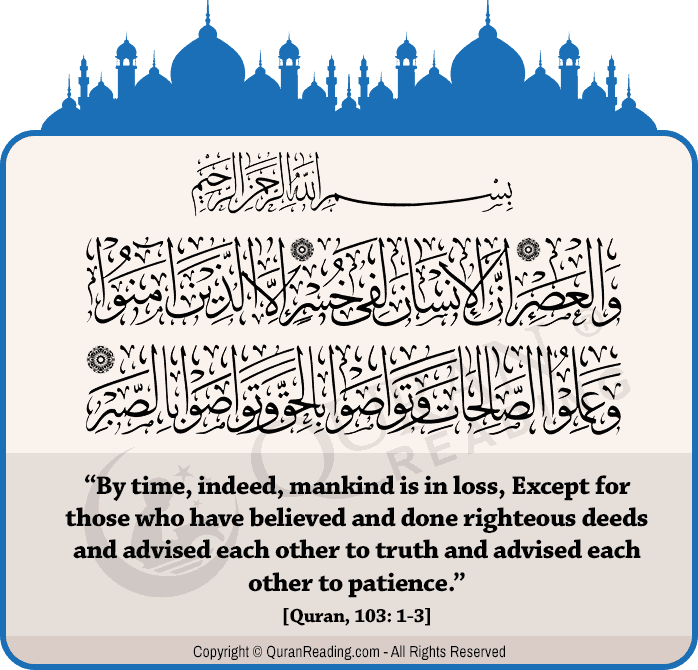
In the name of Allah, Most Gracious, Most Merciful.
By (the Token of) Time (through the ages),
Verily Man is in loss,
Except such as have Faith, and do righteous deeds, and (join together) in the mutual teaching of Truth, and of Patience and Constancy.
Translation and Explanation:
Verse 1:“By the passage of time!” – This verse establishes the significance of time and its fleeting nature. Some scholars say that Allah is swearing by time to draw attention to its importance.
Verse 2:“Indeed, mankind is in loss,” – This verse declares that all humans, except those who meet the criteria in the next verse, are in a state of loss due to the passage of time and their potential shortcomings.
Verse 3:“Except for those who have believed and done righteous deeds and advised each other to truth and advised each other to patience.” – This verse defines the exceptions to the loss. It highlights the importance of faith, good deeds, and mutual encouragement in truth and patience.
Quran 45:5 -Surah Al Jathiyah – And ˹in˺ the alternation of the day and the night, the provision1 sent down from the skies by Allah—reviving the earth after its death—and the shifting of the winds, are signs for people of understanding.
Surah Al Hadid 57:6 – He merges the night into day and the day into night. And He knows best what is ˹hidden˺ in the heart.
(41:49) Man wearies not of praying for good,65 but when evil visits him, he despairs and gives up all hope.
65. “For good”: For prosperity, abundance of provisions, good health, well-being of children, etc. And man here does not imply every human being for it also includes the prophet and the righteous people, who are free from this weakness as is being mentioned below. But here it implies the mean and shallow person who starts imploring God humbly when touched by harm and is beside himself with joy when he receives the good things of life as most human beings are involved in this weakness, it has been called a weakness of man.
(41:50) And if We bestow Our Mercy upon him after hardship, he will surely say: “This is what I truly deserve,66 and I do not believe that the Hour (of Resurrection) will ever come to pass; and if I am returned to my Lord, there too I shall enjoy the best.” Surely We shall fully apprise the unbelievers of what they have done, and We shall certainly make them taste a severe chastisement.
Abu Huraira reported: The Messenger of Allah, peace and blessings be upon him, said, “Verily, there were three among the children of Israel whom Allah Almighty intended to test: a leper, a bald man, and a blind man. He sent an angel to them and he came to the leper, saying: What would you love most? The leper said: I want a beautiful color and beautiful skin, for people have shunned me. The angel wiped over him and it had gone away, then he was given a beautiful color and beautiful skin. The angel said: Which property would you love most? The man said: Camels. Thus, he was given a pregnant camel. The angel said: May Allah bless you in it. The angel came to the bald man, saying: What would you love most? The bald man said: Beautiful hair and to be rid of this, for people have shunned me. The angel wiped over him and it had gone away, then he was given beautiful hair. The angel said: Which property would you love most? The man said: Cows. Thus, he was given a pregnant cow. The angel said: May Allah bless you in it. The angel came to the blind man, saying: What would you love most? The blind man said: For Allah to return my sight so I can see people. The angel wiped over him, then Allah returned his sight. The angel said: Which property would you love most? The man said: Sheep. Thus, he was given a pregnant sheep. The animals had grown and given birth such that one man had a valley of camels, another had a valley of cows, and another had a valley of sheep. Then, the angel came to the former leper while disguised in the shape and appearance of a leper, saying: I am a poor man, bereft of my livelihood while on a journey, none can take care of my needs today but Allah and then you, so I ask by the One who gave you beautiful color and beautiful skin and a wealth of camels to help me reach my destination! The man said: I have many duties. The angel said to him: It is as if I recognize you, were you not a leper shunned by people, in poverty, but Allah gave this to you? The man said: I have inherited it from my forefathers. The angel said: If you are lying, then may Allah return you to what you were before! The angel came to the former bald man in a similar appearance, saying the same as he had said to the leper and the man responded the same way. The angel said: If you are lying, then may Allah return you to what you were before! The angel came to the blind man in a similar form, saying: I am a poor man and wayfarer, bereft of my livelihood while on a journey, none can take care of my needs today but Allah and then you, so I ask by the One who returned your sight and gave you sheep to help me reach my destination! The man said: I was once a blind man and Allah returned my sight, I was poor and He enriched me, so take whatever you wish for, by Allah, I will not dispute you today in whatever you take for Allah’s sake. The angel said: Keep your property, for I was only sent to test you and Allah is pleased with you but angry with your two companions.”
Source: Ṣaḥīḥ al-Bukhārī 3464, Ṣaḥīḥ Muslim 2964
Grade: Muttafaqun Alayhi (authenticity agreed upon) according to Al-Bukhari and Muslim
Laa ilaaha illallaahu wahdahu laa shareeka lahu, lahul-mulku wa lahul-hamdu, yuhyee wa yumeetu, wa Huwa hayyun laa yamootu, biyadihil-khayru, wa Huwa alaa kulli shayin Qadeer.
There is no Lord except Allah. He is One and has no partners. His is the Kingdom and for Him are all praises. He gives life and gives death. He is eternal and everlasting In His control is goodness, and He has power over everything.



 ) brought and the Day of Resurrection, etc.),












 bismillahschool.net