I heard Allah’s Messenger (ﷺ) saying, “If Allah wants to do good to a person, He makes him comprehend the religion. I am just a distributor, but the grant is from Allah. (And remember) that this nation (true Muslims) will keep on following Allah’s teachings strictly and they will not be harmed by any one going on a different path till Allah’s order (Day of Judgment) is established.”
Reference: Sahih al-Bukhari,3-Knowledge, Hadith 71
when the US preaching everyone to join them…The Canadian Response…
A maternal death is defined by the World Health Organization as “the death of a woman while pregnant or within 42 days of termination of pregnancy, irrespective of the duration and the site of the pregnancy, from any cause related to or aggravated by the pregnancy or its management, but not from accidental or incidental causes” (1).
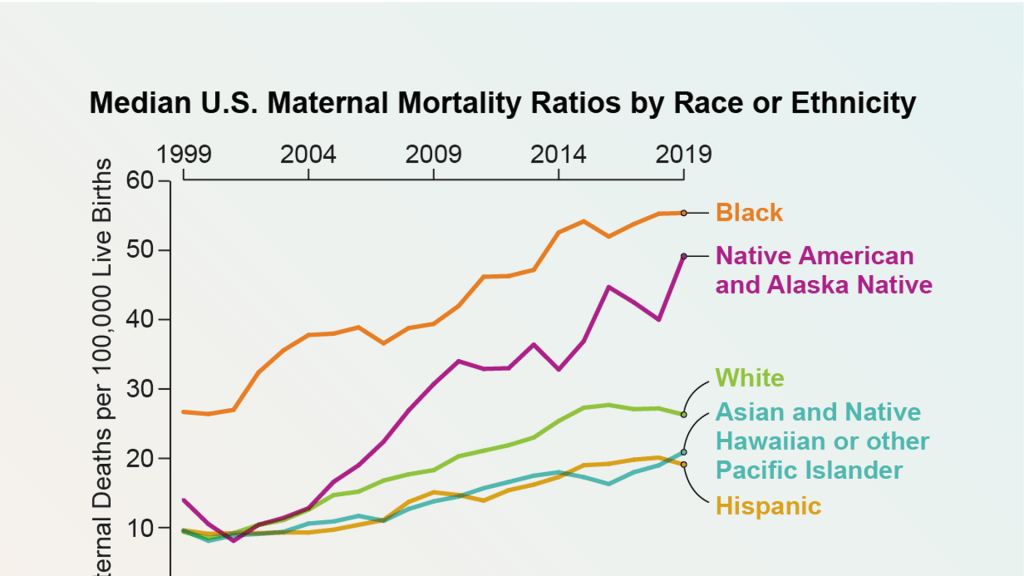
In 2021, the maternal mortality rate for non-Hispanic Black (subsequently, Black) women was 69.9 deaths per 100,000 live births, 2.6 times the rate for non-Hispanic White (subsequently, White) women (26.6) (Figure 1 and Table). Rates for Black women were significantly higher than rates for White and Hispanic women. The increases from 2020 to 2021 for all race and Hispanic-origin groups were significant.
Rates increased with maternal age. Rates in 2021 were 20.4 deaths per 100,000 live births for women under age 25, 31.3 for those aged 25–39, and 138.5 for those aged 40 and over (Figure 2 and Table). The rate for women aged 40 and over was 6.8 times higher than the rate for women under age 25. Differences in the rates between age groups were statistically significant. The increases in the rates between 2020 and 2021 for each of these age groups were statistically significant.
Say, ˹O believers,˺ “We believe in Allah and what has been revealed to us; and what was revealed to Abraham, Ishmael, Isaac, Jacob, and his descendants; and what was given to Moses, Jesus, and other prophets from their Lord. We make no distinction between any of them. And to Allah we all submit.” – Surah Baqarah 2:136
Napoleon’s Horrific Failure in Russia – primarily due to invade around fall – and being trapped in the Russian winter – even though he had about 600 thousand troops – while Russians about 200 thousand soldiers;
In 1811, Tsar Alexander I, supposedly allied with Napoleon, refused to be part of the continental blockade of British goods any longer. Napoleon’s edict barring trade with Great Britain was ruining the Russian economy. Tensions quickly escalated; every attempt to negotiate failed.
SOKHOLOV: The Russian army starts to concentrate its forces on the borders. Napoleon went to Kaurakin, the Russian ambassador, and harshly questioned him. “What does this mean? What does Russia want from me? You know it’s easy to start a war but it’s very difficult to finish one.”
On June 24, 1812, ignoring the advice of his closest advisors, Napoleon invaded Russia. Never in living memory had so large an army been assembled — Italians, Poles, German, French — more than 600,000 men from every corner of his empire. Napoleon prophesied the war would be over in twenty days.
WOLOCH: An army of 600,000, it would seem to be absolutely irresistible no matter what happened. He’ll simply pour in enough men to overwhelm the Russians, force them to engage in battle and defeat them.
“I know Alexander,” Napoleon said. “I once had influence over him; it will come back. If not, let destiny be accomplished and let Russia be crushed under my hatred of England.”
HORNE: And Napoleon, once again with this sense of destiny. His star was such that he thought he could defeat Russia — this enormous country.
As the days passed, the blazing heat of the Russian summer began to take its toll. Soldiers fell out from exhaustion, sickness, and desertion — more than five thousand a day. After two months, before Napoleon had fought a single battle, 150,000 soldiers were out of action.
The Video and Articles – look at some of the potential causes of Cancer Risk – in younger population – such as diet, body weight (overweight and its health risk factors), lifestyle – exercise, rise in microplastics and other environmental factors;
Dr. Anthony Kaveh discusses the concerning rise in cancer rates among young adults, traditionally the lowest-risk group. In this informative video, Dr. Kaveh explores preventable forms of cancer, like colorectal and cervical cancer, which are seeing an uptick in diagnoses among younger people. He emphasizes the importance of early screening and the role of lifestyle choices and environmental factors in cancer risk. By understanding these factors, young adults can take proactive steps to advocate for their health and potentially prevent cancer development. Join us as we delve into the causes and preventative measures for these increasingly prevalent health concerns. 💛 Learn about Dr. Kaveh’s transformational Ketamine clinic: https://www.clarus-health.com 🫀 Exclusive access to Dr. Kaveh’s live streams + more: / @medicalsecrets
Timestamps: 0:00 – Introduction to Rising Cancer Risks in Young Adults 0:25 – Why Young Adults Are At Risk 3:00 – Colorectal and Cervical Cancer: What’s the Increase? 4:05 – Environmental Factors and Cancer Risks 7:00 – Genetic Factors and Screening Importance 9:00 – The Role of Diet and Obesity 12:00 – How to Advocate for Health and Prevent Cancer #CancerPrevention, #YoungAdultHealth, #HealthAwareness
The cell cycle is the series of stages that a cell goes through as it grows and divides. It’s also known as the cell-division cycle.
Stages of the Cell Cycle
G1 phase: The cell grows
S phase: The cell copies its chromosomes, creating two sister chromatids for each chromosome
G2 phase: The cell checks the duplicated chromosomes and prepares to divide
M phase: The cell separates the copied chromosomes into two sets, and then divides into two new cells
Interphase
The period between mitotic divisions (G1, S, and G2) is called interphase. During interphase, the cell grows, replicates its chromosomes, and prepares for division.
Daughter cells
The resulting cells, known as daughter cells, each enter their own interphase and begin a new round of the cell cycle.
Cell Cycle Regulation
The cell cycle is a key regulatory mechanism of cellular growth and proliferation. Dysregulation of the cell cycle is thought to be the first step in carcinogenesis.
Cell cycle regulation refers to the control mechanisms that determine whether cells will divide, remain dormant, arrest, or undergo programmed cell death. It plays a crucial role in normal tissue repair and regeneration, and its disruption is a key feature of cancer. Various signaling pathways are involved in cell cycle regulation, and alterations in these pathways can be induced by both carcinogenic and non-carcinogenic agents. While significant progress has been made in understanding these pathways, our knowledge of cell cycle regulation is still incomplete. Further research in this area may provide insights into diseases that result from dysregulation of these pathways.
Cell Specialization – How Cells become Specialized
If a cell is specialized, it has unique structures that allow it to carry out its function in the body. All cells start as stem cells, which are cells that can become many other types of cells. They go through a process called differentiation to become specialized. During differentiation, different environmental cues trigger changes in protein synthesis inside the cell. Different genes are turned on or off through gene regulation; this creates different proteins, and thus structure and function for the cell.
For example, all cells in the human body have the same DNA. However, neurons in our brain are very different from skin cells because neurons turn on genes needed for their job and thus make neuronal proteins, and skin cells turn on epithelial genes to make proteins required for their job.
Broken heart syndrome is a heart condition that’s often brought on by stressful situations and extreme emotions. The condition also can be triggered by a serious physical illness or surgery. Broken heart syndrome is usually temporary. But some people may continue to feel unwell after the heart is healed.
People with broken heart syndrome may have sudden chest pain or think they’re having a heart attack. Broken heart syndrome affects just part of the heart. It briefly interrupts the way the heart pumps blood. The rest of the heart continues to work as usual. Sometimes the heart contracts more forcefully.
Medicines are used to treat symptoms of broken heart syndrome.
Broken heart syndrome also may be called:
Stress cardiomyopathy.
Takotsubo cardiomyopathy.
Recurrent takotsubo cardiomyopathy.
Apical ballooning syndrome.
Symptoms
Symptoms of broken heart syndrome can mimic those of a heart attack. Symptoms may include:








 bismillahschool.net