
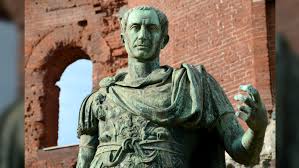
Julius and his Gaul/ France Campaign
Gaius Julius Caesar himself in his “Commentaries on the Gallic wars” (58 to 51 B.C.) gives the following numbers: out of 3 million Gauls, one third was killed and another third was enslaved.
Plutarch, a Roman philosopher of the 1st century A.D., in his “Life of Caesar” confirms Caesar’s figures: one million enslaved and another millon murdered during the Gallic wars.
But French demographers, given Gaul’s agricultural and economic wealth capable to sustain a much bigger population, estimate the population of Gaul right before Caesar’s wars at about 10 to 12 million people.
Therefore, what we don’t know for sure is whether one million here becomes one tenth, and 8 to 10 million Gauls survived the conquest as free men. But it’s very likely.
What is certain is that, in a very fertile and wealthy country like Gaul/France there was a demographic come back of the Gaulish population (in a preindustrial society more than 90% lived in rural areas until the 1800’s).
Ceasar exaggerated these figures in order to enhance his victory.
Source: Sophie Hulot. César génocidaire ? Le massacre des Usipètes et des Tenctères (55 av. J.-C.). Revue des études anciennes, Université Bordeaux Montaigne, 2018, 120 (1), pp.73-99. ffhal-01944519ff
National Geographic – Caesar’s Gaul campaign
Caesar made the political prime time at around age 40 by forging the First Triumvirate with Pompey the Great, noted general and statesman, and Marcus Licinius Crassus, one of Rome’s richest men. In 59 B.C., Caesar was elected consul.
He knew he needed a great military victory to win lasting glory beyond politics, so he set out to conquer the long-defiant Gauls—Celts who lived in modern-day France. Caesar’s seven-year Gaul campaign ended triumphantly in 51 B.C. The Gaul leader Vercingetorix was paraded in chains through Rome before being ritually strangled. In all, Caesar’s campaign killed or enslaved more than a million Gauls, a crushing victory that deepened the growing rivalry with Pompey, who had taken Caesar’s place as consul.
Caesar’s ambitious power grabs through political reform alienated many senators. When he declared himself dictator for life in 45 B.C., he sealed his fate. Threatened by Caesar’s tyranny, a group of conspirators—led by Brutus—plotted against him. On the Ides of March (March 15), 44 B.C., Caesar was assassinated, stabbed 23 times.
Though the conspirators eliminated Caesar himself, they neither thwarted his plans nor saved the republic. His designated heir, Octavian, outlasted Caesar’s antagonists and became the first Roman emperor. In keeping with Caesar’s eternal quest for glory, in death he acquired one last title and tribute.
Month of July named after a Genocidal maniac;
July was renamed for Julius Caesar, who was born that month. Before that, it was called Quintilis in Latin, meaning the fifth month in the ancient Roman calendar. However, Marc Anthony changed the name to July after Caesar’s assassination.
Julius Caesar himself introduced the Julian Calendar in 46 BC, adding 67 additional days by putting two intercalary months between November and December. According to Cicero, he probably did this after returning from an African military campaign in late Quntilis (July). This solved some leap-year problems.
History of the Month of August
What’s in a name? The name of this month was not always August; previously, the Romans referred to it as Sextilis. This was back in the days of Romulus in 753 BC, when there were originally ten months (… Sept, Oct, Nov, Dec). In 8 B.C., the Roman Senate decided to honor their first Emperor, Augustus Caesar, by changing the month’s name to Augustus.
Now, Augustus wasn’t his name; it was a description of his importance. He was born Gaius Octavius, though he is known in the history books as Gaius Julius Caesar Octavianus or Octavius to his friends. The title Augustus in Latin comes from augere, “to increase,” and was granted to him in 27 B.C. by the Roman Senate.
It meant “venerable” or “consecrated,” signifying his religious role in the Roman cultus. We use the term in English to describe someone auspicious, grand, or lordly… or with imperial qualities. The Greek equivalent is Sebaste (Σεβαστή).
He was elected to the College of Pontiffs and later joined his great-uncle, Julius Caesar, on the battlefield. The General (and Dictator) was so impressed that he changed his will and named the boy his prime beneficiary. As Caesar had no legitimate heir, this adoption meant Octavius would succeed him.
Octavius took the name Gaius Julius Caesar, though Roman tradition required that he append the surname Octavianus (or Octavian) to denote his biological family. He is alternatively known as Octavius, Octavian, or Augustus.
References:
https://billpetro.medium.com/history-of-july-bc120cefdeb0
https://www.nationalgeographic.com/culture/article/julius-caesar
https://www.youtube.com/@celtichistorydecoded
Julius Caesar’s Massacre of Celtic Gaul – The Expansion of Rome Into Modern France, Belgium…
Julius #Caesar #Genocide; #millions; #murders; #Month of July named after a Genocidal Maniac; #History; #Month of August (Julius’ Nephew)
 bismillahschool.net