

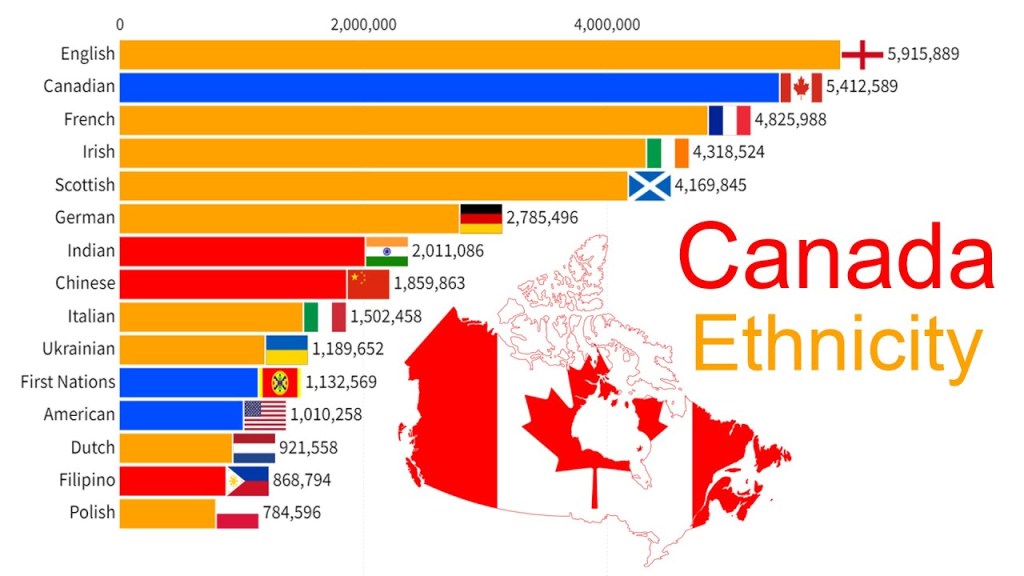
Key Ethnic and Cultural Groups:
- European: 52.5% of the population reported European origins, with English, Scottish, French, and Irish being the most common.
- North American: 22.9% reported North American origins, including Canadian.
- Asian: 19.3% reported Asian origins, with Chinese being a prominent group.
- North American Indigenous: 6.1% of the population identified with North American Indigenous origins.
- Visible Minorities: In 2021, 26.5% of the population belonged to visible minority groups, with South Asians, Chinese, and Black populations being the largest.
Key Statistics:

- Multiple Origins: 35.5% of the population reported multiple ethnic origins.
- Growth of Racialized Population: Between 2001 and 2021, the racialized population increased by 130%, while the White population increased by only 1%.
- Immigrant Population: In 2021, 23% of the population were immigrants or permanent residents.
- Indigenous Population: The Indigenous population grew by 9.4% between 2016 and 2021, while the non-Indigenous population grew by 5.3%.
Statistics Canada conducts a country-wide census that collects demographic data every five years on the first and sixth year of each decade. The 2021 Canadian census enumerated a total population of 36,991,981, an increase of around 5.2 percent over the 2016 figure.[6] It is estimated that Canada’s population surpassed 40 million in 2023 and 41 million in 2024.[7] Between 1990 and 2008, the population increased by 5.6 million, equivalent to 20.4 percent overall growth.[8] The main driver of population growth is immigration,[9][10] with 6.2% of the country’s population being made up of temporary residents as of 2023,[11] or about 2.5 million people.[12] Between 2011 and May 2016, Canada’s population grew by 1.7 million people, with immigrants accounting for two-thirds of the increase.[13]
https://en.wikipedia.org/wiki/Demographics_of_Canada


 bismillahschool.net