Woman must Consent to Nikkah/ Marriage
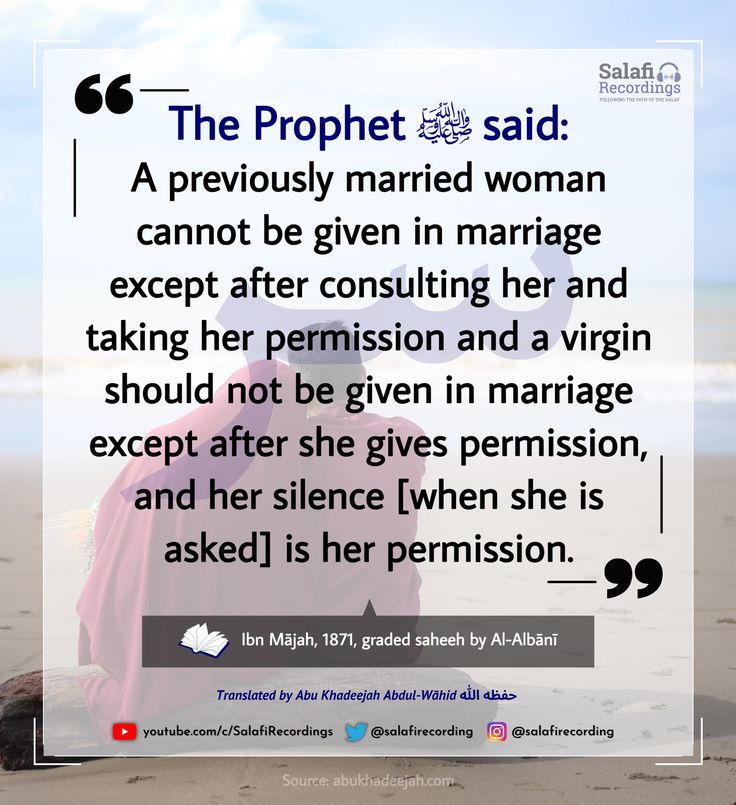
Aisha reported: I said, “O Messenger of Allah, should women be asked for their consent before marriage?” The Prophet, peace and blessings be upon him, said, “Yes.” I said, “A virgin might be shy to speak when asked.” The Prophet said, “Her silence is her consent.” Source: Ṣaḥīḥ al-Bukhārī 6946, Ṣaḥīḥ Muslim 1420 Grade: Muttafaqun Alayhi (authenticity agreed upon) according to Al-Bukhari and Muslim
عَنْ عَائِشَةَ قَالَتْ قُلْتُ يَا رَسُولَ اللَّهِ يُسْتَأْمَرُ النِّسَاءُ فِي أَبْضَاعِهِنَّ قَالَ نَعَمْ قُلْتُ فَإِنَّ الْبِكْرَ تُسْتَأْمَرُ فَتَسْتَحْيِي فَتَسْكُتُ قَالَ سُكَاتُهَا إِذْنُهَا 6946 صحيح البخاري كتاب الإكراه باب لا يجوز نكاح المكره 1420 صحيح مسلم كتاب النكاح باب استئذان الثيب في النكاح بالنطق والبكر بالسكوت
Annuled “Marriage” due to Force
Khansa’ bint Khidam reported: Her father married her off after her previous marriage ended, but she disliked it. She came to the Messenger of Allah, peace and blessings be upon him, and he annulled their marriage. Source: Ṣaḥīḥ al-Bukhārī 5138Grade: Sahih (authentic) according to Al-Bukhari
Imam Ibn Hajar commented, “There is a consensus upon the annulment of the marriage, if her previous marriage ended and then she was married off without her consent.” Source: Fatḥ al-Bārī 9/194
عَنْ خَنْسَاءَ بِنْتِ خِذَامٍ الْأَنْصَارِيَّةِ أَنَّ أَبَاهَا زَوَّجَهَا وَهْيَ ثَيِّبٌ فَكَرِهَتْ ذَلِكَ فَأَتَتْ رَسُولَ اللَّهِ صَلَّى اللَّهُ عَلَيْهِ وَسَلَّمَ فَرَدَّ نِكَاحَهُ; 5138 صحيح البخاري كتاب النكاح باب إذا زوج ابنته وهي كارهة فنكاحه مردود; قال ابن حجر وَرَدُّ النِّكَاحِ إِذَا كَانَتْ ثَيِّبًا فَزُوِّجَتْ بِغَيْرِ رِضَاهَا إِجْمَاعٌ; 9/194 فتح الباري شرح صحيح البخاري
Pohibition of Men Visting Women Alone
‘Uqbah ibn ‘Amir reported: The Messenger of Allah, peace and blessings be upon him, said, “Beware of entering the homes of women alone.” A man from the Ansar said, “What about sisters-in-law?” The Prophet said, “Entering upon them is deadly serious.”
Source: Ṣaḥīḥ al-Bukhārī 5232, Ṣaḥīḥ Muslim 2172; Grade: Muttafaqun Alayhi (authenticity agreed upon) according to Al-Bukhari and Muslim
عَنْ عُقْبَةَ بْنِ عَامِرٍ أَنَّ رَسُولَ اللهِ صَلَّى اللهُ عَلَيْهِ وَسَلَّمَ قَالَ إِيَّاكُمْ وَالدُّخُولَ عَلَى النِّسَاءِ فَقَالَ رَجُلٌ مِنَ الْأَنْصَار يَا رَسُولَ اللهِ أَفَرَأَيْتَ الْحَمْوَ قَالَ الْحَمْوُ الْمَوْتُ
5232 صحيح البخاري كتاب النكاح باب لا يخلون رجل بامرأة إلا ذو محرم والدخول على المغيبة; 2172 صحيح مسلم كتاب السلام باب تحريم الخلوة بالأجنبية والدخول عليها
Propose for the Faith/ Religion
Abu Huraira reported: The Messenger of Allah, peace and blessings be upon him, said, “A woman is married for four reasons: her property, her status, her beauty, and her religion. Thus, give precedence to one with religion.” Source: Ṣaḥīḥ al-Bukhārī 4802, Ṣaḥīḥ Muslim 1466 Grade: Muttafaqun Alayhi (authenticity agreed upon) according to Al-Bukhari and Muslim
عَنْ أَبِي هُرَيْرَةَ عَنْ النَّبِيِّ صَلَّى اللَّهُ عَلَيْهِ وَسَلَّمَ قَالَ تُنْكَحُ الْمَرْأَةُ لِأَرْبَعٍ لِمَالِهَا وَلِحَسَبِهَا وَلِجَمَالِهَا وَلِدِينِهَا فَاظْفَرْ بِذَاتِ الدِّينِ; 4802 صحيح البخاري كتاب النكاح باب الأكفاء في الدين; 1466 صحيح مسلم كتاب الرضاع باب استحباب نكاح ذات الدين
Marry Orphans or Free Women – suran An Nisaa’ /Women
In the name of God, the Gracious, the Merciful. 1. O people! Fear your Lord, who created you from a single soul, and created from it its mate, and propagated from them many men and women. And revere God whom you ask about, and the parents. Surely, God is Watchful over you.
2. And give orphans their properties, and do not substitute the bad for the good. And do not consume their properties by combining them with yours, for that would be a serious sin.
3. If you fear you cannot act fairly towards the orphans—then marry the women you like—two, or three, or four. But if you fear you will not be fair, then one, or what you already have. That makes it more likely that you avoid bias.
4. Give women their dowries graciously. But if they willingly forego some of it, then consume it with enjoyment and pleasure.
Permitted to Marry
Surah Maidah (the Table Spread) 5:5 – Today all good, pure foods have been made lawful for you. Similarly, the food of the People of the Book1 is permissible for you and yours is permissible for them. And ˹permissible for you in marriage˺ are chaste believing women as well as chaste women of those given the Scripture before you—as long as you pay them their dowries in wedlock, neither fornicating nor taking them as mistresses. And whoever rejects the faith, all their good deeds will be void ˹in this life˺ and in the Hereafter they will be among the losers.
Divorce- Verses/ Ayyat Women
226. Those who vow abstinence from their wives must wait for four months. But if they reconcile—God is Forgiving and Merciful.
227. And if they resolve to divorce—God is Hearing and Knowing.
228. Divorced women shall wait by themselves for three periods. And it is not lawful for them to conceal what God has created in their wombs, if they believe in God and the Last Day. Meanwhile, their husbands have the better right to take them back, if they desire reconciliation. And women have rights similar to their obligations, according to what is fair. But men have a degree over them. God is Mighty and Wise.
229. Divorce is allowed twice. Then, either honorable retention, or setting free kindly. It is not lawful for you to take back anything you have given them, unless they fear that they cannot maintain God’s limits. If you fear that they cannot maintain God’s limits, then there is no blame on them if she sacrifices something for her release. These are God’s limits, so do not transgress them. Those who transgress God’s limits are the unjust.
230. If he divorces her, she shall not be lawful for him again until she has married another husband. If the latter divorces her, then there is no blame on them for reuniting, provided they think they can maintain God’s limits. These are God’s limits; He makes them clear to people who know.
231. When you divorce women, and they have reached their term, either retain them amicably, or release them amicably. But do not retain them to hurt them and commit aggression. Whoever does that has wronged himself. And do not take God’s revelations for a joke. And remember God’s favor to you, and that He revealed to you the Scripture and Wisdom to teach you. And fear God, and know that God is aware of everything.
232. When you divorce women, and they have reached their term, do not prevent them from marrying their husbands, provided they agree on fair terms. Thereby is advised whoever among you believes in God and the Last Day. That is better and more decent for you. God knows, and you do not know.
233. Mothers may nurse their infants for two whole years, for those who desire to complete the nursing-period. It is the duty of the father to provide for them and clothe them in a proper manner. No soul shall be burdened beyond its capacity. No mother shall be harmed on account of her child, and no father shall be harmed on account of his child. The same duty rests upon the heir. If the couple desire weaning, by mutual consent and consultation, they commit no error by doing so. You commit no error by hiring nursing-mothers, as long as you pay them fairly. And be wary of God, and know that God is Seeing of what you do.
234. As for those among you who die and leave widows behind, their widows shall wait by themselves for four months and ten days. When they have reached their term, there is no blame on you regarding what they might honorably do with themselves. God is fully acquainted with what you do.
235. You commit no error by announcing your engagement to women, or by keeping it to yourselves. God knows that you will be thinking about them. But do not meet them secretly, unless you have something proper to say. And do not confirm the marriage tie until the writing is fulfilled. And know that God knows what is in your souls, so beware of Him. And know that God is Forgiving and Forbearing.
236. You commit no error by divorcing women before having touched them, or before having set the dowry for them. And compensate them—the wealthy according to his means, and the poor according to his means—with a fair compensation, a duty upon the doers of good.
237. If you divorce them before you have touched them, but after you had set the dowry for them, give them half of what you specified—unless they forego the right, or the one in whose hand is the marriage contract foregoes it. But to forego is nearer to piety. And do not forget generosity between one another. God is seeing of everything you do.
238. Guard your prayers, and the middle prayer, and stand before God in devotion.
Narrations on being Intimate with Slave Girls (War Captives) – Milk Yameen
Those times (prior to Second World War) Slavery was common in all societies – all the way from the Roman Empire, Asia, Middle East and Africa – and women taken Captives from War used to be “Rights Hands Possess” (slave girls to their master); however, historically speaking Islam encouraged to Free the Slaves – and the Children coming from this Union (slave -master relationship)- were born Free and Inherited from the Dad’s Property – and some became Rulers in the Persian Empires (Sons of the Sultan/ Ruler) in the Persian Empire; it’s not the “chains” type of slavery they had in pretty much all over the world – with no option to buy the person out of it – or people would be slaves for generations, as they could not free themselves from the salvery system -except maybe through Civil War (such as the North/ South War) in North America;
The slave owner has the right to be intimate with his female slave (who is a Muslim, Christian, or a Jew) because she is his “milk yameen” (that which his right hand possesses) but he cannot marry her. If he wishes to marry her, he has to set her free and then marry her like the Prophet, sallallaahu ‘alayhi wa sallam, did with Safiyyah bint Huyayy  . He, sallallaahu ‘alayhi wa sallam, set her free and then married her.
Al-Mawsoo‘ah Al-Fiqhiyyah (Fiqh Encyclopedia) reads: “The slave owner is not allowed to marry his slave woman. The author of Al-Hidaayah says: ‘This is because the marriage contract in Islam is established on a basis of partnership and exchange of matrimonial rights and obligations among the spouses and this is incompatible with ownership in case of a slave owner and his slave woman; so there will be no matrimonial rights and obligations in this case.’ Ibn Qudaamah said: ‘This is because the master-slave bond entails deeming it lawful for the slave owner to benefit from the service of his slave woman and to be intimate with her; it cannot be combined with a weaker contract, i.e. marriage…. Therefore, if the man was given the ownership of his wife as a slave (like if he married her as a slave woman, then he bought her from her master), their marriage contract is annulled.’ Ibn Qudaamah asserted that there is no disagreement among scholars concerning this.”
That said, you should know that there is no disagreement among the scholars regarding the following:
1) It is permissible for the Muslim man to marry a free woman from the People of the Book (Christian or Jew), as underlined by Ibn Qudaamah: “There is no disagreement among scholars regarding the permissibility of marrying the free women from the People of the Book.” [Al-Mughni]
2) There is no disagreement among scholars regarding the impermissibility of the Muslim man’s marriage to a disbelieving woman who is not Christian or Jewish. Al-Mawsoo‘ah Al-Fiqhiyyah reads: “It is impermissible for the Muslim man to marry a disbelieving woman who is not from the People of the Book; Allaah, The Exalted, says (what means): {And do not marry polytheistic women until they believe…} [Quran 2:221] This is according to the scholarly consensus. Ibn Qudaamah said: ‘There is no disagreement among scholars that it is impermissible for the Muslim to marry their women or eat their slaughtered animals.’”
As for having lawful intercourse with one’s idolatrous/pagan slave woman (i.e. a non-Muslim slave woman who is not from the People of the Book), jurists held different opinions about this. Most of them maintained that it is forbidden; however, some were of the view that it is allowable given the fact – which you mentioned – that the Companions had slaves from among the women of polytheistic Arabs. The scholars who held that it is forbidden say that this ruling was abrogated by the verse (that means): {And do not marry polytheistic women until they believe.}.
https://www.islamweb.net/en/fatwa/272452/ruling-on-sexual-intercourse-with-ones-polytheistic-slave-woman
Forbidden to Marry – Female Close Relatives;
˹Also˺ forbidden to you for marriage are your mothers, your daughters, your sisters, your paternal and maternal aunts, your brother’s daughters, your sister’s daughters, your foster-mothers, your foster-sisters, your mothers-in-law, your stepdaughters under your guardianship if you have consummated marriage with their mothers—but if you have not, then you can marry them—nor the wives of your own sons, nor two sisters together at the same time—except what was done previously. Surely Allah is All-Forgiving, Most Merciful.
Also ˹forbidden are˺ married women—except ˹female˺ captives in your possession.1 This is Allah’s commandment to you. Lawful to you are all beyond these—as long as you seek them with your wealth in a legal marriage, not in fornication. Give those you have consummated marriage with their due dowries. It is permissible to be mutually gracious regarding the set dowry. Surely Allah is All-Knowing, All-Wise.
But if any of you cannot afford to marry a free believing woman, then ˹let him marry˺ a believing bondwoman possessed by one of you. Allah knows best ˹the state of˺ your faith ˹and theirs˺. You are from one another.1 So marry them with the permission of their owners,2 giving them their dowry in fairness, if they are chaste, neither promiscuous nor having secret affairs. If they commit indecency after marriage, they receive half the punishment of free women.3 This is for those of you who fear falling into sin. But if you are patient, it is better for you. And Allah is All-Forgiving, Most Merciful.
#Marriage, #Divorce, #Islam, #Hadeeth, #Narrations; #Meher– Dowery to the Wife (from Groom) ; #War Captives – Slave Girls (right Hands Possess);

 bismillahschool.net