

Indigenous peoples of the Americas have a historically high frequency of blood type O, with some communities showing nearly universal O type blood, such as the Navajo and Quechua. This genetic trait is linked to an Ancestral Informative Marker (AIM) related to the G542A mutation, which emerged in Beringia during the migration into the Americas from Asia. Scientists continue to study why this genetic uniformity exists, exploring theories about founder effects, adaptation to diseases like malaria, and unique evolutionary histories.
High Frequency of Type O Blood
- Near Universal Presence:Type O blood is a defining feature of many Indigenous populations in the Americas.
- Examples:Studies have found nearly 100% Type O blood in certain Quechua communities in Peru, while other groups like the Navajo in Arizona and the Yanomami in the Amazon have very high frequencies (99% and 92% respectively).
- Genetic Origins
- Beringian Migration:The O blood type gene, specifically the O1V542 allele, is thought to have been selected in the Native American ancestral population during their migration from Asia through Beringia.
- Ancestral Informative Marker (AIM):The G542A mutation, found in the ABO gene, is a unique marker in Native American populations and helps trace their genetic origins.
Scientific Theories and Research
- Founder Effect:A single founding population could have carried this blood type, leading to its high frequency through genetic drift and isolation.
- Disease Resistance:Type O blood is associated with resistance to severe malaria, suggesting a possible evolutionary advantage against this ancient disease in the Americas.
- Continued Study:Research continues to investigate the biological and historical reasons behind this genetic uniformity, which offers insights into the peopling of the Americas and human evolution.
Because group O blood can be received by anyone in a blood transfusion, it was originally thought that this was the ancestral blood type, but more recent work suggests that there are several different mutations that can deactivate the A or B genes to turn them into O. This makes a firm evolutionary timeline much harder to establish and there are several competing theories that contradict each other.
What they agree on is that AB is the most recent and didn’t occur until the 16th Century when group A populations from Europe and group B populations from Asia began to mix. The other blood groups are tens of thousands of years old with B being more recent than A. The oldest group is either group A or one of the forms of group O.
https://www.sciencefocus.com/the-human-body/which-human-blood-group-evolved-first
TYPE O -BLOOD TYPE PROPERTIES
Type O blood lacks A and B antigens, with O-positive being the most common overall type and O-negative being the universal blood donor for emergencies, as its red blood cells can be given to any patient regardless of their blood type. O-positive blood is also in high demand because it can be given to the majority of the population (those with a positive blood type).
Characteristics of Type O Blood
Antigens: Type O red blood cells do not have the A or B antigens on their surface.
Rh Factor:
O-positive: Has the Rh factor present on the red blood cells, making it a positive blood type.
O-negative: Lacks the Rh factor, making it a negative blood type.
Importance of Type O Blood
- Universal Donor (O-negative):O-negative blood is crucial for emergency situations when a patient’s blood type is unknown, as it can be given to anyone.
- High Demand:Both O-positive and O-negative blood types are in high demand.
- O-positive: It is the most common blood type in the population and can be transfused to any patient with a positive blood type (A+, B+, AB+, O+).
- O-negative: It is in constant demand for critical care, emergency resuscitation, and for immune-deficient newborns.
Who can receive O blood?
O-negative recipients: can only receive blood from O-negative donor;
O-positive recipients: can receive blood from O-positive or O-negative donors.
How Blood Type Is Determined And Why You Need To Know – Red Cross – US
Blood types are determined by the presence or absence of certain antigens – substances that can trigger an immune response if they are foreign to the body. Since some antigens can trigger a patient’s immune system to attack the transfused blood, safe blood transfusions depend on careful blood typing and cross-matching. Do you know what blood type is safe for you if you need a transfusion?

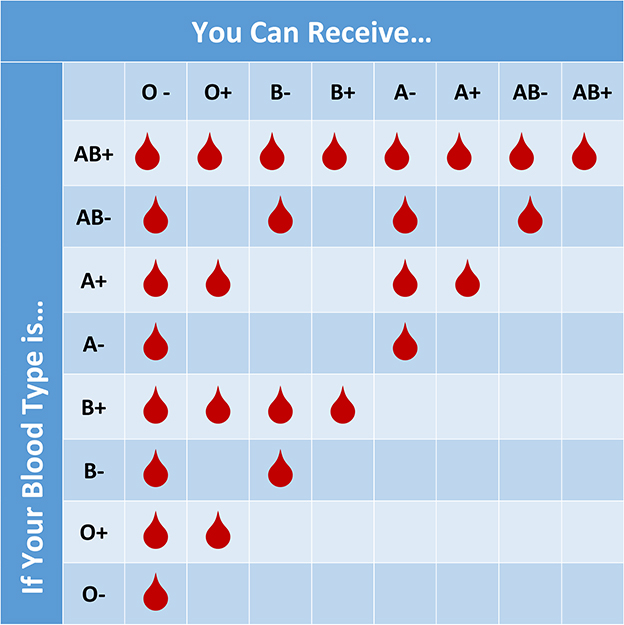
There are four major blood groups determined by the presence or absence of two antigens, A and B, on the surface of red blood cells. In addition to the A and B antigens, there is a protein called the Rh factor, which can be either present (+) or absent (–), creating the 8 most common blood types (A+, A-, B+, B-, O+, O-, AB+, AB-).
What Is A Universal Blood Donor?
Universal donors are those with an O negative blood type. Why? O negative blood can be used in transfusions for any blood type.
Type O is routinely in short supply and in high demand by hospitals – both because it is the most common blood type and because type O negative blood is the universal blood type needed for emergency transfusions and for immune deficient infants.
Approximately 45 percent of Caucasians are type O (positive or negative), but 51 percent of African-Americans and 57 percent of Hispanics are type O. Minority and diverse populations, therefore, play a critical role in meeting the constant need for blood.
Types O negative and O positive are in high demand. Only 7% of the population are O negative. However, the need for O negative blood is the highest because it is used most often during emergencies. The need for O+ is high because it is the most frequently occurring blood type (37% of the population).
The universal red cell donor has Type O negative blood. The universal plasma donor has Type AB blood. For more about plasma donation, visit the plasma donation facts.
Nearly 16 million blood components are transfused each year in the U.S.”
https://www.redcrossblood.org/donate-blood/blood-types.html
#TypeO Blood, #Blood Types, #Native, #Disease, #Resistance, #Blood Types, #Blood Donations;
 bismillahschool.net