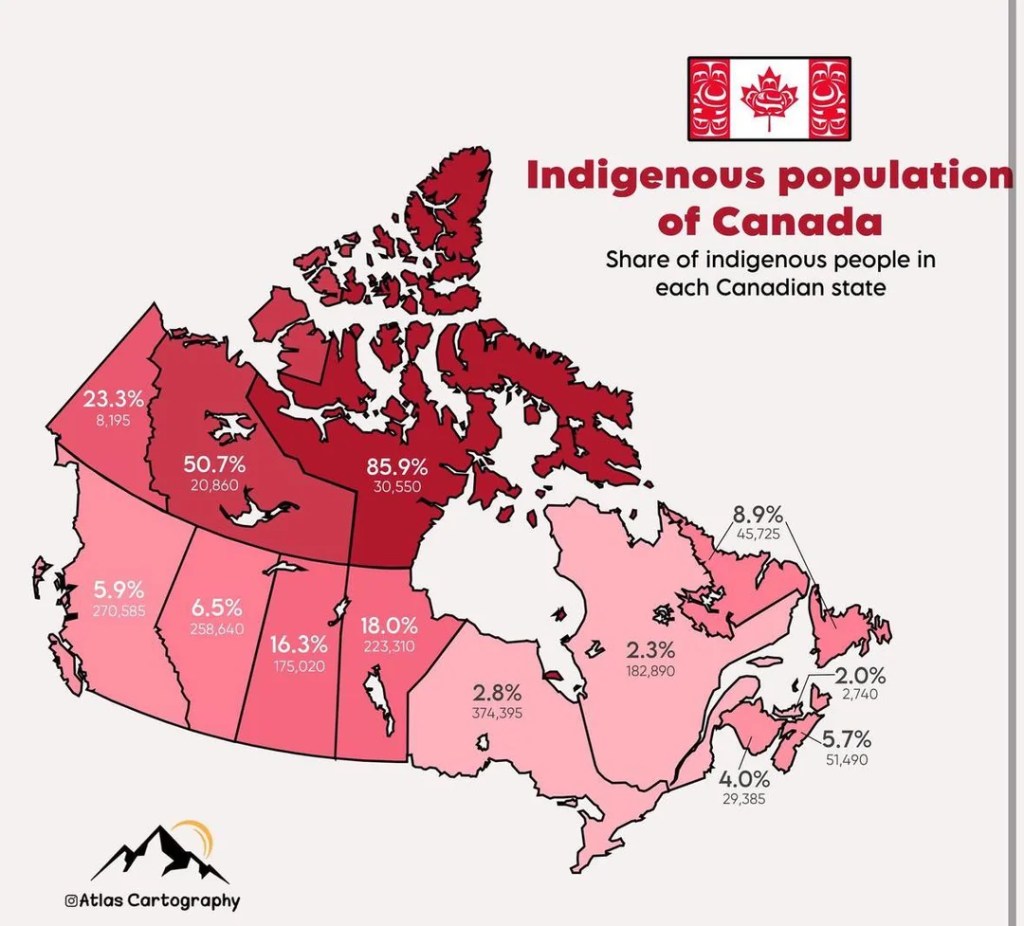
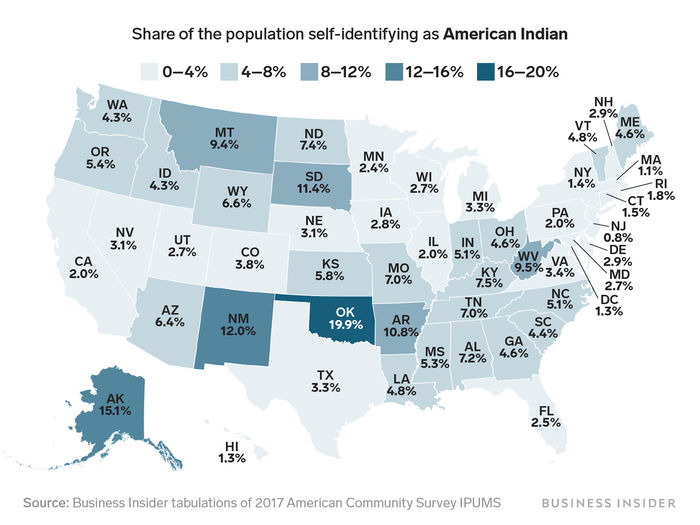
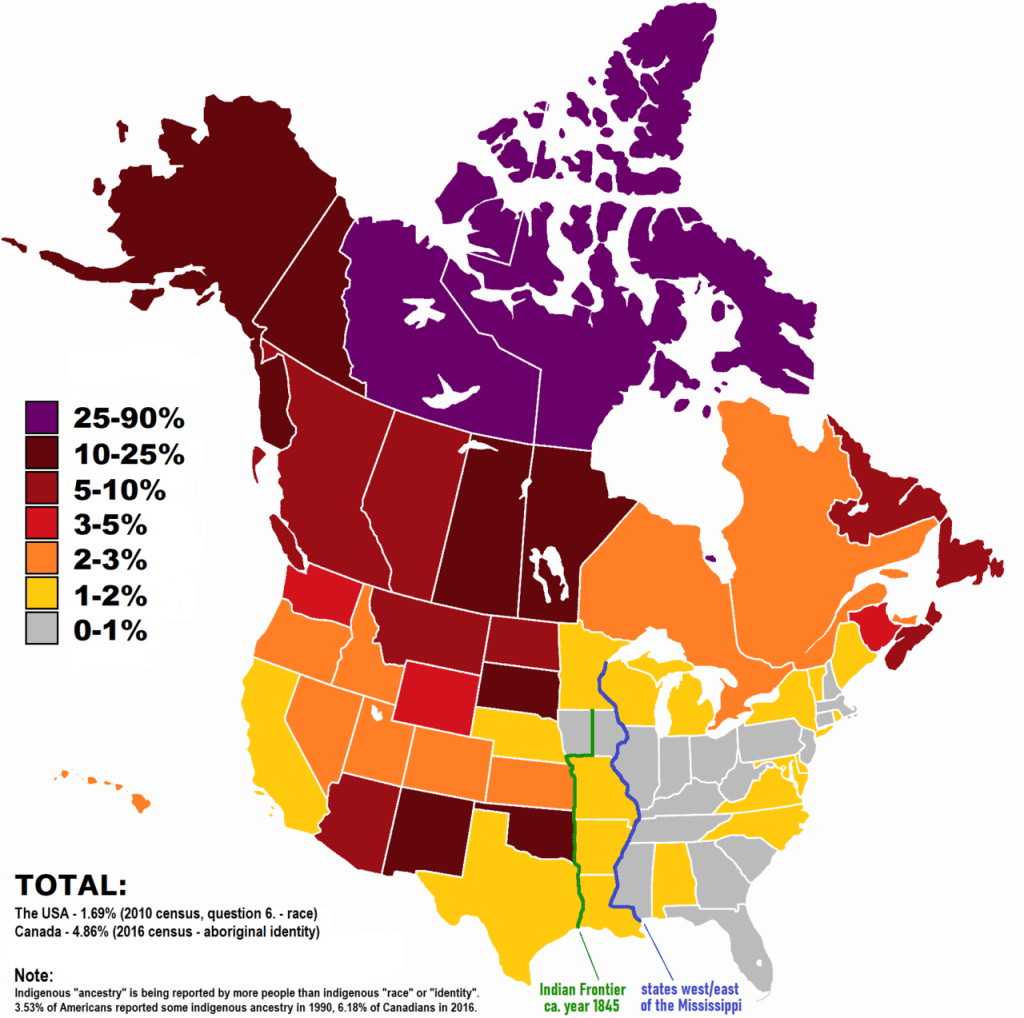
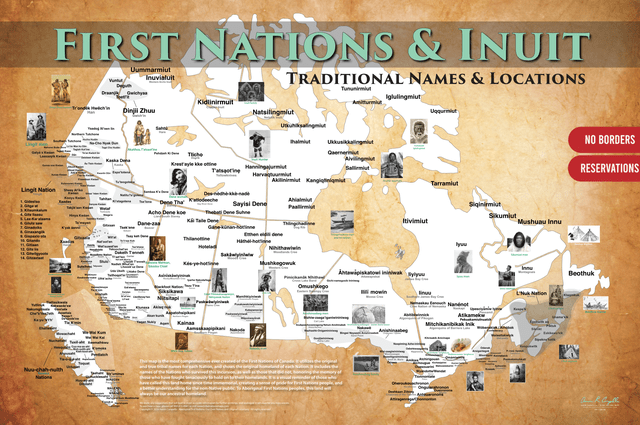
Native people of Canada – or First Nations people – represent 5 percent of Canadian people (with different rates within different provinces)- with a rate of population growth; however – what exactly happened with the other 95 percent?!Excluding the Land possession – Doesn’t this sound like Genocide to anyone with a brain the size of a mustard grain?!
According to the 2021 Census, there were 1.8 million Indigenous people, representing 5.0% of the total Canadian population, up from 4.9% in 2016.
National Indigenous History Month and National Indigenous Peoples Day are opportunities to learn more about the unique cultures, traditions and experiences of First Nations people, Métis, and Inuit. This is also a time to honour the history, achievements, and resilience of Indigenous peoples, who have been living on this land since time immemorial and whose presence continues to impact the evolution of the country. Using 2021 Census of Population data, let’s shed some light on these populations (https://thecanadianencyclopedia.ca/en/article/genocide-and-indigenous-peoples-in-canada)
Forced Living in Reserves without the Right to Leave – Historical Facts
From 1885 into the 1940s, a pass system controlled Indigenous people’s movement, requiring those living on reserve to get written permission from an “Indian agent” (government officials) when needed to leave their community.
Reserves Today
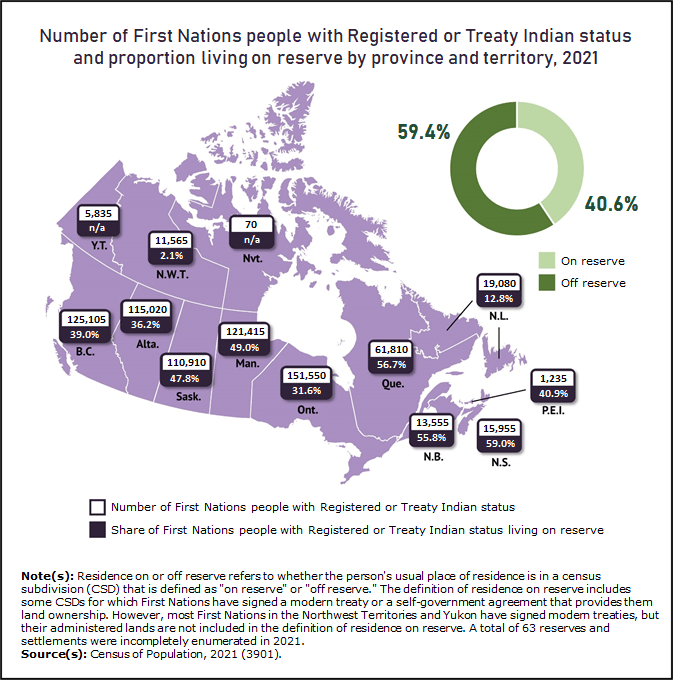
Reserves are still vital land bases for Indigenous people across Canada, which continue to be classified as federal land but as self-governed by Indigenous people of their community.
Some reserves have the most concerning conditions in Canada, such as isolated communities with high poverty rates, substance addiction, suicide, unemployment, and mortality.
It is widely acknowledged that the cultural genocide and social disruption over generations by displacements, discriminatory legislation, and political neglect results in long-term hardships and hinder the re-establishment of social networks and stable communities.
According to the 2021 Census, there were 1.8 million Indigenous people, representing 5.0% of the total Canadian population, up from 4.9% in 2016.
However, this growth was not as fast as in previous years. For example, from 2011 to 2016, the Indigenous population grew by 18.9%, more than double the 2021 growth rate.
For the first time, the Census enumerated more than 1 million (1,048,405) First Nations people living in Canada.
The Language Issues:
English and French are the two “Offiicial” languages of Canada, enjoying equal status, rights, and privileges in all federal government institutions, parliament, and courts. Established by the Official Languages Act (1969) and the Charter of Rights and Freedoms (1982), this policy guarantees Canadians the right to receive federal services in either language
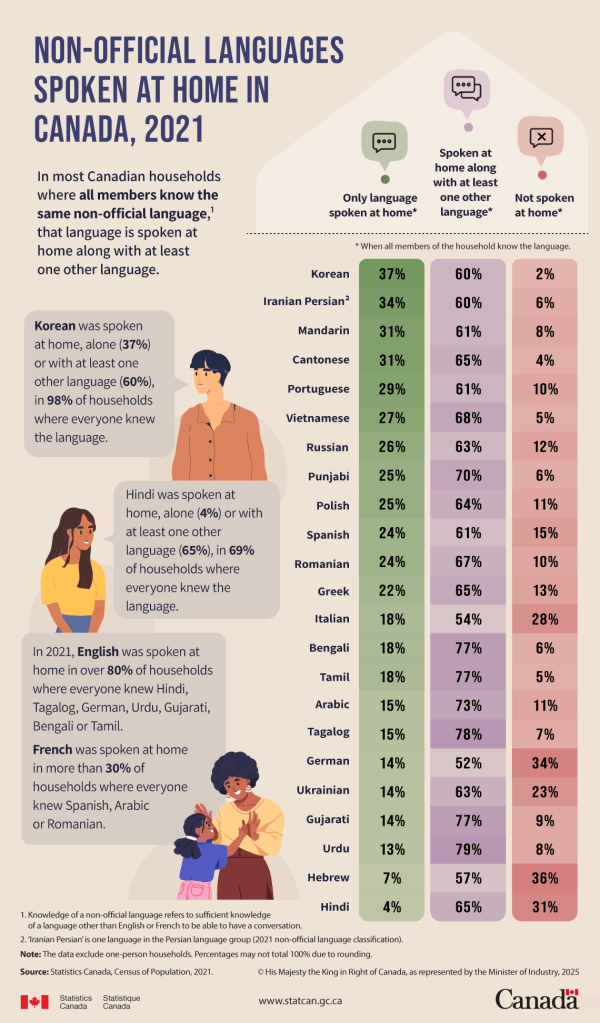
Isn’t it Strange that No Native Languages are official Languages – also Colonization Effect – and again every person may speak their Language – and I guess we use English for convenience; but then again technically speaking Canada should have a goverment language – which may happen to be English – due to colonization – and no official language as technically speaking – Canada and US have majority immigrant populations – so the majority of populations in major urban centers speak a Different language at home.
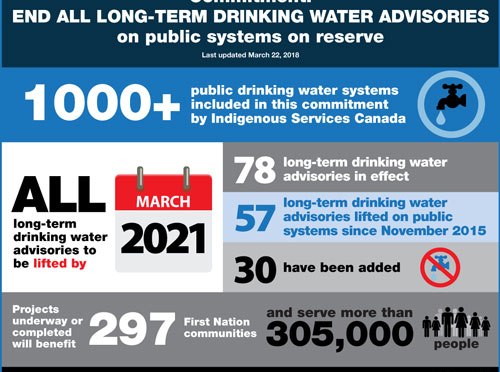
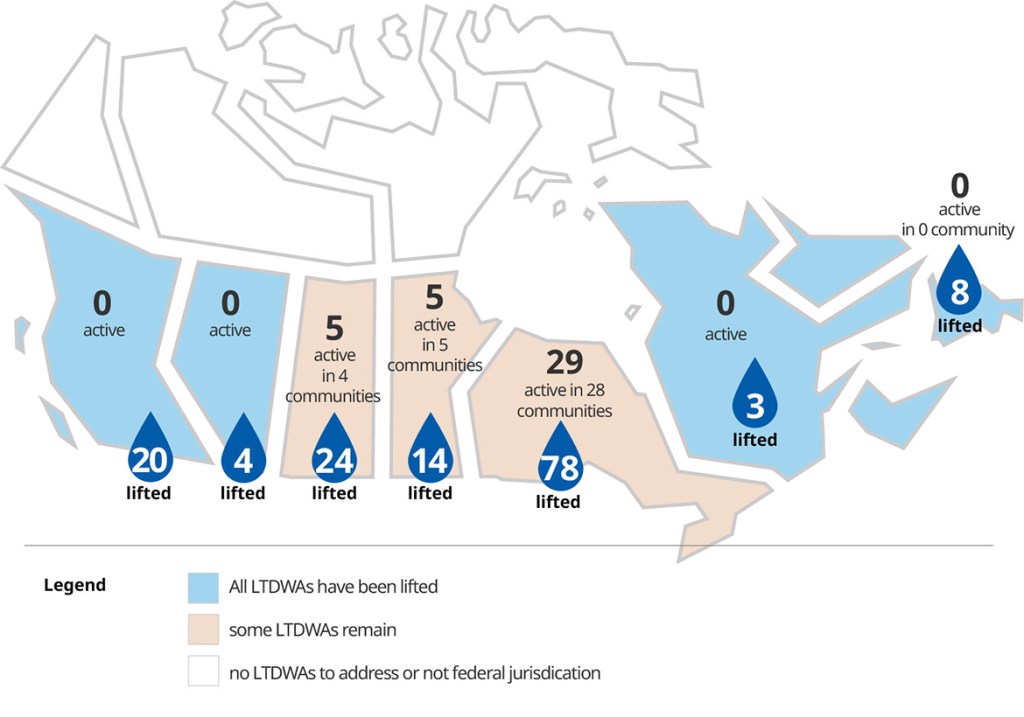
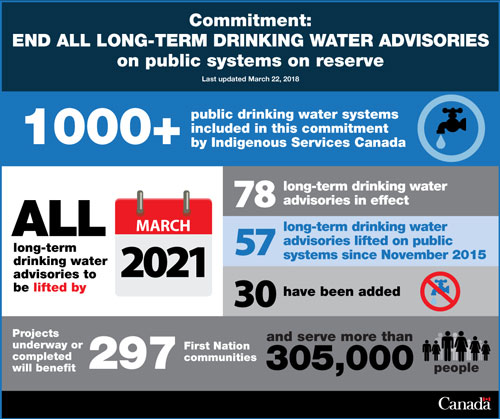
#Canada ; #genocide; #history; #Colonization; #boiling water advisories; #sucide rates; #poverty; #forced Sterilizations, #Language Issues and #History;
Why Quran is the Word of God – Last Revelation on Monotheism
The Word Bible – comes from the Greek Word “Biblos”
biblos (βίβλος) means “book,” “scroll,” or specifically the inner bark of the papyrus plant used to make writing materials. Derived from the Phoenician city of Byblos (a major papyrus exporter), it is the root for words like “bible,” “bibliography,” and “bibliophile; it is basically a Collection of Manuscripts written by Scholars/ Scribes- mostly from Greek and Latin Texts – while most of the Prophets spoke Hebrew and Aramaic
A (Church) History of Burning the Bible Manuscripts
Based on the historical evidence, the claim that Constantine burned scriptures or ordered the destruction of “non-canonical” books is false; this action was carried out by his predecessor, Diocletian, during the “Great Persecution” (303–313 AD).
Here is the breakdown of the historical facts regarding Constantine and the scriptures:
Diocletian, Not Constantine, Burned Scriptures: The Emperor Diocletian launched a massive effort in 303 AD to destroy Christian sacred texts and burn churches.
Constantine Ordered Copies, Not Destruction: Upon converting, Constantine actually financed the production of new copies of the Scriptures. He tasked Eusebius of Caesarea with producing 50 copies of the Bible for the churches in Constantinople to replace those destroyed in the earlier persecution.
No Role in Canonization: Constantine did not select the books of the Bible at the Council of Nicaea (325 AD). The canon was largely established by the church before his reign and finalized by later councils in the late 4th century. ( and here again church authorities decided which Testaments to include or Not to include in the recognized version of the Bible);
Other accounts, letters, and revelations—e.g., the Didachē (Teaching of the Twelve Apostles), Gospel of Peter, First Letter of Clement, Letter of Barnabas, Apocalypse (Revelation) of Peter, Shepherd of Hermas—exist, but through a complex process the canon was fixed for both the Eastern and Western churches in the 4th century. The canon contained four Gospels (Matthew, Mark, Luke, and John), Acts, 21 letters, and one book of a strictly revelatory character, Revelation. These were not necessarily the oldest writings, not all equally revelatory, and not all directed to the church at large. (https://www.britannica.com/topic/biblical-literature/New-Testament-canon-texts-and-versions)
Targeted “Heretical” Writings: While he did not burn the New Testament, Constantine did order the destruction of books written by heretical groups, such as the Arians, to force religious conformity, but this was a separate, targeted action
Arianism, during the time of Emperor Constantine (early 4th century), was a Christological doctrine proposing that Jesus Christ was created by God the Father and was therefore not co-eternal or of the same substance as God. It was proposed by Arius, a presbyter from Alexandria, and became a major theological controversy that threatened the unity of the Roman Empire, prompting Constantine to convene the Council of Nicaea in 325 AD (it meant basically that God/ “Father” is the Creator – and Jesus was Created by God and a Prophet – not of the same substance as God (means no “trinity”/ church introduced idolatry; majority of Christians/ believers at the time Did not believe in “trinity” – but were thereatened by death under Constantine and the church if they publicly decleared God is One (no partners and no son- pure monotheism)- God is One with No Partners)
Roman Empire (303 AD):The first major destruction of Christian books occurred under Emperor Diocletian, who ordered the burning of Christian scriptures to try and destroy the faith itself.
Other Incidents: In 1731, Archbishop Leopold Anton von Firmian ordered the burning of Protestant Bibles in Salzburg. In 1849, 3,000 copies of a Catholic Italian translation were burned in Florence because they were considered Protestant-influenced.
Nazi Germany (1933): In a non-Church context, 70 tonnes of Watch Tower literature and Bibles were burned in Nazi Germany.
Bible – a Collection of Books/ Manuscripts
The New Testament has over 5,800 Greek manuscripts, 10,000 Latin, and 9,300 in other languages, totaling over 25,000, dating from c. 125 to the 15th century. Old Testament Hebrew manuscripts are fewer, with the Dead Sea Scrolls significantly increasing that count to include copies of every book except Esther. (Wikipedia) -None of which perfectly agree with each other;
So Yes – there are Stories/ Concepts Narrated – but we cannot confirm 100 percent the events because the testaments differ with each other – other than God being one entity who created everything in the Heavens and the earth and nothing happens except by Divine Will – and there will be a death, life in the grave, Ressurection Paradise or Hellfire – as a common theme among all these writings; but specific events or word there is no Original text from God’s Books – such as the Torah of Moses, David’s Psalms, the Gospel of Jesus – which only explains why Quran Kareem was sent to clarify the right version of past events and bring people back to monotheism;
Key Manuscript Counts:
New Testament: > 5,800 Greek (catalogued)
New Testament: > 10,000 Latin, > 9,300 other languages (Syriac, Coptic, etc.)
Old Testament: The Masoretic Text is the standard, with thousands of fragments from the Dead Sea Scrolls.
Original Language Breakdown:
Hebrew: The majority of the 39 Old Testament books.
Aramaic: Approximately 268 verses, including parts of Daniel and Ezra.
Greek: All 27 New Testament books (Koine Greek) and the 7 deuterocanonical books.
Latin: Not an original language, but the Vulgate translation was completed by Jerome in the 5th century.
NIV – Translation of the Bible
NIV – Version Information
The New International Version (NIV) is a completely original translation of the Bible developed by more than one hundred scholars working from the best available Hebrew, Aramaic, and Greek texts. (None the Original Torah of Moses, David’s Psalms, Jesus Gospel)
The initial vision for the project was provided by a single individual – an engineer working with General Electric in Seattle by the name of Howard Long. Long was a lifelong devotee of the King James Version, but when he shared it with his friends he was distressed to find that it just didn’t connect. Long saw the need for a translation that captured the truths he loved in the language that his contemporaries spoke.
For 10 years, Long and a growing group of like-minded supporters drove this idea. The passion of one man became the passion of a church, and ultimately the passion of a whole group of denominations. And finally, in 1965, after several years of preparatory study, a trans-denominational and international group of scholars met in Palos Heights, Illinois, and agreed to begin work on the project – determining to not simply adapt an existing English version of the Bible but to start from scratch with the best available manuscripts in the original languages. Their conclusion was endorsed by a large number of church leaders who met in Chicago in 1966.
As proved in the previous paragraphs, all the testaments have been changed, and many testaments in Hebrew and Aramaic have been burnt by the church as well – all the Original prophetic testaments have been changed – therefore Allah/ God AllMighty revealed the Qur’an Kareem (Noble Quran/ Recitation) from Angel Garbriel to Prophet Muhammad to bring humanity back to Monotheism until the Day of Ressurection with no changes;
Islam is a continuation of the message received by previous prophets, such as Noah, Abraham, David, Moses and Jesus, peace be upon them all. Therefore, the Quran maintains the pure teachings of previous revelations, including the Torah and the Gospel. The Quran describes that all the prophets taught people to believe in the One God, the Creator. The messengers also instructed them to spend their lives with God-consciousness, doing good deeds and avoiding sins. Moreover, they warned their fellow humans of accountability in the afterlife, a subject which the Quran returns to again and again.
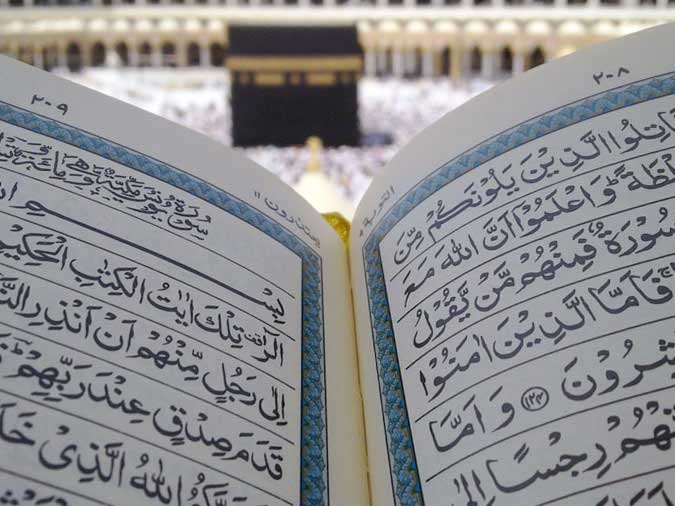
Since its revelation, the Quran (also spelled ‘Koran’) has remained preserved in its exact, primary text. While numerous translations of the Quran exist, they are all based on the single, original Arabic script, making the Quran unique from previous scriptures in its pure authenticity.
Quran’s Message
The distinctive approach of the Quran is that its spiritual message includes practical injunctions aimed at the general welfare of individuals, society and the environment in which we live.
The Quran’s message is eternal and universal, transcending our differences in race, color, ethnicity and nationality. It provides guidance on every facet of human life – from economics and the ethics of trade to marriage, divorce, parenting, gender issues and inheritance.
Say, ˹O believers,˺ “We believe in Allah and what has been revealed to us; and what was revealed to Abraham, Ishmael, Isaac, Jacob, and his descendants; and what was given to Moses, Jesus, and other prophets from their Lord. We make no distinction between any of them. And to Allah we all submit.”
Monotheism is a prominent theme of the Quran, affirming that God is One without any partners. In a concisely-worded Quranic chapter, God commands, “Say, ‘He is God the One, God the eternal. He begot no one nor was He begotten. No one is comparable to Him’” (112:1-4).
#Bible – Collection of Manuscpripts (Writings of Scholars about Real Events and some teachings of God) – #Not word of God; #Burning of Manuscripts, #Quran, #Word of God; #Islam; #monotheism;



 bismillahschool.net