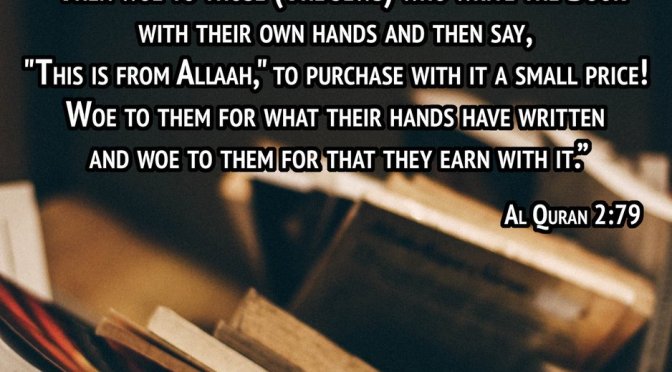
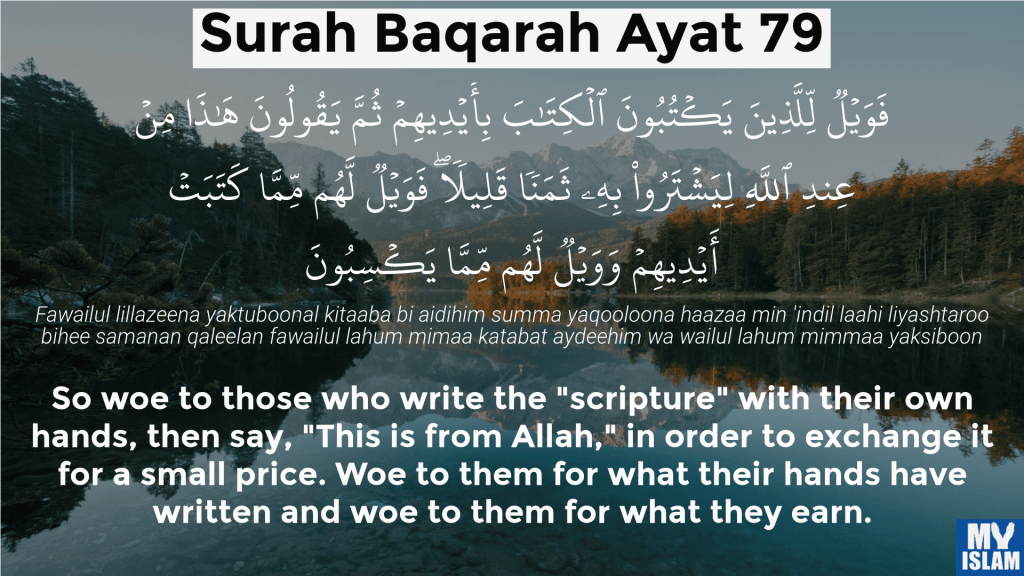
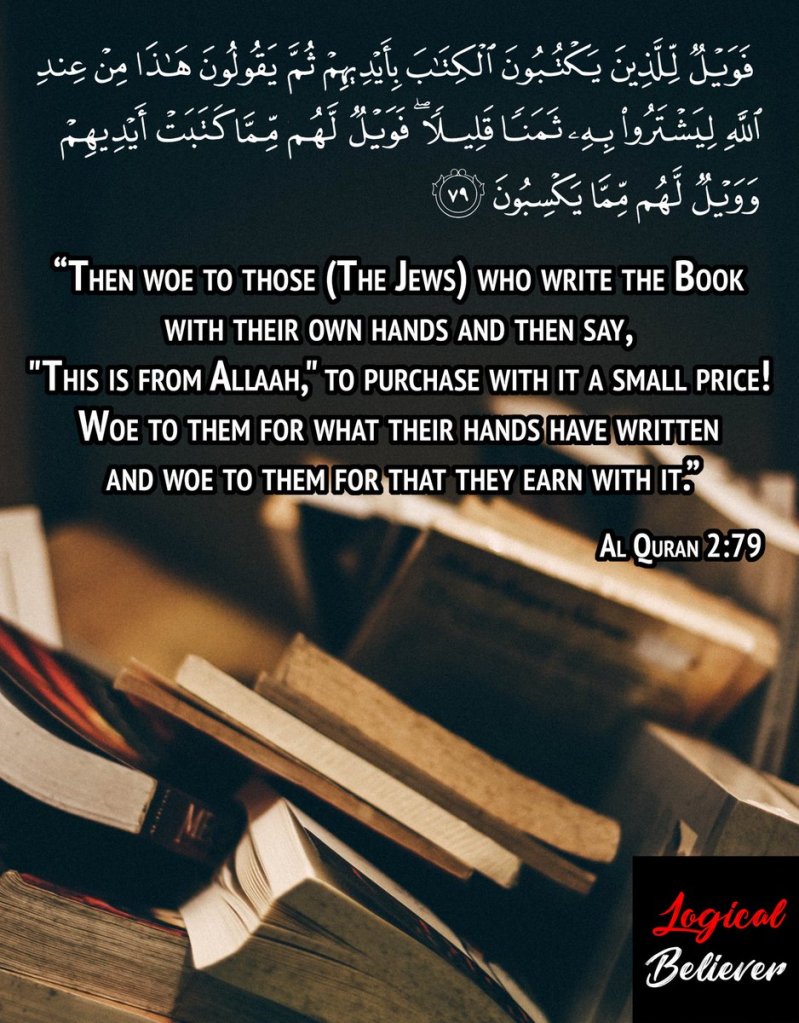
79 –So woe to those who write the “scripture” with their own hands, then say, “This is from Allah,” in order to exchange it for a small price. Woe to them for what their hands have written and woe to them for what they earn.
77. Do they not know that God knows what they conceal and what they reveal? 78. And among them are uneducated who know the Scripture only through hearsay, and they only speculate.
79. So woe to those who write the Scripture with their own hands, and then say, “This is from God,” that they may exchange it for a little price. Woe to them for what their hands have written, and woe to them for what they earn.
80. And they say, “The Fire will not touch us except for a number of days.” Say, “Have you received a promise from God—God never breaks His promise—or are you saying about God what you do not know?”
(2:78) Among them are also the unlettered folk who do not know about the Scriptures but cherish baseless wishes and merely follow their conjectures.[89]
89. This was the state of the Jewish masses. They were ignorant of the Scriptures, unaware of the principles of faith as enunciated by God in His Book, unaware of the rules of conduct that He had laid down, and of the teachings which are of fundamental importance for man’s salvation. Because they lacked this knowledge, they fabricated a whole religion out of their desires and fancies, living in a paradise built on false hopes and illusions.
Ala-Maududi
(2:79) Woe, then, to those who write out the Scriptures with their own hands and then, in order to make a trifling gain, claim: “This is from Allah.”[90] Woe to them for what their hands have written and woe to them for what they thus earn.
90. These observations relate to their rabbis. They were not content with misinterpreting the Word of God. They also interjected into it their readings of the Scriptures and their explanatory comments thereof, stories from their national history, superstitious ideas and fancies, philosophical doctrines and legal rules. The result was that the Divine and the human became inextricably mixed. They claimed, nevertheless, that the entire thing was divine! Every historical anecdote, the interpretation of every commentator, the doctrine of every theologian, and the legal deduction of every jurist that managed to find its way into the Bible became the ‘Word of God’. It was thus obligatory to believe in all that, and every deviation from it became tantamount to deviation from the true faith.
Ala-Maududi
(2:80) They say: “The Fire will certainly not touch us except for a limited number of days.”[91] Say (to them): “Have you received a promise from Allah – for Allah never breaks His promise – or do you attribute to Allah something about which you have no knowledge?”
91. This is a misconception entertained by all Jews, laymen as well as rabbis. They felt sure that no matter what they did, they would remain immune from hell-fire just by virtue of being Jews! The worst they could conceive of was the possibility of a transient punishment before they were transported to heaven.
#Chaging the Torah; #Quran Kareem, #Corruption of the Scholars/ Rabbis;
Last 3 Ayyat/ Verses from Surah Hashr (gathering in Judgement Day);
Translation of the last 3 verses of Surah Hashr: Verses 22-24; He is Allah—there is no god worthy of worship except Him: Knower of the seen and unseen. He is the Most Compassionate, Most Merciful. He is Allah—there is no god except Him: the King, the Most Holy, the All-Perfect, the Source of Serenity, the Watcher of all, the Almighty, the Supreme in Might, the Majestic. Glorified is Allah far above what they associate with Him in worship! He is Allah: the Creator, the Inventor, the Shaper. He alone has the Most Beautiful Names. Whatever is in the heavens and the earth constantly glorifies Him. And He is the Almighty, All-Wise.
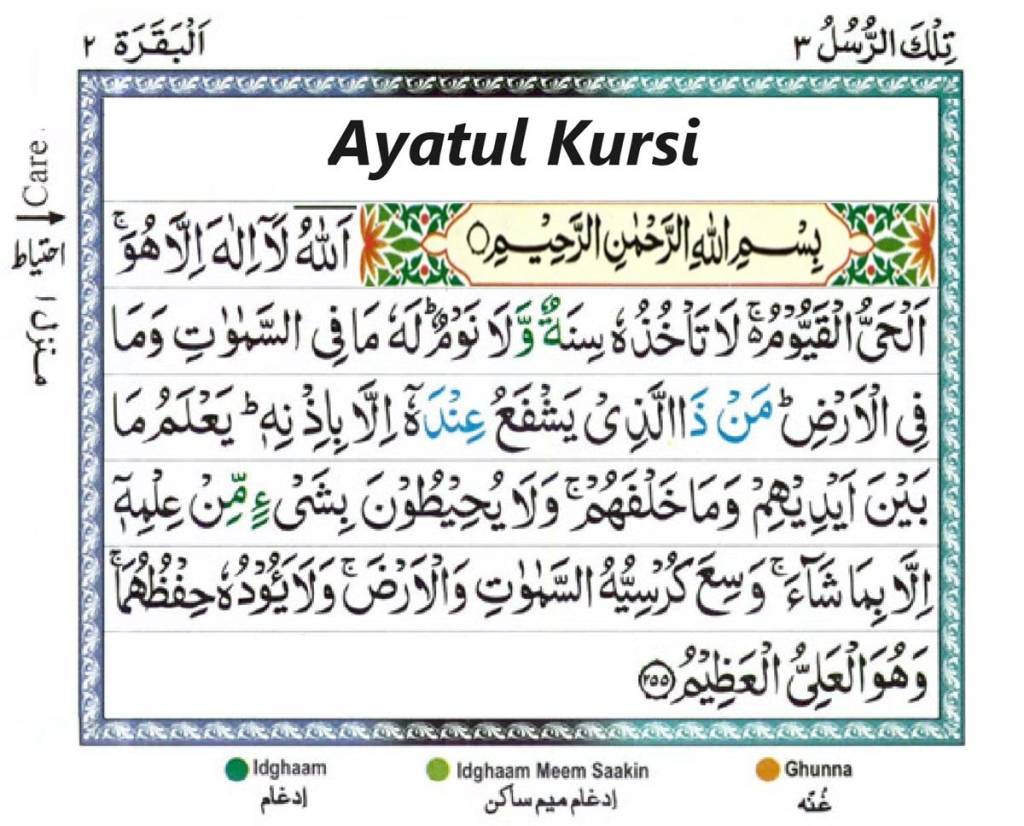
Ayatul Kursi – Verse of the Throne
Allah! There is no god ˹worthy of worship˺ except Him, the Ever-Living, All-Sustaining. Neither drowsiness nor sleep overtakes Him. To Him belongs whatever is in the heavens and whatever is on the earth. Who could possibly intercede with Him without His permission? He ˹fully˺ knows what is ahead of them and what is behind them, but no one can grasp any of His knowledge—except what He wills ˹to reveal˺. His Seat1 encompasses the heavens and the earth, and the preservation of both does not tire Him. For He is the Most High, the Greatest.2
Definitions of God in Semitic Languages
The main Aramaic words for God are Elah (ܐܠܗ) or Alaha (ܐܲܠܵܗܵܐ), meaning “God,” which are cognates of the Hebrew Eloah/Elohim and the Arabic Allah, all stemming from a common Semitic root for divinity. Aramaic also uses Elahi (אֱלָהִי) for “My God,” famously heard in Jesus’ cry “Eloi, Eloi, lama sabachthani?” (My God, my God, why have you forsaken me?).
Key Terms:
Elah / Alaha (אלה / אלהא): The general term for “God,” used in Biblical Aramaic and Syriac.
Elahi (אֱלָהִי): Means “My God,” a possessive form.
Eloi: The specific Aramaic/Hebrew form for “My God,” as used by Jesus in the Gospels.
Connections to Other Languages:
These Aramaic terms share a common root with the Hebrew Elohim (God) and the Arabic Allah (God), highlighting linguistic links across Semitic languages.
Usage:
Jesus’ use of “Eloi” in Aramaic (Mark 15:34) shows direct usage of these terms.
In the Bible (Books of Daniel, Ezra), compound forms like Elah Avahati (God of my fathers) and Elah Shemaiya (God of Heaven) are found.
#God, #Allah, #Divine Attributes, #Definitions, #Islam; #Semitic languages
Numbers 12:3 Now the man Moses was very meek, more than all people who were on the face of the earth.
Exodus 10:3 So Moses and Aaron went in to Pharaoh and said to him, ‘Thus says the LORD, the God of the Hebrews, ‘How long will you refuse to humble yourself before me? Let my people go, that they may serve me.’
1 Samuel 2:7 The Lord makes poor and makes rich; he brings low and he exalts.
2 Samuel 22:28 You save a humble people, but your eyes are on the haughty to bring them down.
2 Chronicles 7:14 If my people who are called by my name humble themselves, and pray and seek my face and turn from their wicked ways, then I will hear from heaven and will forgive their sin and heal their land.
Psalm 95:6 Oh come, let us worship and bow down; let us kneel before the Lord, our Maker! (Notice they bow down and prostrate – just like the Muslims ( because they were Muslims/ eg/ worshipped God Alone);
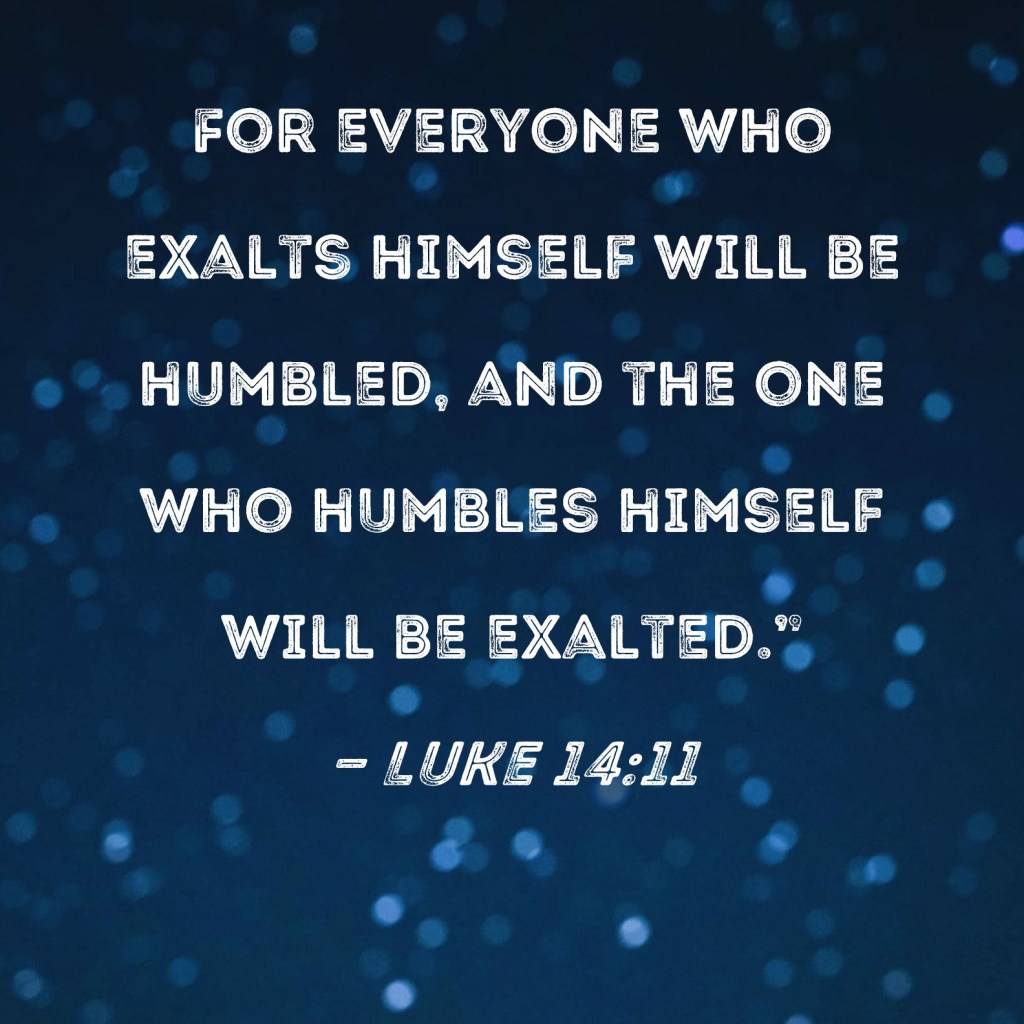
Matthew 23:10–12 Neither be called instructors, for you have one instructor, the Christ. The greatest among you shall be your servant. Whoever exalts himself will be humbled, and whoever humbles himself will be exalted.
Romans 12:3 For by the grace given to me I say to everyone among you not to think of himself more highly than he ought to think, but to think with sober judgment, each according to the measure of faith that God has assigned.
Colossians 3:18–19 Wives, submit to your husbands, as is fitting in the Lord. Husbands, love your wives, and do not be harsh with them.
1 Peter 3:3–4 Do not let your adorning be external—the braiding of hair and the putting on of gold jewelry, or the clothing you wear— but let your adorning be the hidden person of the heart with the imperishable beauty of a gentle and quiet spirit, which in God’s sight is very precious.
HUMILTY IN ISLAM – PRIDE BELONGS TO ALLAH (GOD ALLMIGHTY ALONE)
Abdullah narrated that the Messenger of Allah said: “Whoever has a mustard seed’s weight of pride (arrogance) in his heart, shall not be admitted into Paradise. And whoever has a mustard seed’s weight of faith in his heart, shall not be admitted into the Fire.”
“Verily, for all men and women who have surrendered themselves unto God, and all believing men and believing women, and all truly devout men and truly devout women, and all men and women who are true to their word, and all men and women who are patient in adversity, and all men and women who humble themselves… for them God has readied forgiveness of sins and a mighty reward” (Qur’an33:35).
At-Tirmidhi (1999), Abu Dawood (4091) and Ibn Maajah (59) narrated from ‘Abdullah ibn Mas‘ood that the Prophet (blessings and peace of Allah be upon him) said: “No one will enter Paradise in whose heart is an atom’s weight of arrogance and no one will enter Hell in whose heart is an atom’s weight of faith.” A man said: What if I like my clothes to look nice and my shoes to look nice? He said: “Verily Allah loves beauty; rather arrogance means rejecting the truth and looking down on people.”
PRIDE BELONGS TO ALLAH ALONE:
There is no doubt that Kibriyaa’ (Pride/Grandeur) is one of the Attributes of Allah, The Exalted, as stated in the Quran and Sunnah, and that Al-Mutakabbir (The Superior and Supreme in pride and grandeur) is one of His Names. Allah Says (what means): {And to Him belongs [all] grandeur within the heavens and the earth, and He is the Exalted in Might, the Wise.} [Quran 45:37] Al-Qurtubi said in his Tafseer book: “{to Him belongs [all] grandeur} means that to Him belongs greatness, majesty, immortality, dominion, power, and perfection.” [End of quote]
In the Sunnah, it was narrated on the authority of Abu Hurayrah that the Messenger of Allah, sallallaahu ‘alayhi wa sallam, said: “Allah, The Almighty, Says: “Pride is My Ridaa’ (cloak), and Greatness is My Izaar (lower garment), and whoever claims to share with Me either one of them, I will cast him into Hellfire.” [Ahmad, Abu Daawood and Ibn Maajah]
Moreover, the Prophet, sallallaahu ‘alayhi wa sallam, used to say in his Rukoo‘: “Subhaana Thil-Jabarooti wal-Malakooti wal-Kibriyaa’i wal-‘Athamah (which means: Glory be to the Lord of Might, Dominion, Grandeur, and Greatness).” [Ahmad, Abu Daawood, and An-Nasaa’i]
One of the Most Beautiful Names of Allah is Al-Mutakabbir, as stated in the Quran, where Allah Almighty Says about Himself (what means): {…the Exalted in Might, the Compeller, the Superior.} [Quran 59:23] [Al-Mutakabbir in this verse is translated as ‘the Superior’]
Briefly, the reported meaning of the divine name Al-Mutakabbir is as follows: “The One Who is Superior and Exalted Above all evil, Who is far Exalted above committing injustice against His slaves. To Him belongs all grandeur, and He is far Exalted above the attributes of His creation, and He shows His Superiority to the insolent created beings who dare to claim to share with Him the attribute of greatness, so He destroys them.”
Al-Munaawi said in Faydh Al-Qadeer: “Al-Mutakabbir means the One to Whom belongs all Kibriyaa’ (pride/grandeur), The Sovereign, or The Superior Who sees others as inferior to Him. He regards others in the same way a master regards his slaves, and it is inconceivable that this attribute should be ascribed to other than Allah, The Exalted (in this sense). To Him alone belong greatness and grandeur in all respects and from all aspects, and therefore this attribute cannot be used in reference to other than Allah, The Exalted, except in a context of dispraise.” [End of quote]
#Humility, #Pride, #Islam, #Paradise, #Bible, Quran Kareem, #Comparative religion;
Sahih International: Wherever you may be, death will overtake you, even if you should be within towers of lofty construction. But if good comes to them, they say, “This is from Allah “; and if evil befalls them, they say, “This is from you.” Say, “All [things] are from Allah.” So what is [the matter] with those people that they can hardly understand any statement?
In the name of God, the Gracious, the Merciful.
1. Blessed is He in whose hand is the sovereignty, and Who has power over everything. 2. He who created death and life—to test you—as to which of you is better in conduct. He is the Almighty, the Forgiving. – surah Mulk/ The Domnion (of the Heavens and the Earth)
‘Allāh takes the souls at the time of their death, and those that do not die [He takes] during their sleep. Then He keeps those for which He has decreed death and releases the others for a specified term. Indeed, in that are signs for a people who give thought.’ [Al-Zumar, 39:42]
Narrated by Al-Suddī concerning the saying of the Most High:
وَالَّتِي لَمْ تَمُتْ فِي مَنَامِهَاۖ
‘And those that do not die, [He takes] during their sleep,’
He [al-Suddī] said: ‘Their souls are taken in their sleep such that the souls of the living meet the souls of those who have passed away. They reminisce and remind one another [of events that have transpired].’
He said; ‘The souls of the living then return to their bodies so that they may fulfil the remainder of their lives in this dunyā. While the souls of the dead desire to return to their [abandoned bodies] except that they are blocked from doing so.’
[Imām Ibn al-Qayyim said:] This is one of the two opinions concerning this verse. It is that the soul that is prevented [from returning to the body] belongs only to those whose souls have been taken from [their bodies] due to death. While the souls that are returned are those that leave their bodies while asleep [such that they awaken in this dunyà]. Therefore, according to this opinion, its meaning is thatthe souls of the dead are taken [by the angel of death] and held, unable to return to their physical bodies before the Day of Judgement. The souls of those in slumber are also taken but are returned to their bodies such that the rest of their lives are fulfilled [i.e., their preappointed number of years in this dunyà is completed, at which point] their souls are taken again [for the final time, and they die].
The second opinion regarding this verse is that both types of soul, the ones that are held [from returning to their bodies] and those that are returned, are taken similar to one who enters sleep [i.e. expecting to return]. However, those among them whose lives in this dunyā have been completed are then held, disallowed to return to their bodies [such that they die in their sleep]. While those whose lives have not been fulfilled [i.e., they still have time left in this dunyà], their souls are returned to their bodies such that they are able to complete their course. This [opinion] is the stance of Shaykh al-Islām (Ibn Taymiyyah) [may Allāh have mercy on him and purify his soul], He said: ‘The Qurʾān and the Sunnah testify to this.’ He [also] said: ‘Indeed, the Exalted mentions His taking of the souls of those that He has decreed death upon from among the souls that have been taken in sleep [i.e. in His saying:
فَيُمْسِكُ الَّتِي قَضَىٰ عَلَيْهَا الْمَوْتَ ‘Then He keeps those for which He has decreed death’
referring to those that die in their sleep]. As for the ones whose souls have been taken due to their time of death [while wakeful], they have not been described here, rather they are a separate third party.’1
[Imām Ibn al-Qayyim said:] However, the correct opinion is the first one. This is because the Exalted relates two times that souls are taken: the major taking of the soul at death, and the minor taking of the soul during sleep.
Hence, He has divided the souls into two parties:
A party upon whom death has been decreed and thus [their souls] have been held with Him, taken from their bodies in finality.
Another party whose course of life remains, such that their souls are returned to their bodies to fulfil it.
1. Every Soul Shall Taste Death
“Every self will taste death. You will be paid your wages in full on the Day of Rising. Anyone who is distanced from the Fire and admitted to the Garden, has triumphed. The life of this world is only the enjoyment of delusion.” (Quran, 3:185)
Here, Allah reminds us that we all, collectively as a human race, have a shared destiny with death – none can escape it. What remains for us to do, then, is to ensure we are truly living lives worthy of worshipping and loving Allah. We musn’t fall into the trap of believing this temporal world is worth risking our relationship with Allah.
2. Allah Will Never Delay A Soul When Its Time Has Come
“And spend [in the way of Allah ] from what We have provided you before death approaches one of you and he says, ‘My Lord, if only You would delay me for a brief term so I would give charity and be among the righteous’. But never will Allah delay a soul when its time has come. And Allah is Acquainted with what you do.” (Quran, 63:10-11)
The Quran reminds us time and time again to never take this life for granted – and to never overestimate how long we have on this earth. We must continously strive towards becoming better Muslims, lest we regret it when it is too late.
3. No Soul Perceives In What Land It Will Die
“Indeed, Allah [alone] has knowledge of the Hour and sends down the rain and knows what is in the wombs. And no soul perceives what it will earn tomorrow, and no soul perceives in what land it will die. Indeed, Allah is Knowing and Acquainted.” (Quran, 31:34)
To truly understand tawheed, the Oneness of Allah, will be a lifelong journey – and this verse is a powerful reminder of how much at mercy we are with Allah. None of us can know when our time with death has come, and we must truly believe, accept, and embrace whatever Allah has Planned for us.
4. When Their Specifed Time Has Come, They Cannot Delay It For A Single Hour
“When their specified time arrives, they cannot delay it for a single hour nor can they bring it forward.” (Quran, 16:61)
Here again, we are reminded of our fate with death – none of us can change it. As much as we like to believe we are in control of our lives – even our health, we must submit to Allah’s Will at all times and accept death as a blessing and a preordained end to our life here on earth.
5. Oh Soul At Rest, Return To Your Lord
“O soul that are at rest! Return to your Lord, well-pleased (with him), well-pleasing (Him), So enter among My servants, And enter into My garden.” (Quran, 89:27-30)
Finally, despite our innate fears around death, we must be assured that to embrace death is perhaps the only true comfort we have in this world – we are finally returing to Allah and inshallah, will be blessed with His Glad-Tidings. All we can do is pray for the strength to welcome our death as the last of Allah’s blessings here on earth.
* 5 hadeeth about Death
1. What is death like to believers?
“The gift to a believer is death.” (Al-Tirmidhi, Hadith 1609)
“Allah accepts the repentance of the servant so long as his spirit has not arrived at his throat.” (Al-Tirmidhi)
3. The death of one who seeks knowledge
“When death comes to the seeker of knowledge whilst he is in that state [of seeking knowledge], he dies as a martyr.” (al-Targhib wa al-Tarhib, v. 1, p. 97, no. 16)
4. The remembrance of death
“The most sagacious one from among you is he who remembers death the most, and the most prudent one from among you is he who is the most prepared for it.” – (Alam al-Din, no. 333)
5. What is the destination after death?
“Do not abuse the dead, for they have reached the result of what they have done.” – (Sahih Bukhari)
6. Things that last beyond death
“When a man dies, his good deeds come to an end, except three: Ongoing charity, beneficial knowledge, and a righteous son who will pray for him.” – (Sahih Muslim, 3084)
7. What can save me from an evil death?
“Indeed charity extinguishes the Lord’s anger and protects against the evil death.” – (At-Tirmidhi, 664)
8. Death is an end to comfort
“Remember often the destroyer of all pleasures.” – (At-Tirmidhi)
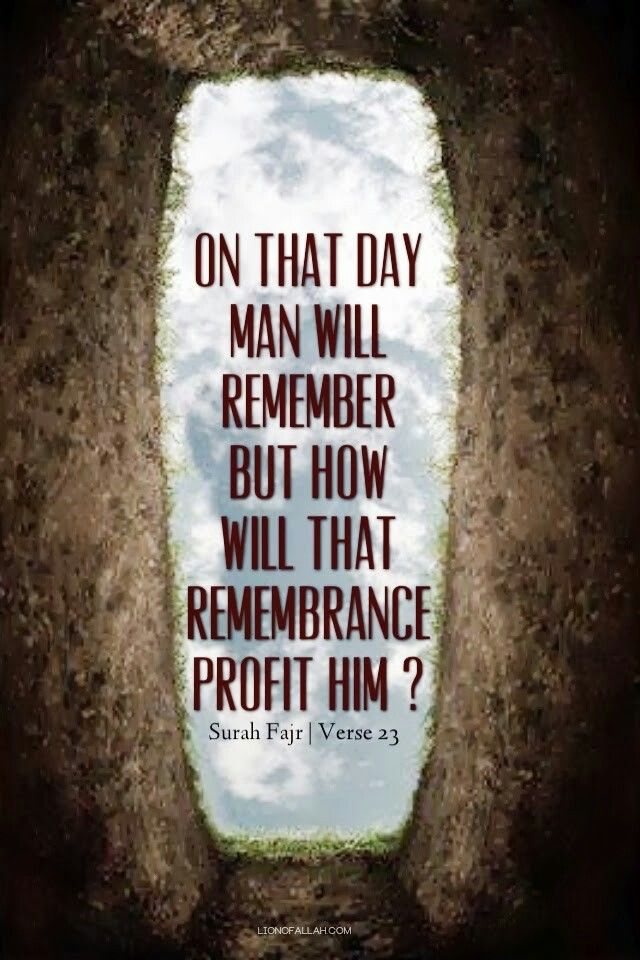
Death will come for us all, let’s attempt to be ready when it does.
#Death, #Islam #Quran #Verses #Hadeeth (sayings of Prophet Muhammad – sal Alllahu alayhi wa Sallam)




 said in his Tafseer book: “{to Him belongs [all] grandeur} means that to Him belongs greatness, majesty, immortality, dominion, power, and perfection.” [End of quote]
 that the Messenger of Allah, sallallaahu ‘alayhi wa sallam, said: “Allah, The Almighty, Says: “Pride is My Ridaa’ (cloak), and Greatness is My Izaar (lower garment), and whoever claims to share with Me either one of them, I will cast him into Hellfire.” [Ahmad, Abu Daawood and Ibn Maajah]






 bismillahschool.net