The hymen has a reputation for being an indicator of sexual activity — like a hard, seal-like covering that blocks your vagina — but it usually has no connection to whether a female has had sex. In reality, it’s soft and elastic and doesn’t necessarily block your vaginal opening. It can break from everyday activities, inserting a tampon or having sex. –
What happens when a woman’s hymen breaks?
Some know when their hymen breaks, while others don’t. Like other tissues in your body, your hymen is flexible and can stretch. It doesn’t usually tear the first time it’s pressed on. Rather, it breaks as a result of being worn down. It’s not like the instant pain you’d feel if you tore a muscle or broke a bone.
Some people experience pain or light bleeding when their hymen breaks, but most will feel nothing. Since it’s a flexible piece of tissue, it stretches and thins over time from day-to-day activities or from using tampons. If you bleed when your hymen breaks, you may believe it’s your period or spotting.
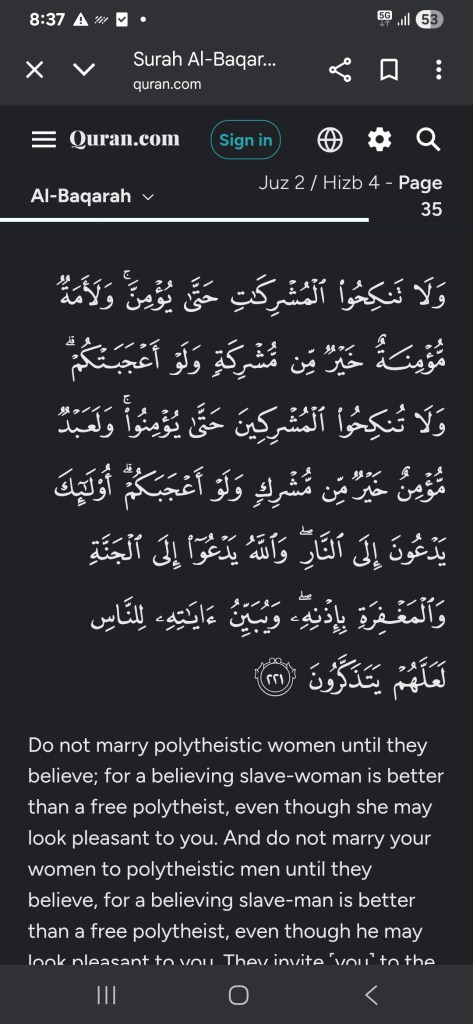
Do not marry polytheistic women until they believe; for a believing slave-woman is better than a free polytheist, even though she may look pleasant to you. And do not marry your women to polytheistic men until they believe, for a believing slave-man is better than a free polytheist, even though he may look pleasant to you. They invite ˹you˺ to the Fire while Allah invites ˹you˺ to Paradise and forgiveness by His grace.1 He makes His revelations clear to the people so perhaps they will be mindful. – Quran Kareem
Surah Maidah – table Spread 5:5 – Muslim men may marry Women from Alhul Kitab (people of the Book)- Christian and Jewish women – as they are Head of the Family – but not vice-versa (no Muslim woman can marry from Ahlul Kitab) – due to them still believeing in Allah azza wa Jal/ God AllMighty; this is also for Non Muslim women to Know if they Christian and/ or Jewish and Chaste marriage to a Muslim men is allowed – but not for any other beliefs – as well if someone does not propose to your right away- as you meet – they have Wring intention – as dating is not allowed in Islam. – so you are aware if some man may want to use and leave you;
Surah Maidah 5:5 – Today all good, pure foods have been made lawful for you. Similarly, the food of the People of the Book1 is permissible for you and yours is permissible for them. And ˹permissible for you in marriage˺ are chaste believing women as well as chaste women of those given the Scripture before you—as long as you pay them their dowries in wedlock, neither fornicating nor taking them as mistresses. And whoever rejects the faith, all their good deeds will be void ˹in this life˺ and in the Hereafter they will be among the losers.
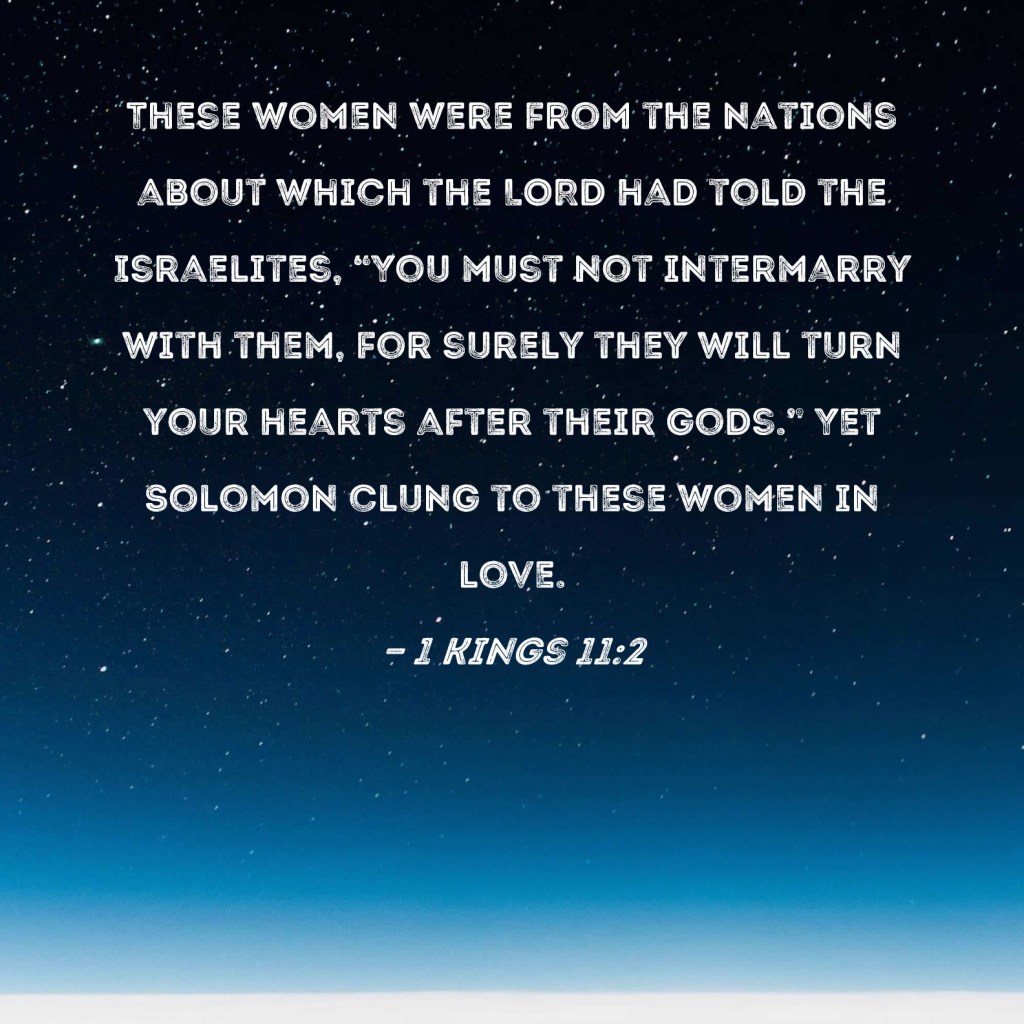
“When the Lord your God brings you into the land that you are entering to take possession of it, and clears away many nations before you, the Hittites, the Girgashites, the Amorites, the Canaanites, the Perizzites, the Hivites, and the Jebusites, seven nations more numerous and mightier than you, and when the Lord your God gives them over to you, and you defeat them, then you must devote them to complete destruction. You shall make no covenant with them and show no mercy to them. You shall not intermarry with them, giving your daughters to their sons or taking their daughters for your sons, for they would turn away your sons from following me, to serve other gods. Then the anger of the Lord would be kindled against you, and he would destroy you quickly.
Now in Islam we do not say Prophet Solomon’s Heart turned after other “gods” – however the pirbicple is there; technically if you look at most Bible Verses and Quran Kareem you will realize the Source of Revelation is the same (Allah- saw- God AllMighty)
2 Corinthians 6:14-16 it reads:
14 Do not be unequally yoked together with unbelievers. For what fellowship has righteousness with lawlessness? And what communion has light with darkness? 15 And what accord has Christ with Belial? Or what part has a believer with an unbeliever? 16 And what agreement has the temple of God with idols? For you[b] are the temple of the living God. As God has said: I will dwell in them And walk among them. I will be their God, And they shall be My people. NKJV
#marriage # believers #not with #polytheists #Islam; #Bible
Jacob Marries Leah and Rachel (Marriage in general)
New American Standard Bible 1995 – Jacob and Rachel marriage – but he way he married Leah first (did not remove her Veil)- so then later on after many more years married Rachel, the mother of Yusuf/ Joseph (aleihis Salam) – as she was the younger sister; hence Lifting the Veil in marriage idea; The Veil; some jewish weddings still have the Face cover in weddings in present day;
?????????
There is a custom practiced during Jewish weddings known as the “bedeken”, or the “veiling”. Before the wedding ceremony, the groom goes to the room where his bride is sitting on a throne, and he covers her face with a veil. Her face remains covered during the entire chupah ceremony. Yet, at the end, it was Leah who became Jacob’s primary wife. Rachel died at a young age, so that most of Jacob’s married life was actually spent with Leah. In addition to this, it was Leah who mothered most of Jacob’s children, the future tribes of Israel and it was she, not Rachel, who ultimately was buried with Jacob in the Cave of Machpela in Hebron.
One of the traditional explanations for this custom is that it commemorates the event that occurred during Jacob’s wedding ceremony. Since Jacob’s bride was veiled, he did not realize that he was marrying the wrong woman. But if that is the reason, shouldn’t the custom be that the groom uncovers his bride’s face to make sure that he is marrying the bride of his choice? Why are we commemorating at each of our weddings this terrible episode that occurred to poor Jacob?
Genesis 29 15-28 – Prophet Yaqub/ Jacob(Alayhis Salam) marriages with Leah, then Rachel
After Jacob had stayed with him for a whole month, 15 Laban said to him, “Just because you are a relative of mine, should you work for me for nothing? Tell me what your wages should be.” 16 Now Laban had two daughters; the name of the older was Leah, and the name of the younger was Rachel. 17 Leah had weak[a] eyes, but Rachel had a lovely figure and was beautiful. 18 Jacob was in love with Rachel and said, “I’ll work for you seven years in return for your younger daughter Rachel.”
19 Laban said, “It’s better that I give her to you than to some other man. Stay here with me.” 20 So Jacob served seven years to get Rachel, but they seemed like only a few days to him because of his love for her. 21 Then Jacob said to Laban, “Give me my wife. My time is completed, and I want to make love to her.” 22 So Laban brought together all the people of the place and gave a feast. 23 But when evening came, he took his daughter Leah and brought her to Jacob, and Jacob made love to her. 24 And Laban gave his servant Zilpah to his daughter as her attendant.
25 When morning came, there was Leah! So Jacob said to Laban, “What is this you have done to me? I served you for Rachel, didn’t I? Why have you deceived me?”26 Laban replied, “It is not our custom here to give the younger daughter in marriage before the older one. 27 Finish this daughter’s bridal week; then we will give you the younger one also, in return for another seven years of work.”
28 And Jacob did so. He finished the week with Leah, and then Laban gave him his daughter Rachel to be his wife. 29 Laban gave his servant Bilhah to his daughter Rachel as her attendant. 30 Jacob made love to Rachel also, and his love for Rachel was greater than his love for Leah. And he worked for Laban another seven years. – but he lifted the Marriage Veil the second time *(yes women mostly used to cover their faces in public)
Notes: back then Men had to pay and work for women in or for marriage – there is “no free lunch” – so well that technically explains the Failure of most marriages today – where women split bills 50/50 – or pay too many bills – well How do you expect they make Good wives and mothers withh al that Stress – therefore the moral and societal decadence has somethings to do with the No Family/ mixed family structure of modern times.
ياأيها النبي إذا جاءك المؤمنات يبايعنك على أن لايشركن بالله شيئا ولا يسرقن ولا يزنين ولا يقتلن أولادهن ولا يأتين ببهتان يفترينه بين أيديهن وأرجلهن ولا يعصينك في معروف فبايعهن واستغفر لهن الله إن الله غفور رحيم سورة: الممتحنة – آية: ( 12 ) – جزء: ( 28 ) – صفحة: ( 551 )
Almuntakhab Fi Tafsir Alquran Alkarim
O you the Prophet: If emigrating women who conformed to Islam come to you and pledge before Allah their vows to you that: they will not incorporate with Allah other deities, they will not steal, nor will they commit adultery nor infanticide, they will not speak or utter slanders nor relate falsehood, they will not conceive an illegitimate child and make the husband believe it is his, nor will they disobey you in matters crowned with equity; then you accept their pledge and invoke on their behalf Allahs forgiveness, for He is indeed Ghafurun and Rahimun
Tafseer Tafheem-ul-Quran by Syed Abu-al-A’la Maududi
(60:12) O Prophet, when believing women come to you and pledge *18 to you that they will not associate aught with Allah in His Divinity, that they will not steal, *19 that they will not commit illicit sexual intercourse, that they will not kill their children, *20 that they will not bring forth a calumny between their hands and feet, *21 and that they will not disobey you in anything known to be good, *22 then accept their allegiance *23 and ask Allah to forgive them. Surely Allah is Most Forgiving, Most Compassionate.
O Prophet, when the believing women come to you pledging to you meaning
*18) As we have explained above, this verse was sent down some time before the conquest of Makkah. After the conquest the Quraish stated coming to the Holy Prophet in large numbers to take the oath of allegiance. From the men he took the oath himself on Mount Safa, As for the woman he appointed Hadrat ‘Umar to administer the oath to them on his behalf and to ask them to pledge that they would refrain from the things mentioned in this verse. (Ibn Jarir, on the authority Of Ibn ‘Abbas; Ibn Abi Hatim, on the authority of Qatadah). Then. on his return to Madinah he ordered the Muslim women of Madinah to be gathered together in a house and he sent Hadrat Umar to take the oath from them. (Ibn Jarir, Ibn Marduyah, Bazzar, Ibn Hibban, on the authority of Umm ‘Atiyyah Ansariah). On the ‘Id day also, after his address to men, he went to the assembly of women and in his sermon to than he recited this verse and asked them to pledge that they would refrain from the things mentioned in it. (Bukhari on the authority of Ibn `Abbas’s tradition). Apart from these occasions. at different other tithes also, the women came before the Holy Prophet individually as well as collectively to take the oath of allegiance, as mentioned in several Ahadith.
*19) In Makkah, when the oath of allegiance was being administered, Hind bint `Utbah. wife of Abu Sufyan, asked the Nabi- Prophet its explanation and said: “Messenger of Allah, Abu Sufyan is rather stingy. Will it be sinful if I take out something from his wealth without his permission to meet my own and my children’s needs?” The Holy Prophet replied: “Nay, but only ,lastly and lawfully; i.e. take only that much as may actually suffice for your needs.” (Ibn al–‘Arabi, Ahkam al-Qur’an).
*20) This also includes abortion, whether ii is abortion of the legitimate or of the illegitimate foetus. *21) This implies two kinds of calumny: (1) a woman’s accusing other women of having illicit relations with other men and her spreading such stories among the people, for the women are generally prone to spreading such things; and (2) a woman’s delivering a child by somebody else and making her husband believe that it is his. Abu Da’ud has related a tradition from Abu Hurairah saying that he heard the Holy Prophet say: “The woman who brings such a child into a family as does not actually belong to it, has no connection with Allah, and Allah will never admit her to Paradise.”
*22) In this brief sentence two important points of the law have been stated: First, that obedience even to the Holy Prophet (upon whom be Allah s peace) has boon restricted to “in what is good”, although about the Holy Prophet no one could imagine that he would order somebody 10 do an evil From this it automatically follows that no one in the world can be obeyed outside the bounds of Divine law. For when obedience to Allah’s Messenger-himself is conditional upon “in what is good”. who else can have a position to demand unconditional obedience and require the people to obey and follow each of his commands laws, rules or customs, which are opposed to the law of Allah? The Nabi- Prophet (upon whom be Allah’s peace) has stated this principle, thus: “There is no obedience in the disobedience of Allah; obedience is only in what is good and right.” (Muslim, Abu Da’ud, Nasa’i). Our great doctors have derived this very theme from this verse, Hadrat ‘Abdur Rehman bin Zaid bin Aslam says: “Allah has not said that they should not disobey you (the Holy Prophet) but that they should not disobey you in what is good. Then, when Allah Almighty has made obedience even to the Holy Prophet himself conditional upon this, how can another person have the right that he should be obeyed in anything but what is good?” (Ibn Jarir).
Imam Abu Bakr al-Jassas writes: “Allah knew that His Prophet never enjoined anything but what was good. Still He restricted obedience to him only in what is good, so that no one ever may find a provision to obey the kings when they enjoined something outside the obedience of AIIah. The Holy Prophet (upon whom be Allah’s peace) has said: ‘He who obeys a creature in disobedience to the Creator, Allah appoints the. same c creature over him in power’ . ” (Ahkam al-Qur an). ‘Allama Alusi says: “This command refutes the view of those ignorant people who think that obedience to the ruler is absolutely necessary. Allah has restricted even obedience to His Messenger only in what is good, whereas the Messenger never enjoins anything but what is good. This is meant to wam the people that obedience to no one is lawful in disobedience to the Creator. ” (Ruh al-Ma ani). Thus, this command in fact, is the foundation stone of the rule of law in Islam. The rule is that anything which is opposed to the law of Islam is a crime, and no one has the right to enjoin any such thing on any one. Anyone who enjoins anything against the law, is a culprit; and the one who obeys such a command is . also a culprit. No subordinate can escape the punishment on the basis of the excuse that his superior officer had ordered him to do something which was a crime in the law.






 bismillahschool.net