
Quran Reading – letters, to joining letters to sounds; Lessons – text and sound; Internet Archive;
https://archive.org/details/Ahsanulqaida/Ahsanulqaida/page/n3/mode/2up


Languages, Literature, Poetry and Short Stories;
RosethornSaif – Rosethorns and a Sword;
Quran Reading – letters, to joining letters to sounds; Lessons – text and sound; Internet Archive;
https://archive.org/details/Ahsanulqaida/Ahsanulqaida/page/n3/mode/2up
This Kit is designed to help homeschooling parents teach various skills to their kids. It includes numerous worksheets to help the kids gain basic learning skills,or think creatively -spelling and Math sheets (Alphabet sheets, Spelling Practice, Numbers and Counting, Addition and Subtraction, Multiplication and Division Sheets); It would also be beneficial for the non-homeschoolers.
Please purchase this Kit- and help our team with their creative effort;
#Worksheets; #Elementary; #English, #math, #Spelling, #Addition/ Subtraction, #Multiplication/ Division;
Prayer – to the Soul,
As Medicine to the patient.
Bitter- sweet, candy taste,
When Losing Concentration.
Brown- sugar, pleasing, aromatic flavour,
As bear savoring delicious Honey comb.
Constancy, Increased practice,
The sweeter, lovelier the Flavour,
Path to Submission, Khushu,
Delight on being a True Abd,
To his/ her Rubb (Lord).
#Prayer, #Soul, Blessings, #Islam, #Poem

Magnetic Pull on the Heart,
Draws you unto Me,
Without a Compass.

The Screeching of Broken- Windowed Glass,
Pierced through My Heart,”
Surgeoned My Veins,
Took My Breath Away,
Left Me Unable to Walk, Talk,
Process My Thoughts,
A Great Abyss into-
NothingNess.
#Broken Hearted, #Love, #Deception, #Poetry.

Scribus is reliable and Free. Free really means Free with an uppercase F. Free is more than just gratis (which is just a side-effect). It means that you are in control of your data and, if you wish, the code of your desktop publishing tool. That’s what smart individuals and companies prefer
https://reedsy.com/resources/writing-apps/book/
A place to plan, draft, edit, and typeset your book.
https://reedsy.com/studio – REEDSY STUDIO – Online Story and Notes Writing;

FocusWriter is a simple, distraction-free word processor. It utilizes a hide-away interface that you access by moving your mouse to the edges of the screen, allowing the program to have a familiar look and feel to it while still getting out of the way so that you can immerse yourself in your work.
FocusWriter allows you to customize your environment by creating themes that control the font, colors, and background image to add ambiance. It also features on-the-fly updating statistics, daily goals, multiple open documents, spell-checking, and much more.
Additionally, when you open the program your current work in progress will automatically load and position you where you last left off so that you can immediately jump back in.
SSuite WordGraph is a free and very useful alternative to Microsoft’s Word, OpenOffice’s Writer, or anything else out there claiming to be the latest and greatest. You don’t even have a need for .NET or even JAVA to be installed. This will save you a lot of hard drive space and precious computer resources.
Platforms: Windows, Mac, iPhone, iPad, Chrome, Android, PC
Best for: Drafting, Story, Book, Essay, and Free
Website: https://www.ssuiteoffice.com/software/wordgraph.htm


https://www.campfirewriting.com


So, You’re looking to write a book. Well, wavemaker is here to help. It’s much much more than a text editor.
Platforms: Mac, Windows, Chrome, Android, Online, PC
Best for: Outlining, Drafting, Book, Story, and Free
Website: https://wavemaker.cards/
Base price: Free; Premium price: –
 Connects to Google Docs; Mind maps Timelines
https://www.literatureandlatte.com

Scrivener is the go-to app for writers of all kinds, used every day by best-selling novelists, screenwriters, non-fiction writers, students, academics, lawyers, journalists, translators and more.
Platforms: Mac, Windows, iPhone, iPad, PC
Best for: Outlining, Drafting, Editing, Publishing, Book, and Story
Website: https://www.literatureandlatte.com/scrivener/overview ; Base price: $59.99 one-time payment
Premium price: – Flexible corkboard Structure outliner
Metadata and target setting Print and export functionalities

Textilus Pro is a great word processor app for students and business people, also being excellent for writing reports, papers, blog posts, journals or ebooks! Textilus Pro can help you organize your research, generate ideas, and remove distractions so you can focus on the most important thing: writing. Platforms: Mac, iPhone, iPad
Best for: Note-taking, Drafting, Blog, Essay, and Free
https://apps.apple.com/us/app/word-processor-textilus-pro/id1018671847

yWriter is a powerful novel-writing program which is free to download and use. It’s designed for Windows 7 and later.yWriter is a word processor which breaks your novel into chapters and scenes, helping you keep track of your work while leaving your mind free to create. It will not write your novel for you, suggest plot ideas or perform creative tasks of any kind. yWriter was designed by an author, not a salesman!
yWriter7 is free to download and use, but you’re encouraged to register your copy if you find it useful.
If you’re just embarking on your first novel a program like yWriter may seem like overkill. I mean, all you have to do is type everything into a word processor! Sure, but wait until you hit 20,000 words, with missing scenes and chapters, notes all over your desk, characters and locations and plot points you’ve just added and which need to be referenced earlier … it becomes a real struggle. Now imagine that same novel at 40,000 or 80,000 words! No wonder most first-time writers give up.
https://www.spacejock.com/yWriter7_Download.html
Mellel is a word processor designed from the ground up to be the ultimate writing tool for academics, technical writers, scholars and students. Mellel is strong, stable and reliable, and is the ideal companion for working on documents that are long and complex, short and simple, or anything in between.
Platforms: Mac, iPhone, iPad Best for: Outlining, Drafting, and Essay
Website: https://mellel.com/
Base price: $49.00 one-time payment
Outline Bibliography Footnotes and endnotes
Multilingual support
Pages is a powerful word processor that lets you create stunning documents, and comes included with most Apple devices. And with real-time collaboration, your team can work together from anywhere, whether they’re on Mac, iPad, iPhone, or a PC.
Platforms: iPad, Mac, iPhone
Best for: Drafting, Book, Essay, Journal, Poetry, Story, Blog, and Free
Website: https://www.apple.com/pages/
Base price: Free
Full feature word processor Track changes
Syncs across devices Offline collaboration

LibreOffice is a free and powerful office suite, and a successor to OpenOffice.org (commonly known as OpenOffice). Its clean interface and feature-rich tools help you unleash your creativity and enhance your productivity.
Platforms: Mac, Windows, PC
Best for: Drafting, Book, Essay, Journal, Poetry, Story, Blog, and Free
Website: https://www.libreoffice.org/ – Base price: Free
Full-feature word processor Customizable fonts and other styles

Are you stuck in a rut? Do you have writer’s block? Need a quick plot idea for that short story writing assignment that’s due tomorrow? Lists for Writers is here to help!
What is it? Lists for Writers is exactly that – lists for writers. We’ve compiled a variety of lists to help writers, both young and old, come up with brainstorming ideas.
Lists for Writers is a great addition to any writer’s toolbox. Helpful to both novice and expert writers alike, this app delivers list after list of prompts and ideas for your brainstorming sessions: names, character traits, plot lines, occupations, obsessions, action verbs, and much more! Whether you are working on a creative writing project, a short story, an essay assignment, National Novel Writing Month / NaNoWriMo, or your next fiction book, this app helps get it done.
It is available now in the iTunes App Store and is a universal app that works for iPhone, iPad, and iPod Touch. It is also available for Android in the Google Play Android market, for Android and Kindle Fire in the Amazon Appstore for Android, for NOOK in the NOOK store, for Windows Phone in the Windows Phone Store, and for BlackBerry 10 in BlackBerry World.
Website: https://thinkamingo.com/lists-for-writers/
All your notes, synced on all your devices. Get Simplenote now for iOS, Android, Mac, Windows, Linux, or in your browser.
ApolloPad is a feature-packed online writing environment that will help you finish your novels, ebooks and short stories.
Platforms: Online
Best for: Outlining, Drafting, Story, Book, and Free
Website: https://apollopad.com/ -Base price: Free
Project outlining & timelines Notes in context To-do lists
https://thequill.app – The Quill App
WPS Office is a lightweight, feature-rich comprehensive office suite with high compatibility. As a handy and professional office software, WPS Office allows you to edit files in Writer, Presentation, Spreadsheet, and PDF to improve your work efficiency.
Platforms: Mac, Windows, Android, iPad, iPhone, PC
Best for: Drafting, Book, Essay, Journal, Poetry, Story, Blog, and Free
Website: https://www.wps.com/
Base price: Free Premium price: $29.99 monthly
Cross platform file management Free templates Colorful themes
Still looking for the perfect app to write your novel? Novelist might just be the perfect tool for the job!
Platforms: Android, iPhone, iPad, Online
Best for: Outlining, Worldbuilding, Drafting, Story, Book, and Free
Website: https://www.novelist.app/ -Base price: Free
Goal setting Rich text editor Back up and restore

Write books, novels, and screenplays by chatting with AI. Say goodbye to writer’s block.
A real-time rhyme suggestion engine offering color-coded rhyme highlighting, the ability to save your work to the cloud, the power to embed SoundCloud jams into your notes, customizable visual layouts, and more.
Platforms: Mac, iPhone, iPad, Android
Best for: Drafting, Poetry, and Free
Website: https://www.rhymersblock.com/welcome
Base price: Free
Real-time ryhme suggestions Slant/near ryhme suggestions
Word frequency analysis Color-coded ryhmes
Create documents, make impact. When your work needs to wow, Craft gives you the tools to make it magnificent.
Platforms: Mac, iPhone, iPad, Windows, Online, PC
Best for: Note-taking, Drafting, Journal, Essay, Blog, and Free
Website: https://www.craft.do/
Base price: Free; Premium price: $5.00 monthly
AI writing assistant Document structuring
Customizable Collaboration
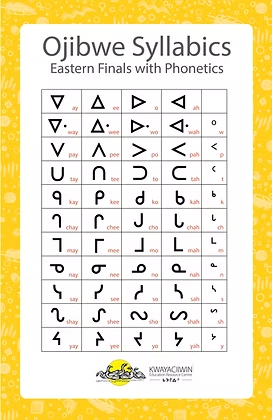
https://ciel.utsc.utoronto.ca/ojibwe-textbook/lesson/1?dialect=southwestern
Source: Ethnologue
In about 1830 James Evans, a Wesleyan missionary, devised a way to write the Ojibwe language of Rice Lake with the Latin alphabet. His goal was to produce a dictionary of Ojibwe to help him to learn the language better, and to help him teach English to the Ojibwe people.
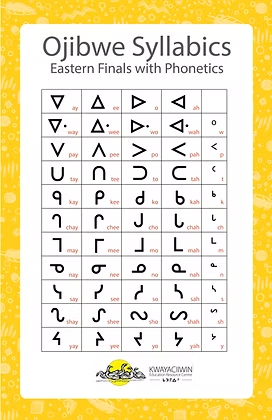
In about 1840, while working at Norway House in Hudson’s Bay, Evans invented a syllabic script for the Ojibwe language, based partly on Pitman shorthand, which had been published in 1837. It is thought that his idea to create a syllabic script was based on the Cherokee script.
Evans’ syllabary for Ojibwe consisted of just nine symbols, each of which could be written in four different orientations to indicate different vowels. This was sufficient to write Ojibwe. Evans translated parts of the Bible and other religious works into Ojibwe, and later Cree, and printed them using type carved from wood, or made from melted-down linings of tea chests.
Evans later adapted it to write Cree. The script proved popular with Ojibwe and Cree speakers, and within about 10 years, many of them had learnt to read and write it, learning mainly from family or friends. As paper was scarce at the time, they wrote on birch bark with soot from burnt sticks, or carved messages in wood, and nicknamed James Evans ‘The man who made birch bark talk’.

The Ojibwe script continued to be widely used until the 1950s and 1960s, when the integration policies of Department of Indian and Northern Affairs led to a decline in use to the script among Ojibwe children taught to write in the Roman alphabet.
Main source: Murdoch, John Stewart, Syllabics: A Successful Educational Innovation (University of Manitoba, 1981).
Ojibwe is a language of verbs. Most of the information in a sentence is carried by verbs, and verbs also tend to carry out functions that are covered by other parts of speech in other languages. For example, Nimbakade – I am hungry. This is a verb. Ojibwe doesn’t really have adjectives. To express that someone or something is in a given state or has a certain property, you almost always use a verb.
Traditional analysis of the grammar of Ojibwe (and related languages) suggests that there are four major categories of verbs in the language. Each category has its own set of prefixes and suffixes. It adds up to a lot to memorize, but don’t worry, we will take you through it step by step, one lesson at a time.
To understand the four categories, it helps to know that Ojibwe nouns come in two kinds, or “genders.” These genders are not male and female as you might be familiar with in certain European languages, but rather animate and inanimate. Animate generally refers to living things and people, while inanimate refers to non-living objects. However, there are many exceptions. For example, in many dialects, the word for rock is animate. Some speakers of the language attribute spiritual significance to this, and some don’t. In this course, we won’t get too much into the philosophy, but we will teach this simply as a property of the language. It is similar to how in Spanish “table” is feminine but “book” is masculine. As you learn Ojibwe nouns, you will have to memorize whether they are animate or inanimate. As you’ll see, this distinction also affects what verbs you can use with different nouns. We’ll talk much more about this in time.
These pronouns are fairly equivalent to their English translations, but they actually aren’t used that much in Ojibwe in ordinary conversation. This is because verbs take prefixes to indicate 1st 2nd and 3rd person, so you don’t need to add a pronoun on top of that. Here are the verb forms with prefixes:
| bare pronoun | verb prefix | full verb | translation |
|---|---|---|---|
| niin | nim- | nimbakade | I am hungry. |
| giin | gi- | gibakade | You are hungry. |
| wiin | —– | bakade | S/he is hungry. |
Here are two more examples. The dictionary forms for these verbs are maajaa and nibaa. Note that these are also the third-person singular forms (this only applies to VAI verbs – the other verb classes have their own dictionary forms, again the most minimal forms with no prefixes or suffixes).
| bare pronoun | full verb | translation |
|---|---|---|
| niin | nimaajaa | I leave |
| giin | gimaajaa | you leave |
| wiin | maajaa | s/he leaves |
| niin | ninibaa | I sleep |
| giin | ginibaa | you sleep |
| wiin | nibaa | s/he sleeps |
| niin | ningiishkaabaagwe | I am thirsty |
| giin | gigiishkaabaagwe | you are thirsty |
| wiin | giishkaabaagwe | s/he is thirsty |
Finally, the preverbs in this lesson. A preverb is a kind of prefix that comes before the main verb, modifying its meaning. Here we use wii-, which is a kind of future tense marker. OPD labels it as pv tns, a preverb of tense. You use this when indicating that someone will probably do something, that they want to do something or are volunteering to do it, like when you say “I’ll get it” when the house phone rings. It is less definite than the other future tense marker ga, which indicates more certainty that something will happen – as in giga-waabamin. The hyphen at the end of wii- reminds you that it comes before the verb, and it is common to use that hyphen in writing but not always. The preverb comes before the main verb, but after the prefix indicating person. So we have:
Grammatical rule: For VAI verbs ending in -o or -i, that final short vowel is deleted for the first-person niin and second-person singular giin forms, but it remains for third person wiin. We will illustrate this for two VAI verbs whose citation forms are the third person singular: wiisini and giigido. The first-person prefix for verbs starting in g is nin-. So we have:
Particles are little words that fulfill specific grammatical functions. Again, the OPD distinguishes many different kinds, and we will tell you the part of speech as listed in the OPD, but we will not delve deeply into the meaning of those categories. For now, we will discuss na and enya’, both of which are classified as pc disc, or discourse particles.
Na is an important word that marks yes/no questions. To turn a statement into a question, you simply add na as the second word of the sentence. It may also be ina, if following a hard pronounced consonant. So we have:
| Gibakade. | You are hungry. |
| Gibakade na? | Are you hungry? |
| Niwii-wiisin omaa. | I want to eat here. |
| Giwii-wiisin na omaa? | Do you want to eat here? |

GAMES AND QUIZZES
WORD OF THE DAY
GRAMMAR
SLANG
WORD FINDER
NEWSLETTERS

MERRIAM – WEBSTER APP LINK


English language teacher Kiera Ayres suggests focusing on the grammar you see and hear used in everyday communication with native English speakers, like when watching the news or reading a book. Some other great tips include:
Learn the parts of speech and how they function in sentences. Understand the three points of view: first-person, second-person, and third-person.
Learn the proper structure of a sentence: subject-verb-object.
Conjugate verbs and punctuate sentences properly.
Read books to understand basic words, spelling, and sentence structure .
Play grammar games online to test your skills and learn from your mistakes. Practice writing every day and focus on improving any problem areas.
 1Know the parts of speech. These are the types of words that make up the language, and they are nouns, adjectives, pronouns, verbs, adverbs, prepositions, conjunctions, interjections, and sometimes articles.[1] To put sentences together properly, you must understand what the parts of speech are and how they function in sentences.
Am Learning about different Languages – including Gaelic Spelling – since it seems to be unknown and a bit Aracheaic – as it was repressed under the Crown for hundreds of years; @Language revival; similar history with native Languages in North America; like Ojbwe, cree and the Like – Kids used to be forbidden to speak their own language at school;
IRISH LANGUAGE OVERVIEW
The query “irish officially recognized language 19” does not correspond to a single factual event, but the year 1922 is significant as it was the year the first Irish Constitution was enacted, which established Irish as a “national language” and a “first official language”. This status was reaffirmed in the 1937 Constitution and has been maintained in the Republic of Ireland since.
KEY POINTS:
1922:The first Irish Constitution recognized the Irish language as the “national language” and a “first official language”.
Status:Irish remains the national and first official language of the Republic of Ireland. English is recognized as the second official language.
Official Languages Act (2003):This legislation further solidified the status of the Irish language, requiring public bodies to provide services in Irish.
European Union:Irish was made an official language of the EU in 2007 and gained full working language status in 2022.
IRISH/ GAELIC – WIKEPEDIA ARTICLE
Irish (Standard Irish: Gaeilge), also known as Irish Gaelic or simply Gaelic (/ˈɡeɪlɪk/ ⓘ GAY-lik),[4][5][4][6][7][8][9] is a Celtic language of the Indo-European language family that belongs to the Goidelic languages and further to Insular Celtic, and is indigenous to the island of Ireland.[10] It was the majority of the population’s first language until the 19th century, when English gradually became dominant, particularly in the last decades of the century, in what is sometimes characterised as a result of linguistic imperialism. (wkepedia)
Written Irish is first attested in Ogham inscriptions from the 4th century AD,[25] a stage of the language known as Primitive Irish. These writings have been found throughout Ireland and the west coast of Great Britain.
Primitive Irish underwent a change into Old Irish through the 5th century. Old Irish, dating from the 6th century, used the Latin alphabet and is attested primarily in marginalia to Latin manuscripts. During this time, the Irish language absorbed some Latin words, some via Old Welsh, including ecclesiastical terms: examples are easpag (bishop) from episcopus, and Domhnach (Sunday, from dominica).
By the 10th century, Old Irish had evolved into Middle Irish, which was spoken throughout Ireland, the Isle of Man and parts of Scotland. It is the language of a large corpus of literature, including the Ulster Cycle. From the 12th century, Middle Irish began to evolve into modern Irish in Ireland, Scottish Gaelic in Scotland, and Manx on the Isle of Man.
Early Modern Irish, dating from the 13th century, was the basis of the literary language of both Ireland and Gaelic-speaking Scotland.
Modern Irish, sometimes called Late Modern Irish, as attested in the work of such writers as Geoffrey Keating, is said to date from the 17th century, and was the medium of popular literature from that time on.[26][27]
From the 18th century on, the language lost ground in the east of the country. The reasons behind this shift were complex but came down to a number of factors:
Main article: Irish language in Northern Ireland

Before the partition of Ireland in 1921, Irish was recognised as a school subject and as “Celtic” in some third level institutions. Between 1921 and 1972, government in Northern Ireland was devolved. During those years, the political party holding power in the Stormont Parliament, the Ulster Unionist Party (UUP), was hostile to the language as it was almost exclusively used by nationalists.[71] In broadcasting, reporting minority cultural issues was prohibited and Irish was excluded from radio and television for almost the first fifty years of the devolved government.[72]
After the 1998 Good Friday Agreement, Irish in Northern Ireland gradually gained a degree of formal recognition from the United Kingdom.[73] Then, in 2003, the British government ratified the European Charter for Regional or Minority Languages with respect to the use of Irish in Northern Ireland. In the 2006 St Andrews Agreement, the British government promised to enact legislation to promote the language[74] and in 2022 it approved legislation to recognise Irish as an official language alongside English. The bill received royal assent on 6 December 2022.[2]
The status of Irish has often been used as a bargaining chip during government formation in Northern Ireland, prompting protests from organisations and groups such as An Dream Dearg.[75]
IRISH, LANGUAGE, HISTORY, REPRESSION, SOUNDS;
LANGUAGE REPRESSION IN EX SOVIET UNION – USSR
The USSR significantly repressed local languages through deliberate language policies that promoted Russification and Cyrillicization, especially in the late 1930s, to foster political unity and eliminate nationalist sentiments. Early efforts included shifting away from Arabic and Latin scripts to Cyrillic for Turkic and other languages, severing cultural ties and enhancing control. Later policies mandated Russian as a compulsory school subject, suppressed local media and publications, and purged non-Russian national elites accused of fostering division.
Early Soviet Period (Post-1917):
Russification in Education and Culture:
Long-Term Consequences:
Decline of Non-Russian Languages:The policies led to a decline in the use of many native languages, particularly among younger generations, and a widespread adoption of Russian as a second language.
SOVIET UNION – LANGUAGE SUPPRESSION
CANADA – INDIGENOUS LANGUAGES – SUPPRESSION – INDIAN ACT
Language repression in Canada involved colonial policies like the Indian Act and the residential school system, which forcibly prohibited Indigenous languages and punished children for speaking them, leading to widespread cultural loss and intergenerational trauma. This systemic suppression aimed to assimilate Indigenous peoples into Canadian society, resulting in the endangerment and potential extinction of many Indigenous languages today. Efforts to counter this legacy include the Indigenous Languages Act of 2019, funding for revitalization programs, and community-led initiatives to restore pride and pass languages to future generations.
The Historical Context of Language Repression
Residential Schools:A primary tool of assimilation was the residential school system, which removed Indigenous children from their families and communities.
Prohibition and Punishment:Students were forbidden to speak their mother tongues and faced severe punishment for doing so.
Cultural Genocide:This was a deliberate attempt to destroy Indigenous cultures by silencing their languages, which is a form of cultural genocide.
Indian Act:This legislation and associated colonial policies further reinforced the ban on Indigenous languages and traditions, contributing to their decline.
IMPACT OF LANGUAGE REPRESSION
Revitalization and Reclamation Efforts
REVITALIZATION AND RECLAMATION EFFORTS:
Indigenous Languages Act:In 2019, Canada passed the Indigenous Languages Act to support the preservation, revitalization, and strengthening of Indigenous languages.
Funding and Resources: Government funding and community-led initiatives provide resources for language programs, such as immersion schools, educational materials, and digital resources.
Community Involvement: Elders, language speakers, educators, and communities are actively working to revitalize languages through “language nests,” classrooms, and online platforms.
Promoting Pride and Healing: These efforts aim to restore cultural pride, rebuild self-esteem, and ease the intergenerational trauma caused by past policie









 bismillahschool.net
