
(And of Ibrahim (Abraham) who fulfilled (or conveyed) all that (Allah ordered him to do or convey)) (53:37) -meaning, he was truthful and he was obedient to Allah’s legislation. Also, Allah said,
إِنَّ إِبْرَهِيمَ كَانَ أُمَّةً قَـنِتًا لِلَّهِ حَنِيفًا وَلَمْ يَكُ مِنَ الْمُشْرِكِينَ – شَاكِراً لانْعُمِهِ اجْتَبَـهُ وَهَدَاهُ إِلَى صِرَطٍ مُّسْتَقِيمٍ – وَءاتَيْنَـهُ فِى الْدُّنْيَا حَسَنَةً وَإِنَّهُ فِى الاٌّخِرَةِ لَمِنَ الصَّـلِحِينَ – ثُمَّ أَوْحَيْنَآ إِلَيْكَ أَنِ اتَّبِعْ مِلَّةَ إِبْرَهِيمَ حَنِيفًا وَمَا كَانَ مِنَ الْمُشْرِكِينَ
(Verily, Ibrahim was an Ummah (or a nation), obedient to Allah, Hanif (i.e. to worship none but Allah), and he was not one of those who were Al-Mushrikin (polytheists), (He was) thankful for His (Allah’s) favors. He (Allah) chose him and guided him to a straight path. And We gave him good in this world, and in the Hereafter he shall be of the righteous. Then, We have sent the revelation to you (O Muhammad saying): “Follow the religion of Ibrahim Hanif (Islamic Monotheism ـ to worship none but Allah) and he was not of the Mushrikin.) (16:120-123)
قُلْ إِنَّنِى هَدَانِى رَبِّى إِلَى صِرَطٍ مُّسْتَقِيمٍ دِينًا قِيَمًا مِّلَّةَ إِبْرَاهِيمَ حَنِيفًا وَمَا كَانَ مِنَ الْمُشْرِكِينَ
(Say (O Muhammad ): “Truly, my Lord has guided me to a straight path, a right religion, the religion of Ibrahim, Hanifan, and Ibrahim (to worship none but Allah, alone) and he was not of Al-Mushrikin.”/ not of Idolaters) (6:161) and,
مَا كَانَ إِبْرَهِيمُ يَهُودِيًّا وَلاَ نَصْرَانِيًّا وَلَكِن كَانَ حَنِيفًا مُّسْلِمًا وَمَا كَانَ مِنَ الْمُشْرِكِينَ – إِنَّ أَوْلَى النَّاسِ بِإِبْرَهِيمَ لَلَّذِينَ اتَّبَعُوهُ وَهَـذَا النَّبِىُّ وَالَّذِينَ ءَامَنُواْ وَاللَّهُ وَلِىُّ الْمُؤْمِنِينَ
(Ibrahim was neither a Jew nor a Christian, but he was a true Muslim Hanifan (Islamic Monotheism ـ to worship none but Allah alone) and he was not of Al-Mushrikin. Verily, among mankind who have the best claim to Ibrahim are those who followed him, and this Prophet (Muhammad ) and those who have believed (Muslims). And Allah is the Wali (Protector and Helper) of the believers) (3:67-68).
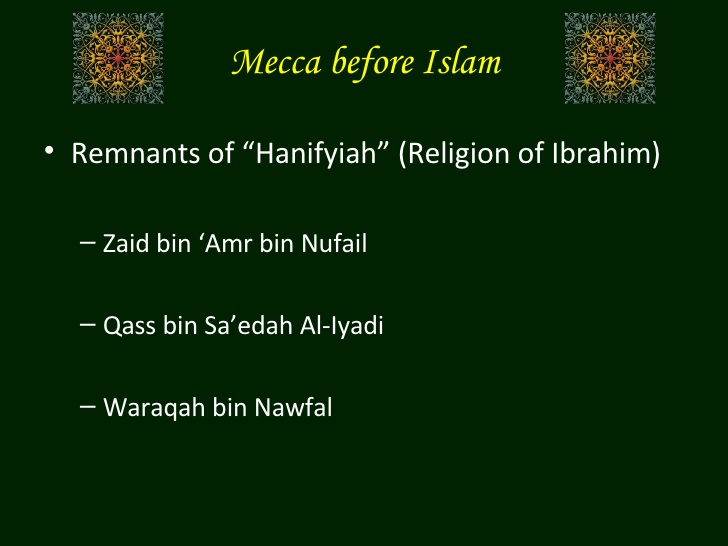
Zayd ibn Amr ibn Nufayl (died 605) was a monotheist and poet who lived in Mecca shortly before Islam.
The Promise of Paradise: The Prophet ﷺ said of Zaid: “He will be raised on the Day of Resurrection as a single nation [or like a nation], between me and ‘Isa (Jesus).”
Zaid bin ‘Amr ibn Nufail (رضي الله عنه) Being Upon Pure Monotheism (Al-Haneef)
Narrated ‘Abdullah bin ‘Umar (رضي الله عنه): The Prophet (ﷺ) met Zaid bin ‘Amr bin Nufail in the bottom of (the valley of) Baldah before any Divine Inspiration came to the Prophet (ﷺ). A meal was presented to the Prophet (ﷺ) but he refused to eat from it. (Then it was presented to Zaid) who said, “I do not eat anything which you slaughter in the name of your stone idols. I eat none but those things on which Allah’s Name has been mentioned at the time of slaughtering.”
Zaid bin ‘Amr used to criticize the way Quraysh used to slaughter their animals, and used to say, “Allah has created the sheep and He has sent the water for it from the sky, and He has grown the grass for it from the earth; yet you slaughter it in other than the Name of Allah. He used to say so, for he rejected that practice and considered it as something abominable.” [319]
Narrated ‘Abdullah bin ‘Umar (رضي الله عنه):
Zaid bin ‘Amr bin Nufail (رضي الله عنه) went to Shaam, inquiring about a true religion to follow. He met a Jewish religious scholar and asked him about their religion. He said, “I intend to embrace your religion, so tell me something about it.” The Jew said, “You will not embrace our religion unless you receive your share of Allah’s Anger.” Zaid (رضي الله عنه) said, “I do not run except from Allah’s Anger, and I will never bear a bit of it if I have the power to avoid it. Can you tell me of some other religion?” He said, “I do not know any other religion except the Haneef.” Zaid enquired, “What is Haneef?” He said, “Haneef is the religion of the Prophet) Ibraheem (عَلَيْهِ ٱلسَّلَامُ) who was neither a Jew nor a Christian, and he used to worship none but Allah (Alone)”
Then Zaid went out and met a Christian religious scholar and told him the same as before. The Christian said, “You will not embrace our religion unless you get a share of Allah’s Curse.” Zaid replied, “I do not run except from Allah’s Curse, and I will never bear any of Allah’s Curse and His Anger if I have the power to avoid them. Will you tell me of some other religion?” He replied, “I do not know any other religion except Haneef.”
Zaid enquired, “What is Haneef?” He replied, “Haneef is the religion of the Prophet) Ibraheem who was neither a Jew nor a Christian and he used to worship none but Allah (Alone)” When Zaid heard their Statement about the religion of) Ibraheem, he left that place, and when he came out, he raised both his hands and said, “O Allah! I make you my Witness that I am on the religion of Abraham.” [321]
Narrated Asma bint Abi Bakr (رضى الله عنها): “I saw Zaid bin ‘Amr bin Nufail (رضي الله عنه) standing with his back against the Ka’bah and saying, “O people of Quraysh! By Allah, none amongst you is on the religion of Abraham [322] except me.” He used to preserve the lives of little girls- If somebody wanted to kill his daughter he would say to him, “Do not kill her for I will feed her on your behalf.”
So he would take her, and when she grew up nicely, he would say to her father, “Now if you want her, I will give her to you, and if you wish, I will feed her on your behalf.” [323]
[319] Sahih Al-Bukhari 3826.;[321] Sahih Al-Bukhari 3827;[322] Prophet Ibraheem (عَلَيْهِ ٱلسَّلَامُ); [323] Sahih Al-Bukhari 3828.
Family
He was the son of Amr ibn Nufayl, a member of the Adi clan of the Quraysh tribe.[1]: 296 Zayd’s mother had previously been married to his grandfather, Nufayl ibn Abduluzza, so her son from this marriage, al-Khattab ibn Nufayl, was at the same time Zayd’s maternal half-brother and paternal half-uncle.[2]: 101
Zayd married Fatima bint Baaja from the Khuza’a tribe, and their son was Sa’id ibn Zayd.[1]: 296 A subsequent wife, Umm Kurz Safiya bint al-Hadrami, bore his daughter Atiqa.[3]: 186
Religious beliefs- Wikepedia Reference
Abandonment of idols
According to the Islamic historians Ibn Ishaq and Ibn Sa’d, Zayd became disillusioned with the traditional religion of Arabia, for the stone that the people worshipped “could neither hear nor see nor hurt nor help”[2]: 99 and “the worship of stone or hewn wood is nothing.”[1]: 296 He pledged with three friends that they would seek the true religion of Abraham, which they called al-Hanafiya. The other three men eventually converted to Christianity.[2]: 99 Another of his friends was Abdul-Muttalib.[4]
Zayd travelled to Syria to question both Jews and Christians about their beliefs, but he was not happy with the answers of either group. According to later Muslim historians, he had “the religion of Abraham, following the natural form” and “worshipped Allah alone with no partner.”[1]: 296 [5] Amir ibn Rabi’a, an ally of al-Khattab, later said that Zayd had told him that he believed in the future coming of a prophet.[1]: 296, 302
Monotheistic beliefs
Three points of Zayd’s religious beliefs are mentioned in traditional Islamic sources. First, he did not worship idols and he rebuked the Quraysh for doing so.[2]: 99 Asma bint Abi Bakr heard him declaring outside the Kaaba: “O Quraysh, none of you is following Abraham’s religion except me.“[2]: 99, 100 [1]: 297 He composed this poem:
Am I to worship one lord or a thousand?
If there are as many as you claim,
I renounce al-Lat and al-Uzza, both of them,
as any strong-minded person would.
I will not worship al-Uzza and her two daughters …
I will not worship Hubal, though he was our lord
in the days when I had little sense.[2]: 100
Second, he modified his diet. He did not eat carrion, blood or anything that had been slaughtered for an idol.[2]: 99 He told the Quraysh: “Allah has created the sheep and he has sent the rain and the grass for it; yet you don’t mention Allah’s name when you slaughter it.”[6]
Third, he opposed infanticide. He rescued infant girls who were about to be buried alive and brought them up in his own house. When the girls had grown older, he would offer their fathers a choice between taking their daughters back or leaving them to be supported at Zayd’s expense.[1]: 297–298
Journeys and Death
Finding it impossible to stay in Makkah, he left the Hijaaz and went as far as Mosul in the north of Iraq and from there southwest into Syria. Throughout his journeys, he always questioned monks and rabbis about the religion of Ibrahim. He found no satisfaction until he came upon a monk in Syria who told him that the religion he was seeking did not exist any longer but the time was now near when God would send forth, from his own people whom he had left, a Prophet who would revive the religion of Ibrahim. The monk advised him that should he see this Prophet he should have no hesitation in recognizing and following him.
Zayd retraced his steps and headed for Makkah intending to meet the expected Prophet. As he was passing through the territory of Lakhm on the southern border of Syria he was attacked by a group of nomad Arabs and killed before he could arrive at Meccah. According to Islamic sources, before he died, he raised his eyes to the heavens and said:
O Lord, if You have prevented me from attaining this good, do not prevent my son from doing so.
His son Sa’id bin Zayd was one of the first converts to Islam, and amongst the special group of 10 people that were promised Jannah in a famous hadith.
Waraka ibn Nawfal is said to have composed an elegy for him:
You were altogether on the right path, Ibn Amr;
You have escaped Hell’s burning oven
by serving the one and only God
and abandoning vain idols …
for the mercy of God reaches men
though they be seventy valleys deep below the earth.[2]: 103







 bismillahschool.net