Sister Maryam:
Teacher, Traveller; Tutoring Services - English, Math, Islamic Studies;
Worked with Kids/ students from the ages 4 to 18 - in elementary school, hischool and madrasah tutoring;
Drax to stop burning B.C. wood pellets for U.K. energy: A significant milestone for the climate
March 12, 2026
səl̓ílwətaʔɬ (Tsleil-Waututh), xʷməθkwəy̓əm (Musqueam) and Skwxwú7mesh (Squamish) Territories (Vancouver, B.C.) — International energy giant Drax has begun to phase out burning forest biomass from British Columbia at its power station in the United Kingdom. As reported by The Guardian, Drax will stop burning “controversial” wood from forests in Canada at its North Yorkshire power station within the next year.
This is a significant milestone. It demonstrates that burning forest biomass to generate energy at utility-scale is untenable and sends a warning signal to all governments and investors currently supporting the global biomass industry: this dirty form of energy is a weak economic proposition.
B.C.’s failure to properly protect old growth and enact a biodiversity law have been exposed on the international stage. As other countries examine their wood pellet supply chains, the facts are clear – there is no sustainable way to source biomass for export from forests in B.C.
This move by Drax follows years of political controversy and public outcry in the U.K. over the company’s Canadian sourcing practices. Most recently, a Stand.earth investigation confirmed that Drax purchased whole logs cut from old growth forests in 2024, and very likely in 2025. This conclusive finding adds to an existing body of evidence in reports, documentaries, and whistleblower testimony.
However, the broader problems with the biomass export industry in Canada continue. While the company will no longer burn biomass from B.C. in the U.K., Drax continues to hold a near-monopoly on wood pellet production in the province, and is likely to continue sourcing from old growth and primary forests to supply customers in Asian and European countries.
Narrated Anas bin Malik: Hudhaifa bin Al-Yaman came to `Uthman at the time when the people of Sham and the people of Iraq were Waging war to conquer Arminya and Adharbijan. Hudhaifa was afraid of their (the people of Sham and Iraq) differences in the recitation of the Qur’an, so he said to `Uthman, “O chief of the Believers! Save this nation before they differ about the Book (Qur’an) as Jews and the Christians did before.” So `Uthman sent a message to Hafsa saying, “Send us the manuscripts of the Qur’an so that we may compile the Qur’anic materials in perfect copies and return the manuscripts to you.” Hafsa sent it to `Uthman. `Uthman then ordered Zaid bin Thabit, `Abdullah bin AzZubair, Sa`id bin Al-As and `AbdurRahman bin Harith bin Hisham to rewrite the manuscripts in perfect copies. `Uthman said to the three Quraishi men, “In case you disagree with Zaid bin Thabit on any point in the Qur’an, then write it in the dialect of Quraish, the Qur’an was revealed in their tongue.” They did so, and when they had written many copies, `Uthman returned the original manuscripts to Hafsa. `Uthman sent to every Muslim province one copy of what they had copied, and ordered that all the other Qur’anic materials, whether written in fragmentary manuscripts or whole copies, be burnt.
Reference – Sahid al Bukhari 4987, Book 66; Hadith 9; #Tashhkent copy;
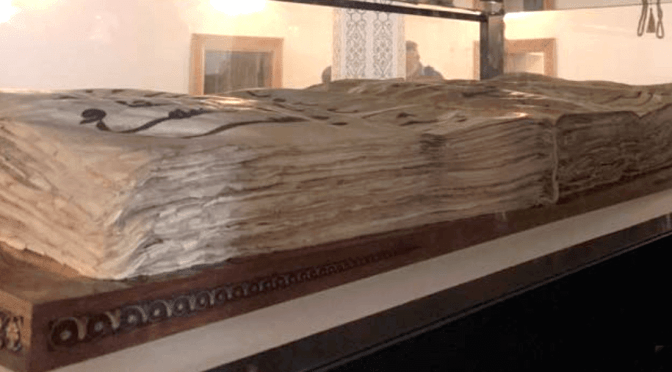
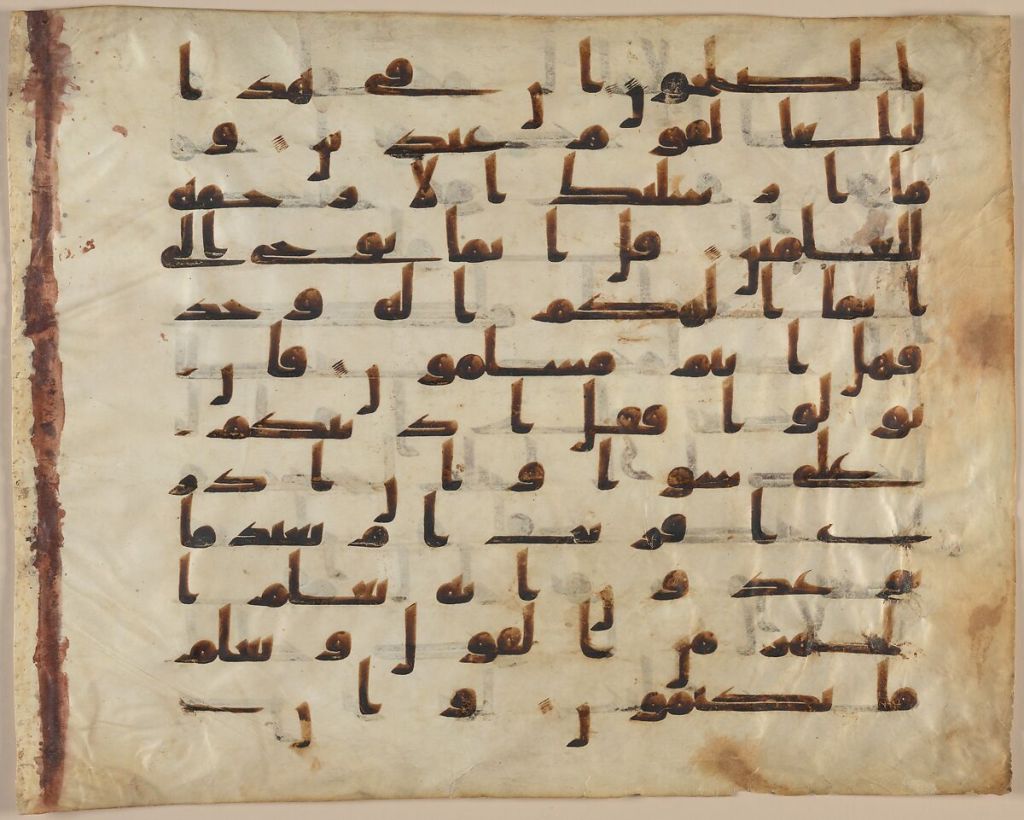
Folio from the “Tashkent Qur’an”
late 8th–early 9th century
Magnificent in size, this folio comes from one of the oldest surviving Qur’an manuscripts in existence. It is written in an early version of the kufic script with no diacritical marks (tashkeel) to distinguish the letters, and with very limited illumination. Based on the form of the script, and the illuminations that do survive on other pages from this Qur’an, the book has been attributed to Cairo, Egypt; Damascus, Syria; or Sana’a, Yemen. About one third of the original manuscript is housed in the Hast-Imam Library in Tashkent, Uzbekistan.
At that time, there were no printing presses. Books had to be written manually by specialized scribes and making a copy required a similar effort. The Quran was dictated word by word and letter by letter by the Prophet himself to specialized scribes.[1] The Prophet passed away in 632 AD. Afterwards, Abu Bakr, the first leader of the Muslims, gathered the original scripts of the scribes into one book, and then some time later, when the Muslim empire stretched from East to West, Uthman, the son-in-law of the Prophet and the third Caliph, ordered five copies of the original to be made and distributed to all parts of the Muslim world some twenty years later.[2]
Today, we have three manuscripts of Quran which are traced back to the Prophet’s son-in-law, the Caliph Uthman.
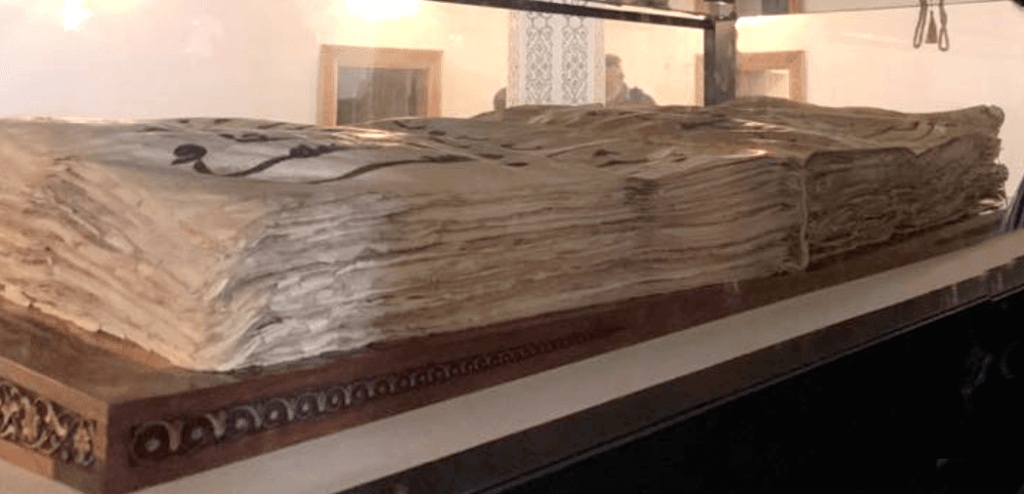
(1) The Samarqand Manuscript located in Tashkent, Uzbekistan. It is written on a parchment from gazelle skin. According to Memory of the World Program, UNESCO, an arm of the United Nations, ‘it is the definitive version, known as the Mushaf of Uthman, superseding all other versions.’[3]
Figure 1 This manuscript, held by the Muslim Board of Uzbekistan, is the earliest existent written version of the Quran. It is the definitive version, known as the Mushaf of Othman, superseding all other versions. Image courtesy of Memory of the World Register, UNESCO.
Figure 2 The Holy Quran of Othman in its glass-fronted safe. Image courtesy of Memory of the World Register, UNESCO.
The Surahs in Juz Amma, often referred to as Qisar as-Suwar (the shortest Surahs), are largely Meccan, meaning they were revealed during the Prophet Muhammad’s (peace be upon him) early, challenging years in Makkah. This historical context shapes their powerful, foundational themes:
The Oneness of Allah / God(Tawhid): Many Surahs, most notably Al-Ikhlas (The Sincerity), offer a clear, unambiguous declaration of monotheism.
The Day of Judgment (Qiyamah): A dominant theme, with vivid and striking descriptions of the cataclysmic events that will precede the Day, the resurrection, and the ultimate accountability for human deeds (An-Naba’, At-Takwir, Al-Infitar).
Prophethood and Revelation: The Surahs remind believers of the truth of the Quran as a Divine message, offering solace to the Prophet and the early Muslim community (Al-‘Alaq, Ad-Dhuha, Ash-Sharh).
Moral and Social Rectitude: Condemnation of moral failings like dishonesty, backbiting, and the pursuit of excessive wealth (Al-Mutaffifin, Al-Humazah, At-Takathur).
Seeking Protection:The final three Surahs (Al-Ikhlas, Al-Falaq, and An-Nas), collectively known as the Mu’awwidhat, are revered for their profound role in seeking refuge and protection from Allah.
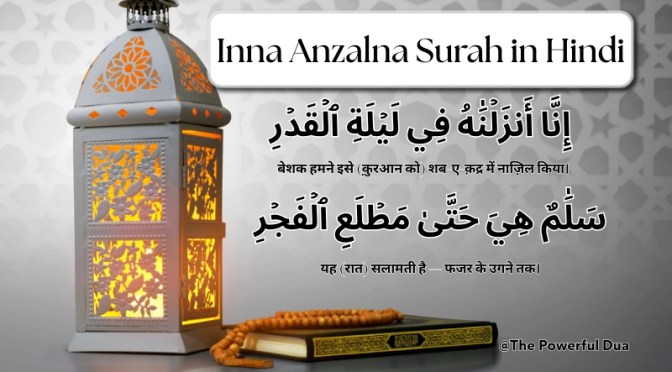
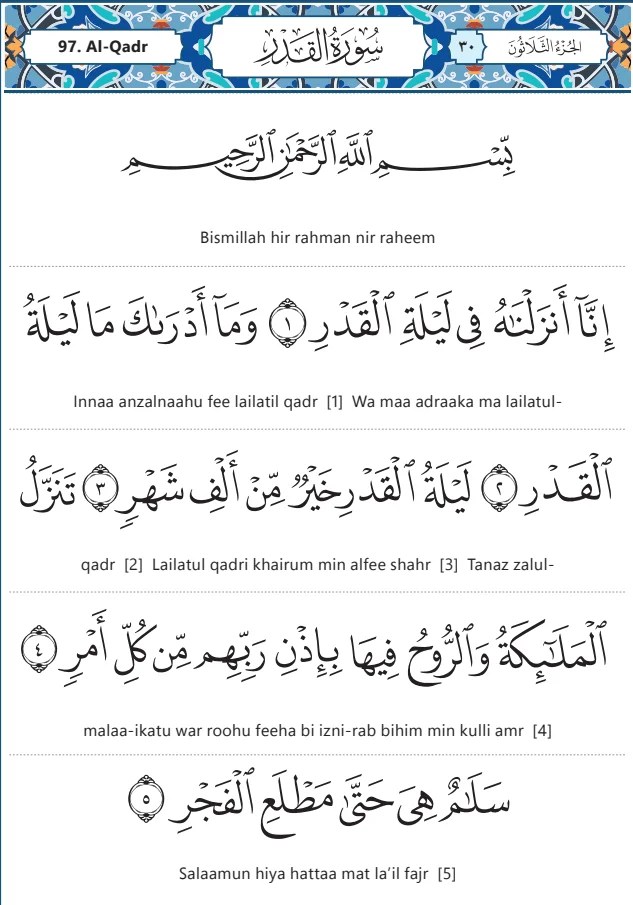
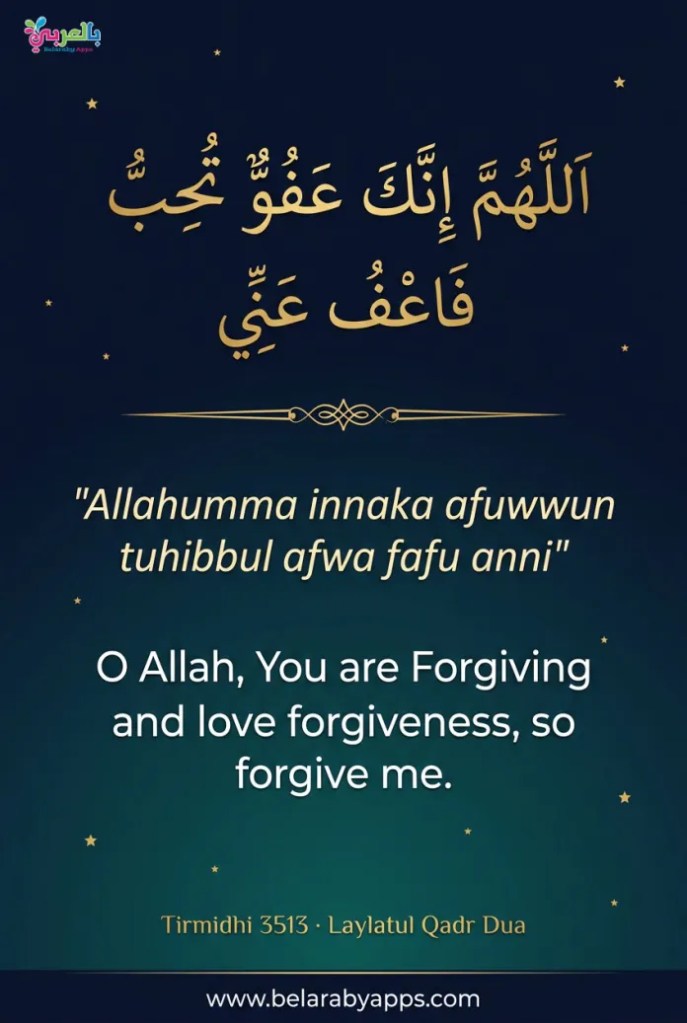
إِنَّا أَنْزَلْنَاهُ فِي لَيْلَةِ الْقَدْرِ Innā anzalnāhu fī laylati-l-qadr Indeed, We sent it down on the Night of Decree.
2. وَمَا أَدْرَاكَ مَا لَيْلَةُ الْقَدْرِ Wa mā adrāka mā laylatu-l-qadr And what can make you know what is the Night of Decree?
3. لَيْلَةُ الْقَدْرِ خَيْرٌ مِنْ أَلْفِ شَهْرٍ Laylatu-l-qadri khayrun min alfi shahr The Night of Decree is better than a thousand months.
4. تَنَزَّلُ الْمَلَائِكَةُ وَالرُّوحُ فِيهَا بِإِذْنِ رَبِّهِمْ مِنْ كُلِّ أَمْرٍ Tanazzalu-l-malā’ikatu wa-r-rūḥu fīhā bi’idhni rabbihim min kulli amr The angels and the Spirit descend therein by permission of their Lord for every matter.
5. سَلَامٌ هِيَ حَتَّىٰ مَطْلَعِ الْفَجْرِ Salāmun hiya ḥattā maṭla’il-fajr Peace it is until the emergence of dawn.
Believe in Allah(God AllMighty) – doing Good and forbidding Evil, Paradise and Hellfire – and helping people believe in the afterlife and improve themselves to achieve best in afterlife;
(And of Ibrahim (Abraham) who fulfilled (or conveyed) all that (Allah ordered him to do or convey)) (53:37) -meaning, he was truthful and he was obedient to Allah’s legislation. Also, Allah said,
(Verily, Ibrahim was an Ummah (or a nation), obedient to Allah, Hanif (i.e. to worship none but Allah), and he was not one of those who were Al-Mushrikin (polytheists), (He was) thankful for His (Allah’s) favors. He (Allah) chose him and guided him to a straight path. And We gave him good in this world, and in the Hereafter he shall be of the righteous. Then, We have sent the revelation to you (O Muhammad saying): “Follow the religion of Ibrahim Hanif (Islamic Monotheism ـ to worship none but Allah) and he was not of the Mushrikin.) (16:120-123)
(Say (O Muhammad ): “Truly, my Lord has guided me to a straight path, a right religion, the religion of Ibrahim, Hanifan, and Ibrahim (to worship none but Allah, alone) and he was not of Al-Mushrikin.”/ not of Idolaters) (6:161) and,
(Ibrahim was neither a Jew nor a Christian, but he was a true Muslim Hanifan (Islamic Monotheism ـ to worship none but Allah alone) and he was not of Al-Mushrikin. Verily, among mankind who have the best claim to Ibrahim are those who followed him, and this Prophet (Muhammad ) and those who have believed (Muslims). And Allah is the Wali (Protector and Helper) of the believers) (3:67-68).
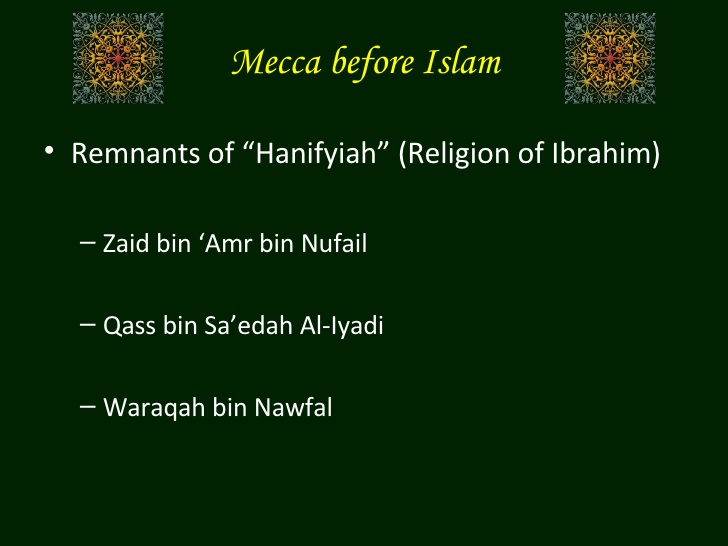
Zayd ibn Amr ibn Nufayl (died 605) was a monotheist and poet who lived in Mecca shortly before Islam.
The Promise of Paradise: The Prophet ﷺ said of Zaid: “He will be raised on the Day of Resurrection as a single nation [or like a nation], between me and ‘Isa (Jesus).”
Zaid bin ‘Amr ibn Nufail (رضي الله عنه) Being Upon Pure Monotheism (Al-Haneef)
Narrated ‘Abdullah bin ‘Umar (رضي الله عنه): The Prophet (ﷺ) met Zaid bin ‘Amr bin Nufail in the bottom of (the valley of) Baldah before any Divine Inspiration came to the Prophet (ﷺ). A meal was presented to the Prophet (ﷺ) but he refused to eat from it. (Then it was presented to Zaid) who said, “I do not eat anything which you slaughter in the name of your stone idols. I eat none but those things on which Allah’s Name has been mentioned at the time of slaughtering.”
Zaid bin ‘Amr used to criticize the way Quraysh used to slaughter their animals, and used to say, “Allah has created the sheep and He has sent the water for it from the sky, and He has grown the grass for it from the earth; yet you slaughter it in other than the Name of Allah. He used to say so, for he rejected that practice and considered it as something abominable.” [319]
Narrated ‘Abdullah bin ‘Umar (رضي الله عنه):
Zaid bin ‘Amr bin Nufail (رضي الله عنه) went to Shaam, inquiring about a true religion to follow. He met a Jewish religious scholar and asked him about their religion. He said, “I intend to embrace your religion, so tell me something about it.” The Jew said, “You will not embrace our religion unless you receive your share of Allah’s Anger.” Zaid (رضي الله عنه) said, “I do not run except from Allah’s Anger, and I will never bear a bit of it if I have the power to avoid it. Can you tell me of some other religion?” He said,“I do not know any other religion except the Haneef.” Zaid enquired, “What is Haneef?” He said, “Haneef is the religion of the Prophet) Ibraheem (عَلَيْهِ ٱلسَّلَامُ) who was neither a Jew nor a Christian, and he used to worship none but Allah (Alone)”
Then Zaid went out and met a Christian religious scholar and told him the same as before. The Christian said,“You will not embrace our religion unless you get a share of Allah’s Curse.”Zaid replied, “I do not run except from Allah’s Curse, and I will never bear any of Allah’s Curse and His Anger if I have the power to avoid them. Will you tell me of some other religion?”He replied, “I do not know any other religion except Haneef.”
Zaid enquired, “What is Haneef?” He replied, “Haneef is the religion of the Prophet) Ibraheem who was neither a Jew nor a Christian and he used to worship none but Allah (Alone)” When Zaid heard their Statement about the religion of) Ibraheem, he left that place, and when he came out, he raised both his hands and said, “O Allah! I make you my Witness that I am on the religion of Abraham.” [321]
Narrated Asma bint Abi Bakr (رضى الله عنها): “I saw Zaid bin ‘Amr bin Nufail (رضي الله عنه) standing with his back against the Ka’bah and saying, “O people of Quraysh! By Allah, none amongst you is on the religion of Abraham [322] except me.”He used to preserve the lives of little girls- If somebody wanted to kill his daughter he would say to him, “Do not kill her for I will feed her on your behalf.”
So he would take her, and when she grew up nicely, he would say to her father, “Now if you want her, I will give her to you, and if you wish, I will feed her on your behalf.” [323]
[319] Sahih Al-Bukhari 3826.;[321] Sahih Al-Bukhari 3827;[322] Prophet Ibraheem (عَلَيْهِ ٱلسَّلَامُ); [323] Sahih Al-Bukhari 3828.
Family
He was the son of Amr ibn Nufayl, a member of the Adi clan of the Quraysh tribe.[1]: 296 Zayd’s mother had previously been married to his grandfather, Nufayl ibn Abduluzza, so her son from this marriage, al-Khattab ibn Nufayl, was at the same time Zayd’s maternal half-brother and paternal half-uncle.[2]: 101
Zayd married Fatima bint Baaja from the Khuza’a tribe, and their son was Sa’id ibn Zayd.[1]: 296 A subsequent wife, Umm Kurz Safiya bint al-Hadrami, bore his daughter Atiqa.[3]: 186
Religious beliefs- Wikepedia Reference
Abandonment of idols
According to the Islamic historians Ibn Ishaq and Ibn Sa’d, Zayd became disillusioned with the traditional religion of Arabia, for the stone that the people worshipped “could neither hear nor see nor hurt nor help”[2]: 99 and “the worship of stone or hewn wood is nothing.”[1]: 296 He pledged with three friends that they would seek the true religion of Abraham, which they called al-Hanafiya. The other three men eventually converted to Christianity.[2]: 99 Another of his friends was Abdul-Muttalib.[4]
Zayd travelled to Syria to question both Jews and Christians about their beliefs, but he was not happy with the answers of either group. According to later Muslim historians, he had “the religion of Abraham, following the natural form” and “worshipped Allah alone with no partner.”[1]: 296 [5]Amir ibn Rabi’a, an ally of al-Khattab, later said that Zayd had told him that he believed in the future coming of a prophet.[1]: 296, 302
Monotheistic beliefs
Three points of Zayd’s religious beliefs are mentioned in traditional Islamic sources. First, he did not worship idols and he rebuked the Quraysh for doing so.[2]: 99 Asma bint Abi Bakr heard him declaring outside the Kaaba: “O Quraysh, none of you is following Abraham’s religion except me.“[2]: 99, 100 [1]: 297 He composed this poem:
Am I to worship one lord or a thousand? If there are as many as you claim, I renounce al-Lat and al-Uzza, both of them, as any strong-minded person would. I will not worship al-Uzza and her two daughters … I will not worship Hubal, though he was our lord in the days when I had little sense.[2]: 100
Second, he modified his diet. He did not eat carrion, blood or anything that had been slaughtered for an idol.[2]: 99 He told the Quraysh: “Allah has created the sheep and he has sent the rain and the grass for it; yet you don’t mention Allah’s name when you slaughter it.”[6]
Third, he opposed infanticide. He rescued infant girls who were about to be buried alive and brought them up in his own house. When the girls had grown older, he would offer their fathers a choice between taking their daughters back or leaving them to be supported at Zayd’s expense.[1]: 297–298
Journeys and Death
Finding it impossible to stay in Makkah, he left the Hijaaz and went as far as Mosul in the north of Iraq and from there southwest into Syria. Throughout his journeys, he always questioned monks and rabbis about the religion of Ibrahim. He found no satisfaction until he came upon a monk in Syria who told him that the religion he was seeking did not exist any longer but the time was now near when God would send forth, from his own people whom he had left, a Prophet who would revive the religion of Ibrahim. The monk advised him that should he see this Prophet he should have no hesitation in recognizing and following him.
Zayd retraced his steps and headed for Makkah intending to meet the expected Prophet. As he was passing through the territory of Lakhm on the southern border of Syria he was attacked by a group of nomad Arabs and killed before he could arrive at Meccah. According to Islamic sources, before he died, he raised his eyes to the heavens and said:
O Lord, if You have prevented me from attaining this good, do not prevent my son from doing so.
His son Sa’id bin Zayd was one of the first converts to Islam, and amongst the special group of 10 people that were promised Jannah in a famous hadith.
You were altogether on the right path, Ibn Amr; You have escaped Hell’s burning oven by serving the one and only God and abandoning vain idols … for the mercy of God reaches men though they be seventy valleys deep below the earth.[2]: 103
#Zayd bin Amr bin Nufail, #Story, #Abraham, #Haneef, #monotheism, #taking care of orphans, #Muslim diet, #abandoning idolatry; #faith;
SUPPORT LOCAL WELFARE We operate four food banks across Canada, serving over 112,000 people in 2024 alone. Hot meals go out to Toronto’s homeless every weekend, and seniors receive meal delivery twice weekly across the GTA. A long-term care facility is underway for seniors on the verge of homelessness.
This is what your Zakat funds. Give locally, help your neighbours in the holiest month. SUPPORT GLOBAL WELFARE Since 2005, we’ve built 3,800 water wells across Pakistan, serving 321,000 people. Over 1,000 children attend our schools right now because of monthly sponsors. 75 deaf students receive specialized education that would otherwise be impossible for them.
Emergency relief reaches Gaza, Yemen, and Sudan through established partners. Your Zakat and Sadaqah Jariyah work across crisis zones and sustainable projects.
Support Women & Children In Need
When a drought strikes, women and children are the ones that are most at risk. This is why MWC supports pregnant women suffering in Tharparkar, a desert region of Pakistan.
Why Your Support Matters?
Your support will allow us to continue our lifesaving work in the desert region of Tharparkar. Here’s what we’ve achieved and aim to build upon with your support:
Enhanced hygiene and disease prevention education to boost community health and support Pakistan’s healthcare system.
Focused maternal and child health initiatives to promote safer pregnancies and lower mortality rates.
Improved prenatal care contributing to healthier mothers and babies.
Nutritional education to help reshape dietary choices and reduce malnutrition.
Overcoming Challenges
Despite limited healthcare, harsh environmental conditions and other obstacles, we have implemented nutritional improvement initiatives, enhanced access to healthcare services, and provided specialized care for safe childbirth and prenatal care.
#Muslim welfare center; #Zakat; #Islam; #charity; women prenatal and natal care, #children care;
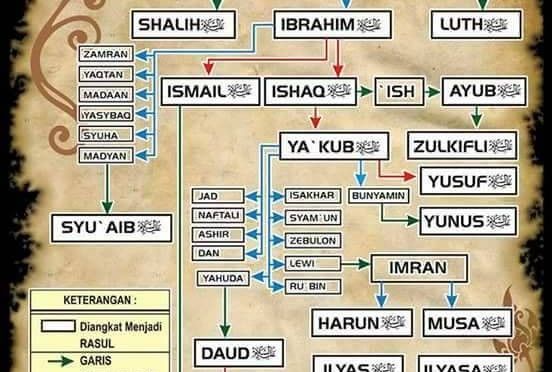
Surah Baqarah 136 – Say, ˹O believers,˺ “We believe in Allah and what has been revealed to us; and what was revealed to Abraham, Ishmael, Isaac, Jacob, and his descendants; and what was given to Moses, Jesus, and other prophets from their Lord. We make no distinction between any of them. And to Allah we all submit.”
“We have sent you with the Truth as a bearer of good news and warning– every community has been sent a warner.” (Qur’an 35:24) (News of Paradise for the Believers and HellFire for the Disbelievers);
All prophets in Islam came with the message of Tawhid (Oneness of God – wroshipping God Alone). It was only a difference in the Shariah (commandments and laws) of each Divine religion that set it apart from the others. It should be noted that all prophets propagated the same message of Islam throughout all ages, Tawhid, which is the core of all Divine religions. Allah Almighty mentions in the Qur’an:
“We sent a messenger to every community, saying, ‘Worship God and shun false gods.’”(Qur’an 16:36)
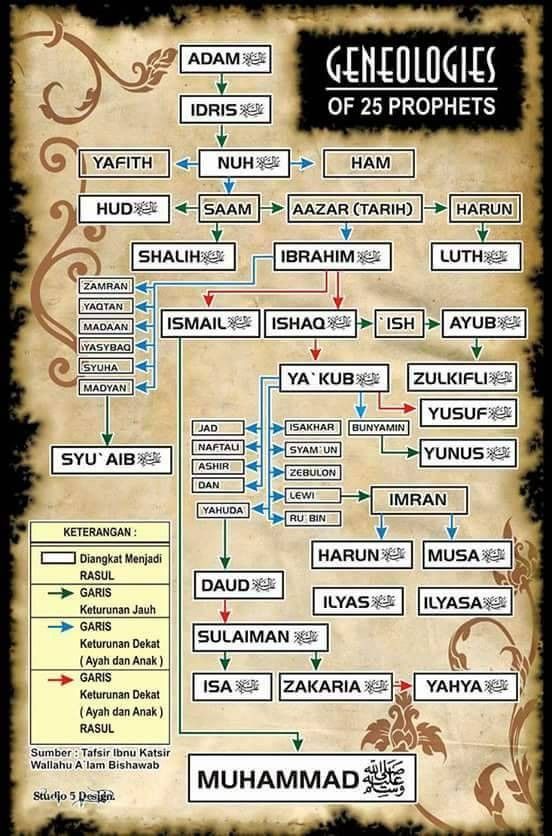
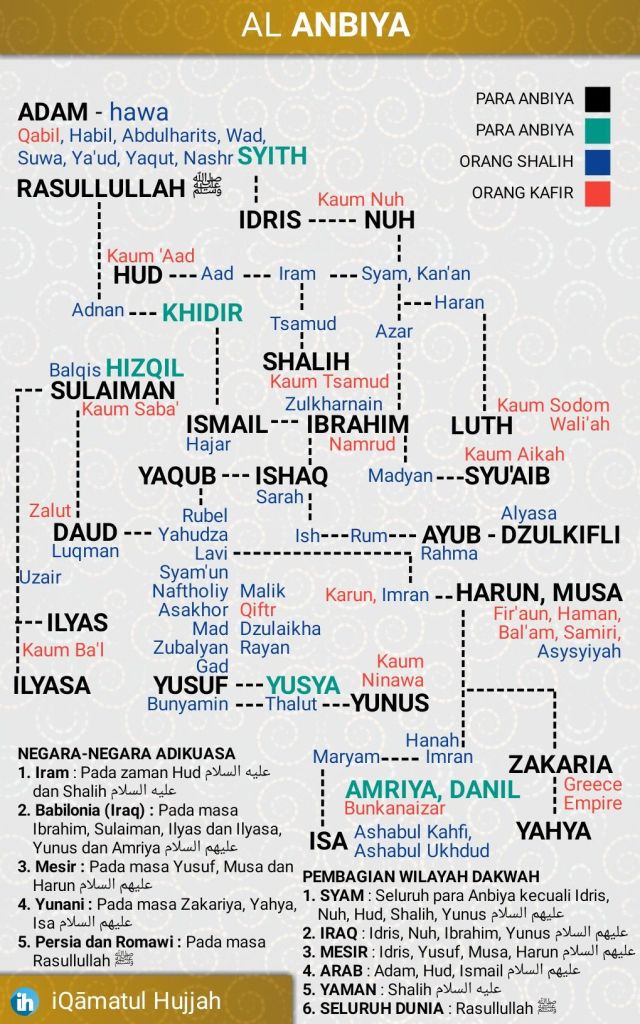
“We have sent revelation to you [Prophet] as We did to Noah and the prophets after him, to Abraham, Ishmael, Isaac, Jacob, and the Tribes, to Jesus, Job, Jonah, Aaron, and Solomon- to David We gave the book [of Psalms]- to other messengers We have already mentioned to you, and also to some We have not. To Moses God spoke directly.” (Qur’an 4:163-164)
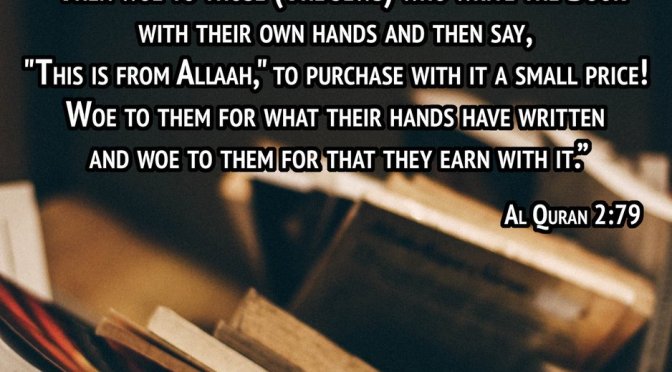
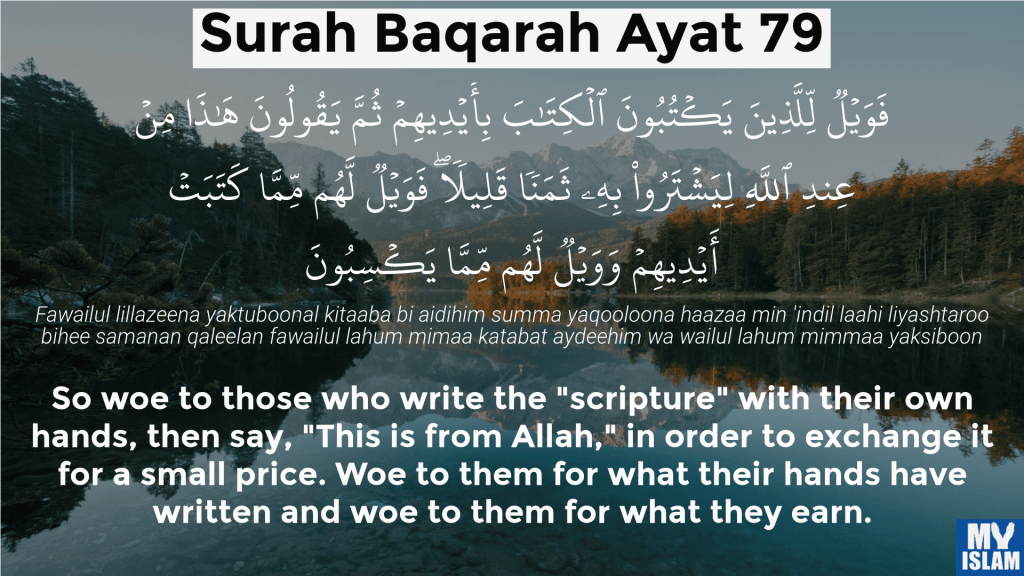
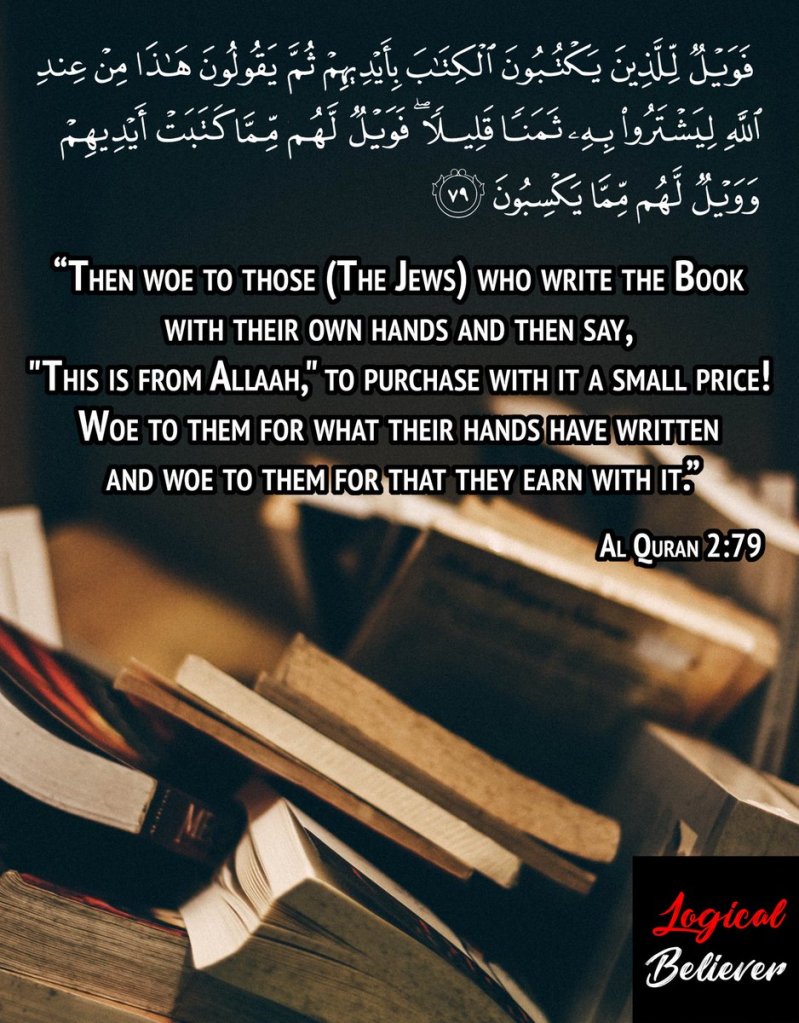
79 –So woe to those who write the “scripture” with their own hands, then say, “This is from Allah,” in order to exchange it for a small price. Woe to them for what their hands have written and woe to them for what they earn.
77. Do they not know that God knows what they conceal and what they reveal? 78. And among them are uneducated who know the Scripture only through hearsay, and they only speculate.
79. So woe to those who write the Scripture with their own hands, and then say, “This is from God,” that they may exchange it for a little price. Woe to them for what their hands have written, and woe to them for what they earn.
80. And they say, “The Fire will not touch us except for a number of days.” Say, “Have you received a promise from God—God never breaks His promise—or are you saying about God what you do not know?”
(2:78) Among them are also the unlettered folk who do not know about the Scriptures but cherish baseless wishes and merely follow their conjectures.[89]
89. This was the state of the Jewish masses. They were ignorant of the Scriptures, unaware of the principles of faith as enunciated by God in His Book, unaware of the rules of conduct that He had laid down, and of the teachings which are of fundamental importance for man’s salvation. Because they lacked this knowledge, they fabricated a whole religion out of their desires and fancies, living in a paradise built on false hopes and illusions.
Ala-Maududi
(2:79) Woe, then, to those who write out the Scriptures with their own hands and then, in order to make a trifling gain, claim: “This is from Allah.”[90] Woe to them for what their hands have written and woe to them for what they thus earn.
90. These observations relate to their rabbis. They were not content with misinterpreting the Word of God. They also interjected into it their readings of the Scriptures and their explanatory comments thereof, stories from their national history, superstitious ideas and fancies, philosophical doctrines and legal rules. The result was that the Divine and the human became inextricably mixed. They claimed, nevertheless, that the entire thing was divine! Every historical anecdote, the interpretation of every commentator, the doctrine of every theologian, and the legal deduction of every jurist that managed to find its way into the Bible became the ‘Word of God’. It was thus obligatory to believe in all that, and every deviation from it became tantamount to deviation from the true faith.
Ala-Maududi
(2:80) They say: “The Fire will certainly not touch us except for a limited number of days.”[91] Say (to them): “Have you received a promise from Allah – for Allah never breaks His promise – or do you attribute to Allah something about which you have no knowledge?”
91. This is a misconception entertained by all Jews, laymen as well as rabbis. They felt sure that no matter what they did, they would remain immune from hell-fire just by virtue of being Jews! The worst they could conceive of was the possibility of a transient punishment before they were transported to heaven.
#Chaging the Torah; #Quran Kareem, #Corruption of the Scholars/ Rabbis;
93. And We made a covenant with you, and raised the Mount above you: “Take what We have given you firmly, and listen.” They said, “We hear and disobey.” And their hearts became filled with the love of the calf because of their disbelief. Say, “Wretched is what your faith commands you to do, if you are believers.”
94. Say, “If the Final Home with God is yours alone, to the exclusion of all other people, then wish for death if you are sincere.”
95. But they will never wish for it, because of what their hands have forwarded. God is aware of the evildoers.
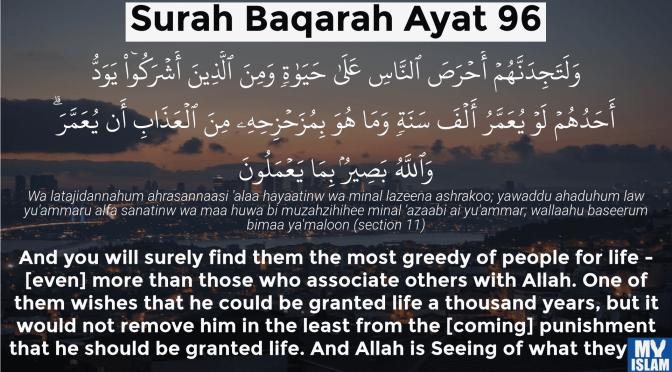
96. You will find them, of all mankind, the most eager for life, even more than the polytheists. Every one of them wishes he could live a thousand years; but to be granted a long life will not nudge him from the punishment. God is Seeing of what they do.
97. Say, “Whoever is hostile to Gabriel—it is he who revealed it to your heart by God’s leave, confirming what preceded it, and guidance and good news for the believers.”
98. Whoever is hostile to God, and His angels, and His messengers, and Gabriel, and Michael—God is hostile to the faithless.
99. We have revealed to you clear signs, and none rejects them except the sinners.
#Jews; #Eager/ Love of the Dunia/ Temporary Life; #Quran Kareem; #Life of 1,000 years;
SUMMARY: People drank alcohol before it was prohibited and were killed as martyrs on the same day.
Narrated Jabir: Some people drank alcoholic beverages in the morning (of the day) of the Uhud battle and on the same day they were killed as martyrs, and that was before wine was prohibited.
This hadith is about a group of people who drank alcohol in the morning of the Battle of Uhud, before it was prohibited. They were then killed as martyrs on that same day. This hadith teaches us that even though drinking alcohol was not yet prohibited, it still led to their death and they were still considered martyrs. It also shows us that even if something is not explicitly forbidden, we should still be careful with our actions and think about how they will affect us in the long run. We should also strive to do good deeds so that we can be rewarded for them in this life or the hereafter.









 bismillahschool.net