Chapter: To inflict the legal punishment on the noble and the weak people
Usama approached the Prophet (ﷺ) on behalf of a woman (who had committed theft). The Prophet (ﷺ) said, “The people before you were destroyed because they used to inflict the legal punishments on the poor and forgive the rich. By Him in Whose Hand my soul is! If Fatima (the daughter of the Prophet (ﷺ) ) did that (i.e. stole), I would cut off her hand.”
The word يحيى mentioned in Quran. Quranic Verses about Yahya/ John
Surah Maryam/ Mary 19:15
وسلام عليه يوم ولد ويوم يموت ويوم يبعث حيا ١٥
ﱢPeace be upon him the day he was born, and the day of his death, and the day he will be raised back to life!
The Birth of the Boy and His Characteristics
This also implies what is not mentioned, that this promised boy was born and he was Yahya. There is also the implication that Allah taught him the Book, the Tawrah which they used to study among themselves. The Prophets who were sent to the Jews used to rule according to the Tawrah, as did the scholars and rabbis among them. He was still young in age when Allah gave him this knowledge. This is the reason that Allah mentioned it. Because of how Allah favored him and his parents, He says,
ييَحْيَى خُذِ الْكِتَـبَ بِقُوَّةٍ
(O Yahya! Hold fast to the Scripture the Tawrah.) Means, “Learn the Book with strength.” In other words, learn it well, with zeal and studious effort.
وَآتَيْنَاهُ الْحُكْمَ صَبِيّاً
(And We gave him wisdom while yet a child.) This means he was given understanding, knowledge, fortitude, diligence and zeal for good and the pursuit of good. He was blessed with these characteristics even though he was young. Allah said,
وَحَنَانًا مِّن لَّدُنَّا
(And (made him) Hananan from Us,) 19:13 Ali bin Abi Talhah reported that Ibn `Abbas said,
وَحَنَانًا مِّن لَّدُنَّا
(And Hananan from Us, ) “This means mercy from Us.” `Ikrimah, Qatadah and Ad-Dahhak all said the same. Ad-Dahhak added, “Mercy that no one would be able to give except Us.” Qatadah added, “With it, Allah had mercy upon Zakariyya.” Mujahid said,
وَحَنَانًا مِّن لَّدُنَّا
(And Hananan from Us,) “This was gentleness from His Lord upon him.” The apparent meaning is that Allah’s statement Hananan (affection, compassion) is directly related to His statement,
وَآتَيْنَاهُ الْحُكْمَ صَبِيّاً
(and We gave him wisdom while yet a child.) meaning, “We gave him wisdom, compassion and purity.” This means that he was a compassionate man, who was righteous. Hanan means the love for affection and tenderness (towards others). Concerning Allah’s statement,
وَزَكَوةً
(and Zakatan,) This is related to His statement,
وَحَنَانًا
(And Hananan) The word Zakah means purity from filth, wickedness and sins. Qatadah said, “The word Zakah means the righteous deed.” Ad-Dahhak and Ibn Jurayj both said, “The righteous deed is the pure (Zakah) deed.” Al-`Awfi reported that Ibn `Abbas said, وَزَكَوةً
(and Zakatan,) “This means that he was a blessing.” وَكَانَ تَقِيًّا
(and he was pious.)19:13 meaning that he was pure and had no inclination to do sins. Allah said;
(And dutiful to his parents, and he was not arrogant or disobedient.) After Allah mentioned Yahya’s obedience to his Lord and that Allah created him full of mercy, purity and piety, He attached to it his obedience to his parents and his good treatment of them. Allah mentioned that he refrained from disobeying them in speech, actions, commands and prohibitions. Due to this Allah says,
وَلَمْ يَكُن جَبَّاراً عَصِيّاً
(and he was not arrogant or disobedient.) Then, after mentioning these beautiful characteristics, Allah mentions his reward for this,
(And Salam (peace) be on him the day he was born, and the day he dies, and the day he will be raised up to life (again)!) This means that he had security and safety in these three circumstances. Sufyan bin `Uyaynah said, “The loneliest that a man will ever feel is in three situations. The first situation is on the day that he is born, when he sees himself coming out of what he was in. The second situation is on the day that he dies, when he sees people that he will not see anymore. The third situation is on the day when he is resurrected, when he sees himself in the great gathering. Allah has exclusively honored Yahya, the son of Zakariyya, by granting him peace in these situations. Allah says,
(And Salam (peace) be on him the day he was born, and the day he dies, and the day he will be raised up to life (again)!) This narration was reported by Ibn Jarir, from Ahmad bin Mansur Al-Marwazi, from Sadaqah bin Al-Fadl, from Sufyan bin `Uyaynah.
The word Yahya يحيى (Her shall Live – John) mentioned 05 times in Quran in 05 verses. (3:39)
So the angels called him while he was standing in prayer in the chamber, “Indeed, Allah gives you good tidings of John, confirming a word from Allah and [who will be] honorable, abstaining [from women], and a prophet from among the righteous. (6:85)
[He was told], “O Zechariah, indeed We give you good tidings of a boy whose name will be John. We have not assigned to any before [this] name. -(19:12)
So We responded to him, and We gave to him John, and amended for him his wife. Indeed, they used to hasten to good deeds and supplicate Us in hope and fear, and they were to Us humbly submissive.
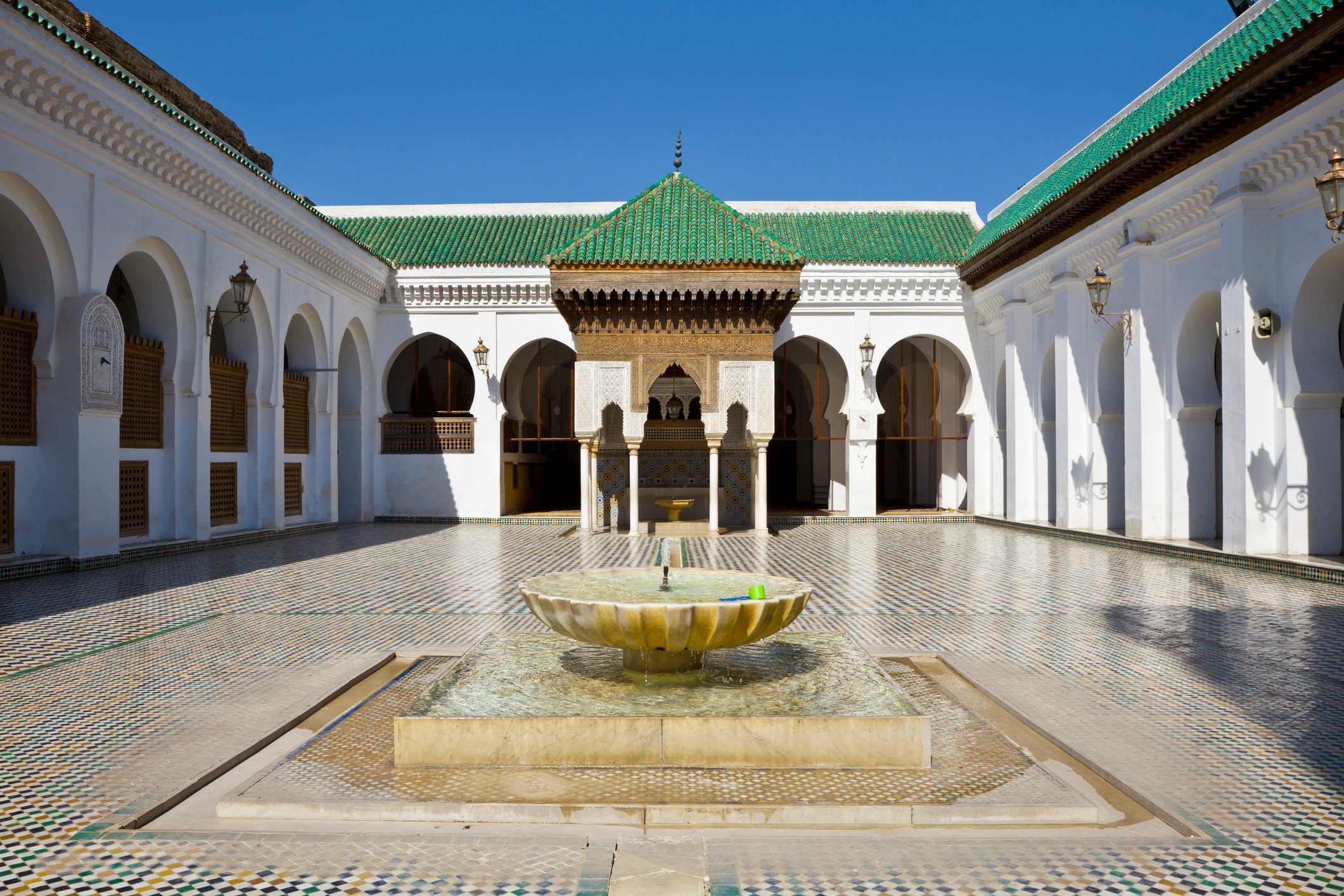
The oldest university in the world is the University of Al Quaraouiyine, in Fez, Morocco. It was originally founded as a mosque in 859, before developing into one of the leading spiritual and educational centres of the Islamic Golden Age.
Founded in 859 A.D. by Tunisian-born Fatima al-Fihri in Morocco’s Fez, the university is not only the oldest higher education institution on Earth but also the first to be founded by a woman, and a Muslim one at that. Fatima used her inheritance from her merchant father’s wealth to found the university which started as an associated school – known as a madrasa – and a mosque that eventually grew into a place of higher education. It also introduced the system of awarding degrees according to different levels of study in a range of fields, such as religious studies, grammar and rhetoric. Though the university first focused on religious instruction, its fields of study quickly expanded to include logic, medicine, mathematics and astronomy, among many others.
In 1963, it officially became a part of Morocco’s modern state university system, and is now widely known for being the oldest continuously operating university in the world.
The university has contributed significantly to global Islamic education, and has played a massive role in shaping intellectual and cultural traditions. The classes taught there concentrate heavily on the Islamic religious and legal sciences, with a particular focus on Classical Arabic grammar and linguistics and Maliki law.
The mosque building itself features elements from various periods of Moroccan history, becoming an important architectural landmark.
(NB: Although many scholars consider the University of Al Quaraouiyine to be the oldest university in the world, some scholars consider that it operated as an Islamic madrasa until after WWII and only became a university in 1963.)
The library currently hosts more than 4,000 valuable manuscripts in a range of fields, including historic copies of Islam’s holy book, the Quran. Some of these precious texts include the 14th-century work of “Al-Muqaddimah” and an original copy of “Al-‘Ibar” by the famous Muslim historian Ibn Khaldun, a pioneer in sociology. Other pieces such as the famous “Al-Muwatta” – the earliest collection of hadith texts (the Prophet Muhammad’s sayings) gathered by Malik, considered to be one of the first legal texts to incorporate both hadiths and fiqh, Islamic jurisprudence.
#First #university in the World; #Muslim, #Woman, #Islam, #Marocco,#History;
These categories are the categories you may find in a large physical bookstore. They have been automatically assigned.
Choose among free epub and Kindle eBooks, download them or read them online. You will find the world’s great literature here, with focus on older works for which U.S. copyright has expired. Thousands of volunteers digitized and diligently proofread the eBooks, for you to enjoy.
There is a missing chapter in the narrative of Canada’s Indigenous peoples—the story of the Métis Nation, a new Indigenous people descended from both First Nations and Europeans
Their story begins in the last decade of the eighteenth century in the Canadian North-West. Within twenty years the Métis proclaimed themselves a nation and won their first battle. Within forty years they were famous throughout North America for their military skills, their nomadic life and their buffalo hunts.
The Métis Nation didn’t just drift slowly into the Canadian consciousness in the early 1800s; it burst onto the scene fully formed. The Métis were flamboyant, defiant, loud and definitely not noble savages. They were nomads with a very different way of being in the world—always on the move, very much in the moment, passionate and fierce. They were romantics and visionaries with big dreams. They battled continuously—for recognition, for their lands and for their rights and freedoms. In 1870 and 1885, led by the iconic Louis Riel, they fought back when Canada took their lands. These acts of resistance became defining moments in Canadian history, with implications that reverberate to this day: Western alienation, Indigenous rights and the French/English divide.
After being defeated at the Battle of Batoche in 1885, the Métis lived in hiding for twenty years. But early in the twentieth century, they determined to hide no more and began a long, successful fight back into the Canadian consciousness. The Métis people are now recognized in Canada as a distinct Indigenous nation. Written by the great-grandniece of Louis Riel, this popular and engaging history of “forgotten people” tells the story up to the present era of national reconciliation with Indigenous peoples.
In 1993, the Métis Nation of Ontario (MNO) was established through the will of Métis people and Métis communities coming together throughout Ontario to create a Métis-specific governance structure. Prior to 1993, Métis had been involved in pan-Indigenous lobby groups and organizations. The MNO was not created to represent all individuals and communities that claim to be Métis, but those individuals and communities that are a part of the Métis Nation.
Police Criminal Records Check (PCRC) or the basic criminal record check for employment purposes costs $60.00 (includes HST) which is payable at the time of submitting your application. You must produce government-issued photo identification. (See Photo Identification Standards for acceptable identification.)
Volunteers and students seeking a record check for unpaid placement purposes will only be required to pay a $9.95 (+hst) online service fee.
This check is intended for applicants who are involved as a volunteer, employee or in any situation where a basic PCRC is requested (i.e. immigration, general labour, truck driving, warehouse, retail, etc.). This check is NOT intended for applicants who are seeking to volunteer and/or be employed with vulnerable persons.
This search is based on a query of the Royal Canadian Mounted Police’s National Repository for Criminal Records in Canada. It is based upon photo identification only and, therefore, is not confirmed by fingerprints. The completed check indicating the results of the criminal record search shall include the corporate seal of the Sault Ste. Marie Police Service as proof of authenticity.
If an applicant has a criminal conviction, this check can only be provided by the local Police Service where the applicant resides. If the person lives out of town and has a criminal conviction, again the check must be completed in the city in which they reside.
Police Criminal Records and Judicial Matters Check (PCRJMC – level two)
Police Criminal Records and Judicial Matters Check (PCRJMC – level two) is intended for applicants who are seeking to volunteer or be employed with agencies who require a PCRC (level one) along with a local police involvement and other systems/records where authorized – employment, volunteers, or student placement purposes where the position does not qualify for the vulnerable position screening:
A PCRJMC for employment purposes costs $60.00 (includes HST). This search is intended for individuals who will be employed in positions such as car sales, park wardens, Driver Seat (as Designated Driver), firefighters, etc.
Volunteers and students seeking a record check for unpaid placement purposes will only be required to pay a $9.95 (+hst) online service fee.
Police Vulnerable Sector Check (VSC- level three)
Police Vulnerable Sector Check (VSC- level three) is restricted to applicants seeking employment and/or volunteering with vulnerable individuals. It includes student placements.
A VSC for employment purposes costs $60.00 (includes HST). This search is intended for individuals who will be employed in vulnerable positions such as: day care centres, nursing, social workers, teaching, etc. This search is required when working with children (persons under 18 years of age), the elderly, sick or infirm.
This is available only to residents of Sault Ste. Marie and Prince Township. The Sault Ste. Marie Police Service does not provide record checks to people living outside of Canada. (For more information, please refer to our FAQ below.)
Volunteers and students seeking a record check for unpaid placement purposes will pay $30 as per the new fee schedule (includes HST). This record check is also for individuals who will be volunteering in vulnerable positions such as the: Children’s Aid Society, Boy Scouts, Girl Guides, boys and girls clubs, etc. This is required when volunteering with children (persons under 18 years of age), the elderly, sick or infirm.
Volunteers who require fingerprints to confirm their identity as required by the R.C.M.P.: You must provide AN ACCOMPANYING LETTER from the organization in which you will be volunteering so as to have the administrative fees waived by the Sault Ste. Marie Police Service and the R.C.M.P., otherwise all fees will be collected.
Students: If you are in Sault Ste. Marie attending school, and you are able to prove a Sault Ste. Marie or Prince Township residency, i.e. a bill or lease document, you may have your search done here.
Please note: If you are requesting a Police Vulnerable Sector Check, you will be required to confirm in the application process that the position for which you are applying meets the following criteria:
The position must be one of trust and authority towards vulnerable persons;
You will be interacting with vulnerable clients in a largely unsupervised capacity;
Contact with vulnerable persons will be sustained and regular.
Additionally, you may be required to provide a detailed job description that outlines the above-noted requirements to obtain a Vulnerable Sector Check.
The Onus of Proof is on the Claimant and The Taking of an Oath is on the Denier
On the authority of Ibn Abbas (may Allah be pleased with him), that the Messenger of Allah (peace be upon him) said:
Were people to be given everything that they claimed, men would [unjustly] claim the wealth and lives of [other] people. But, the onus of proof is upon the claimant, and the taking of an oath is upon him who denies. [Baihaqi]
عَنْ ابْنِ عَبَّاسٍ رَضِيَ اللَّهُ عَنْهُمَا أَنَّ رَسُولَ اللَّهِ صلى الله عليه و سلم قَالَ:
This mock jury selection exercise is designed to help you understand the process of establishing an impartial jury. While many of us understand the process of how jurors collaborate and deliberate on a case, the selection process is not often discussed or well understood. Many movies and television shows demonstrate how lawyers persuade jurors when presenting an argument; however, few media sources show the process of forming jury panels and selecting jury members for individual trials. This simulation will assess jury selection in hypothetical scenarios. When incorporated into a lesson, this task will simulate the entire process of jury selection. The re-enactment of this task requires students to play the role of lawyers, a judge, a registrar, prospective jurors, and the accused.
INTRODUCTION TO JURY DUTY Jury duty is one of many responsibilities that Canadian citizens are required to carry out. A jury is a group of individuals that makes a decision about a court hearing in an impartial manner. By being impartial, jurors are required to reach a decision based on the evidence presented in court, and reach a decision without any biases. In order to ensure that jurors are not biased, a series of steps occurs in the jury selection process to ensure that qualified and impartial jurors are selected to participate on juries.
The jury selection process is a critical process for the parties involved in a legal matter because the jury will ultimately decide the outcome of the trial. Therefore, it is important for both sides to have an impartial jury.
THE JURIES ACT The legislation governing the rules and regulations related to juries in Ontario is called the Juries Act. 1 It outlines the laws related to the eligibility of jurors, the preparation of jury rolls, the preparation of jury panels, the drawing of juries during a trial, and bringing challenges against potential jurors on the grounds that they might be biased or otherwise unsuitable to act as a juror.
ELIGIBILITY OF JURORS According to s. 2 of the Juries Act, in order to be eligible to act as a juror in Ontario, one must: (1) reside in Ontario, (2) be a Canadian citizen, (3) be at least 18 years of age at the beginning of the year in which the jury is selected, and (4) be able to speak, read, and understand English or French. A person may be ineligible to serve as a juror depending on their occupation, their connection with the court matter that they are a potential juror for, the recency of their previous jury service, or any personal circumstances that may
The Kebaowek First Nation’s legal challenge against Canadian Nuclear Laboratories over a proposed nuclear waste facility near the Ottawa River illustrates how progress on Indigenous rights often meets resistance. In a landmark ruling, Justice Julie Blackhawk affirmed that Canada’s commitments under the UNDRIP must meaningfully inform federal decision-making. Canadian Nuclear Laboratories appealed the decision, arguing against application of the UN Declaration Act and the requirement to obtain free, prior and informed consent from Indigenous nations.
Uncertainty is also being used by opponents of Indigenous-led marine protected areas. They promote and leverage the fears and uncertainties of concerned small businesses while also opposing the interests of other small-scale operators, including recreational fishers, that support MPAs.
It’s a familiar refrain: Those with established power seek to prevent change, hiding behind the concerns and doubts of community members, but quickly turn on them when it’s in their interest to do so.
In Manitoba, pushback against a Parks Canada initiative to establish corridors to maintain or restore ecological connectivity is rooted in scare tactics about Indigenous governance, among other fears. At a standing committee on environment and sustainable development meeting in 2024, a policy adviser for the hunting and fishing advocacy group the Manitoba Wildlife Federation said, “When you turn management over to Parks Canada, to Indigenous protected areas or to different control mechanisms that are not by elected officials, how is there any accountability?”
Each year, September 30 marks the National Day for Truth and Reconciliation (also known as Orange Shirt Day) as a response to Call #80
It is a day to honour and remember the children taken from their families, those who never returned home, and the individuals, families and communities still living with the lasting impacts and trauma caused by the residential school system in Canada. Public commemoration of the tragic and painful history and ongoing impacts of residential schools is a vital component of the reconciliation process. —Government of Canada
People wear orange shirts on this day because of Phyllis Webstad’s story. On her first day at residential school, her shiny new orange shirt, that was bought by her grandmother, was taken away from her as a sixyear old girl. —Orange Shirt Day Society
Modern DNA tells a surprising story: the Palestinian Arabs are more genetically connected to the ancient Israelites than the European Jews who displaced them. This is the untold story of how today’s Palestinians can trace their roots back to the Bronze Age Canaanites and to the people who once built the Kingdoms of Israel and Judah.
Historical religious Records: Jews – converted to Christianity – converted to Islam;
The Genomic History of the Bronze Age Southern Levant
Highlights
•Analysis of genome-wide data for nine sites from the Bronze Age Southern Levant
•Contemporaneous samples from multiple sites are genetically similar
•Migration from the Zagros and/or Caucasus to the Levant between 2500–1000 BCE
•People related to these individuals contributed to all present-day Levantine populations
Summary
We report genome-wide DNA data for 73 individuals from five archaeological sites across the Bronze and Iron Ages Southern Levant. These individuals, who share the “Canaanite” material culture, can be modeled as descending from two sources: (1) earlier local Neolithic populations and (2) populations related to the Chalcolithic Zagros or the Bronze Age Caucasus. The non-local contribution increased over time, as evinced by three outliers who can be modeled as descendants of recent migrants.
We show evidence that different “Canaanite” groups genetically resemble each other more than other populations. We find that Levant-related modern populations typically have substantial ancestry coming from populations related to the Chalcolithic Zagros and the Bronze Age Southern Levant. These groups also harbor ancestry from sources we cannot fully model with the available data, highlighting the critical role of post-Bronze-Age migrations into the region over the past 3,000 years.
Narrated Anas bin Malik: Hudhaifa bin Al-Yaman came to `Uthman at the time when the people of Sham and the people of Iraq were Waging war to conquer Arminya and Adharbijan. Hudhaifa was afraid of their (the people of Sham and Iraq) differences in the recitation of the Qur’an, so he said to `Uthman, “O chief of the Believers! Save this nation before they differ about the Book (Qur’an) as Jews and the Christians did before.” So `Uthman sent a message to Hafsa saying, “Send us the manuscripts of the Qur’an so that we may compile the Qur’anic materials in perfect copies and return the manuscripts to you.” Hafsa sent it to `Uthman. `Uthman then ordered Zaid bin Thabit, `Abdullah bin AzZubair, Sa`id bin Al-As and `AbdurRahman bin Harith bin Hisham to rewrite the manuscripts in perfect copies. `Uthman said to the three Quraishi men, “In case you disagree with Zaid bin Thabit on any point in the Qur’an, then write it in the dialect of Quraish, the Qur’an was revealed in their tongue.” They did so, and when they had written many copies, `Uthman returned the original manuscripts to Hafsa. `Uthman sent to every Muslim province one copy of what they had copied, and ordered that all the other Qur’anic materials, whether written in fragmentary manuscripts or whole copies, be burnt.
Reference – Sahid al Bukhari 4987, Book 66; Hadith 9; #Tashhkent copy;
Folio from the “Tashkent Qur’an”
late 8th–early 9th century
Magnificent in size, this folio comes from one of the oldest surviving Qur’an manuscripts in existence. It is written in an early version of the kufic script with no diacritical marks (tashkeel) to distinguish the letters, and with very limited illumination. Based on the form of the script, and the illuminations that do survive on other pages from this Qur’an, the book has been attributed to Cairo, Egypt; Damascus, Syria; or Sana’a, Yemen. About one third of the original manuscript is housed in the Hast-Imam Library in Tashkent, Uzbekistan.
At that time, there were no printing presses. Books had to be written manually by specialized scribes and making a copy required a similar effort. The Quran was dictated word by word and letter by letter by the Prophet himself to specialized scribes.[1] The Prophet passed away in 632 AD. Afterwards, Abu Bakr, the first leader of the Muslims, gathered the original scripts of the scribes into one book, and then some time later, when the Muslim empire stretched from East to West, Uthman, the son-in-law of the Prophet and the third Caliph, ordered five copies of the original to be made and distributed to all parts of the Muslim world some twenty years later.[2]
Today, we have three manuscripts of Quran which are traced back to the Prophet’s son-in-law, the Caliph Uthman.
(1) The Samarqand Manuscript located in Tashkent, Uzbekistan. It is written on a parchment from gazelle skin. According to Memory of the World Program, UNESCO, an arm of the United Nations, ‘it is the definitive version, known as the Mushaf of Uthman, superseding all other versions.’[3]
Figure 1 This manuscript, held by the Muslim Board of Uzbekistan, is the earliest existent written version of the Quran. It is the definitive version, known as the Mushaf of Othman, superseding all other versions. Image courtesy of Memory of the World Register, UNESCO.
Figure 2 The Holy Quran of Othman in its glass-fronted safe. Image courtesy of Memory of the World Register, UNESCO.