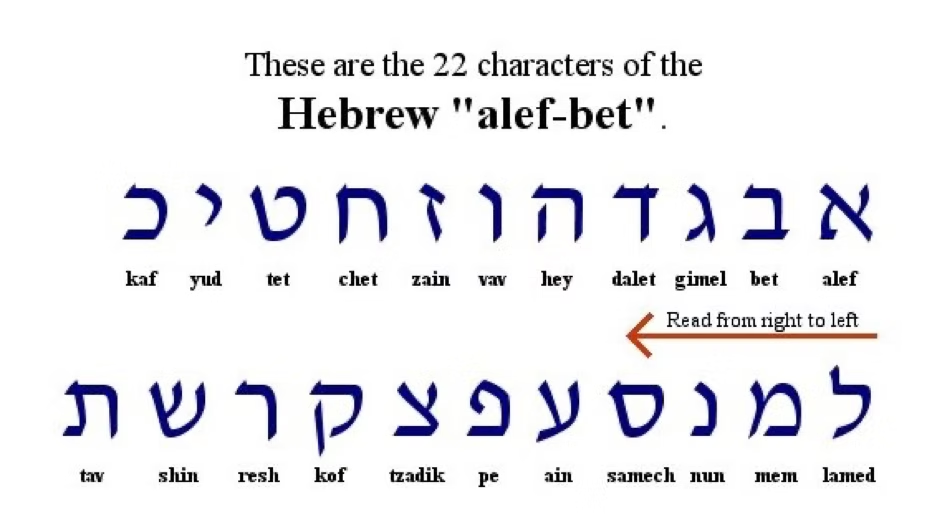
The main Aramaic words for God are Elah (ܐܠܗ) or Alaha (ܐܲܠܵܗܵܐ), meaning “God,” which are cognates of the Hebrew Eloah/Elohim and the Arabic Allah, all stemming from a common Semitic root for divinity. Aramaic also uses Elahi (אֱלָהִי) for “My God,” famously heard in Jesus’ cry “Eloi, Eloi, lama sabachthani?” (My God, my God, why have you forsaken me?).
* KEY TERMS:
Elah / Alaha (אלה / אלהא): The general term for “God,” used in Biblical Aramaic and Syriac.
Elahi (אֱלָהִי): Means “My God,” a possessive form.
Eloi: The specific Aramaic/Hebrew form for “My God,” as used by Jesus in the Gospels.
Connections to Other Languages:
These Aramaic terms share a common root with the Hebrew Elohim (God) and the Arabic Allah (God), highlighting linguistic links across Semitic languages.
*USAGE:
Jesus’ use of “Eloi” in Aramaic (Mark 15:34) shows direct usage of these terms.
In the Bible (Books of Daniel, Ezra), compound forms like Elah Avahati (God of my fathers) and Elah Shemaiya (God of Heaven) are found.
Ahmad (22978) narrated from Abu Nadrah: Someone who heard the khutbah of the Messenger of Allah (blessings and peace of Allah be upon him) on the second of the days of at-Tashreeq told me that he said: “O people, verily your Lord is One and your father is one. Verily there is no superiority of an Arab over a non-Arab or of a non-Arab over an Arab, or of a red man over a black man, or of a black man over a red man, except in terms of Taqwa (Piety, Fear of God). Have I conveyed the message?” They said: The Messenger of Allah (blessings and peace of Allah be upon him) has conveyed the message. Classed as saheeh by al-Albaani in as-Saheehah (6/199).
Last 3 Ayyat/ Verses from Surah Hashr (gathering in Judgement Day);
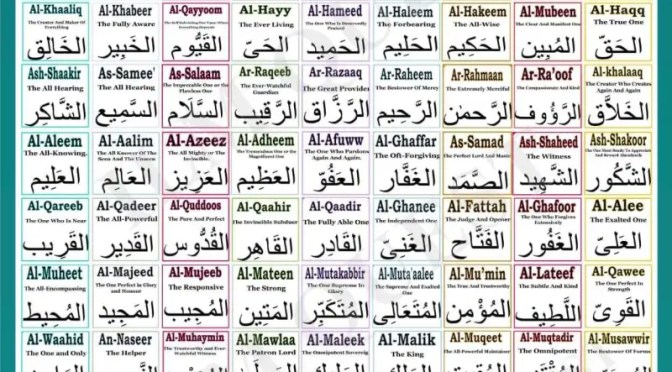
Translation of the last 3 verses of Surah Hashr: Verses 22-24; He is Allah—there is no god worthy of worship except Him: Knower of the seen and unseen. He is the Most Compassionate, Most Merciful. He is Allah—there is no god except Him: the King, the Most Holy, the All-Perfect, the Source of Serenity, the Watcher of all, the Almighty, the Supreme in Might, the Majestic. Glorified is Allah far above what they associate with Him in worship! He is Allah: the Creator, the Inventor, the Shaper. He alone has the Most Beautiful Names. Whatever is in the heavens and the earth constantly glorifies Him. And He is the Almighty, All-Wise.
Ayatul Kursi – Verse of the Throne
Allah! There is no god ˹worthy of worship˺ except Him, the Ever-Living, All-Sustaining. Neither drowsiness nor sleep overtakes Him. To Him belongs whatever is in the heavens and whatever is on the earth. Who could possibly intercede with Him without His permission? He ˹fully˺ knows what is ahead of them and what is behind them, but no one can grasp any of His knowledge—except what He wills ˹to reveal˺. His Seat1 encompasses the heavens and the earth, and the preservation of both does not tire Him. For He is the Most High, the Greatest.2
Definitions of God in Semitic Languages
The main Aramaic words for God are Elah (ܐܠܗ) or Alaha (ܐܲܠܵܗܵܐ), meaning “God,” which are cognates of the Hebrew Eloah/Elohim and the Arabic Allah, all stemming from a common Semitic root for divinity. Aramaic also uses Elahi (אֱלָהִי) for “My God,” famously heard in Jesus’ cry “Eloi, Eloi, lama sabachthani?” (My God, my God, why have you forsaken me?).
Key Terms:
Elah / Alaha (אלה / אלהא): The general term for “God,” used in Biblical Aramaic and Syriac.
Elahi (אֱלָהִי): Means “My God,” a possessive form.
Eloi: The specific Aramaic/Hebrew form for “My God,” as used by Jesus in the Gospels.
Connections to Other Languages:
These Aramaic terms share a common root with the Hebrew Elohim (God) and the Arabic Allah (God), highlighting linguistic links across Semitic languages.
Usage:
Jesus’ use of “Eloi” in Aramaic (Mark 15:34) shows direct usage of these terms.
In the Bible (Books of Daniel, Ezra), compound forms like Elah Avahati (God of my fathers) and Elah Shemaiya (God of Heaven) are found.
#God, #Allah, #Divine Attributes, #Definitions, #Islam; #Semitic languages
Verily, the creation of each one of you is brought together in his mother’s womb for forty days as a drop, then he is a clot for a similar period, then a morsel for a similar period, then there is sent to him the angel who blows the spirit into him and he is commanded regarding four matters: to write down his provision, his life span, his deeds, and whether he is blessed or damned. By Allah, other than whom there is no God, one of you acts like the people of Paradise until he is but an arm’s length from it, and what is written overtakes him so he acts like the people of Hellfire and he enters it. Verily, one of you acts like the people of Hellfire until he is but an arm’s length from it, and what is written overtakes him so he acts like the people of Paradise and he enters it. Source: Ṣaḥīḥ al-Bukhārī 7454, Grade: Muttafaqun Alayhi
Hadith 5: Religious innovation البدعة
Aisha reported: The Messenger of Allah, peace be upon him, said:
Whoever innovates into this matter of ours that which does not belong to it, it will be rejected. Source: Ṣaḥīḥ al-Bukhārī 2697, Grade: Muttafaqun Alayhi
Hadith 2: Islam, faith, and excellence الإسلام والإيمان والإحسان
Umar ibn al-Khattab reported: We were sitting with the Messenger of Allah, peace and blessings be upon him, one day when a man appeared with very white clothes and very black hair. There were no signs of travel on him and we did not recognize him. He sat down in front of the Prophet and rested his knees by his knees and placed his hands on his thighs. The man said, “O Muhammad, tell me about Islam.” The Prophet said:
Islam is to testify there is no God but Allah and Muhammad is the Messenger of Allah, to establish prayer, to give charity, to fast the month of Ramadan, and to perform pilgrimage to the House if a way is possible.
The man said, “You have spoken truthfully.” We were surprised that he asked him and then said he was truthful. He said, “Tell me about faith.” The Prophet said:
Faith is to believe in Allah, His angels, His books, His messengers, the Last Day, and to believe in providence, its good and its evil.
The man said, “You have spoken truthfully. Tell me about excellence.” The Prophet said: أَنْ تَعْبُدَ اللَّهَ كَأَنَّكَ تَرَاهُ فَإِنْ لَمْ تَكُنْ تَرَاهُ فَإِنَّهُ يَرَاكَ
* Excellence is to worship Allah as if you see Him, for if you do not see Him, He surely sees you.
The man said, “Tell me about the final hour.” The Prophet said: مَا الْمَسْئُولُ عَنْهَا بِأَعْلَمَ مِنْ السَّائِلِ ; The one asked does not know more than the one asking.
The man said, “Tell me about its signs.” The Prophet said:
The slave girl will give birth to her master and you will see barefoot, naked, and dependent shepherds compete in the construction tall buildings.
Then, the man left and I remained. The Prophet said to me: يَا عُمَرُ أَتَدْرِي مَنْ السَّائِلُ O Umar, do you know who he was? I said, “Allah and his messenger know best.” The Prophet said: فَإِنَّهُ جِبْرِيلُ أَتَاكُمْ يُعَلِّمُكُمْ دِينَكُمْVerily, he was Gabriel who came to teach you your religion. Source: Ṣaḥīḥ Muslim 8, Grade: Sahih
Hadith 3: Pillars of Islam أركان الإسلام
Ibn Umar reported: The Messenger of Allah, peace and blessings be upon him, said:
Islam is built upon five: to worship Allah and to disbelieve in what is worshiped besides him, to establish prayer, to give charity, to perform Hajj pilgrimage to the house, and to fast the month of Ramadan. Source: Ṣaḥīḥ al-Bukhārī 8, Grade: Muttafaqun Alayhi;
#Pillars of #Islam, Eeeman/ Faith; #Hadith, #Narrations;
Verily, deeds are only with intentions. Verily, every person will have only what they intended. Whoever emigrated to Allah and his messenger, his emigration is for Allah and his messenger. Whoever emigrated to get something in the world or to marry a woman, his emigration is for that to which he emigrated.
On the authority of Abu ‘Abdullah al-Nu’man bin Bashir (ra) who said: I heard the Messenger of Allah(sas) say:
“The halal is clear and the haram is clear, and between them are matters unclear that are unknown to most people. Whoever is wary of these unclear matters has absolved his religion and honor. And whoever indulges in them has indulged in the haram. It is like a shepherd who herds his sheep too close to preserved sanctuary, and they will eventually graze in it. Every king has a sanctuary, and the sanctuary of Allah is what He has made haram. There lies within the body a piece of flesh. If it is sound, the whole body is sound; and if it is corrupted, the whole body is corrupted. Verily this piece is the heart.” [Bukhari & Muslim]
Mathew 23:8 – 8“But you are not to be called ‘Rabbi,’ for you have one Teacher, and you are all brothers. 9And do not call anyone on earth ‘father,’ for you have one Father, and he is in heaven. 10Nor are you to be called instructors, for you have one Instructor, the Messiah. 11The greatest among you will be your servant.
12For those who exalt themselves will be humbled, and those who humble themselves will be exalted.
Hadith Qudsi 19 – Pride and Greatness Belong to Allah (God) Alone – HADITH – ISLAM
The Messenger of Allah (ﷺ) said: “Allah, the Most High, said: ‘Pride is My cloak and greatness is My robe. Whoever competes with Me in respect of either of them, I shall cast him into the Hellfire.’” — Narrated by Abu Dawud, Ibn Majah, Ahmad. Also reported with sound chain in Sahih Muslim.
Reflection: This Hadith Qudsi is a stark reminder of the danger of arrogance. Pride and greatness belong only to Allah — when a person tries to claim them, they cross a boundary set by the Divine. True honor is found in humility, submission, and recognizing that everything we have is from Him alone.
1Then Jesus said to the crowds and to his disciples: 2“The teachers of the law and the Pharisees sit in Moses’ seat. 3So you must be careful to do everything they tell you. But do not do what they do, for they do not practice what they preach. 4They tie up heavy, cumbersome loads and put them on other people’s shoulders, but they themselves are not willing to lift a finger to move them.
5“Everything they do is done for people to see: They make their phylacteries a wide and the tassels on their garments long; 6they love the place of honor at banquets and the most important seats in the synagogues; 7they love to be greeted with respect in the marketplaces and to be called ‘Rabbi’ by others.
8“But you are not to be called ‘Rabbi,’ for you have one Teacher, and you are all brothers. 9And do not call anyone on earth ‘father,’ for you have one Father, and he is in heaven. 10Nor are you to be called instructors, for you have one Instructor, the Messiah. 11The greatest among you will be your servant. 12For those who exalt themselves will be humbled, and those who humble themselves will be exalted.
Seven Woes on the Teachers of the Law and the Pharisees
13“Woe to you, teachers of the law and Pharisees, you hypocrites! You shut the door of the kingdom of heaven in people’s faces. You yourselves do not enter, nor will you let those enter who are trying to. [14]b
15“Woe to you, teachers of the law and Pharisees, you hypocrites! You travel over land and sea to win a single convert, and when you have succeeded, you make them twice as much a child of hell as you are.
29“Woe to you, teachers of the law and Pharisees, you hypocrites! You build tombs for the prophets and decorate the graves of the righteous. 30And you say, ‘If we had lived in the days of our ancestors, we would not have taken part with them in shedding the blood of the prophets.’ 31So you testify against yourselves that you are the descendants of those who murdered the prophets. 32Go ahead, then, and complete what your ancestors started!
33“You snakes! You brood of vipers! How will you escape being condemned to hell? 34Therefore I am sending you prophets and sages and teachers. Some of them you will kill and crucify; others you will flog in your synagogues and pursue from town to town. 35And so upon you will come all the righteous blood that has been shed on earth, from the blood of righteous Abel to the blood of Zechariah son of Berekiah, whom you murdered between the temple and the altar. 36Truly I tell you, all this will come on this generation.
37“Jerusalem, Jerusalem, you who kill the prophets and stone those sent to you, how often I have longed to gather your children together, as a hen gathers her chicks under her wings, and you were not willing. 38Look, your house is left to you desolate. 39For I tell you, you will not see me again until you say, ‘Blessed is he who comes in the name of the Lord.’ c ”
Paying the Imperial Tax to Caesar
15 Then the Pharisees went out and laid plans to trap him in his words. 16 They sent their disciples to him along with the Herodians. “Teacher,” they said, “we know that you are a man of integrity and that you teach the way of God in accordance with the truth. You aren’t swayed by others, because you pay no attention to who they are. 17 Tell us then, what is your opinion? Is it right to pay the imperial tax[a] to Caesar or not?”
18 But Jesus, knowing their evil intent, said, “You hypocrites, why are you trying to trap me? 19 Show me the coin used for paying the tax.” They brought him a denarius, 20 and he asked them, “Whose image is this? And whose inscription?”
21 “Caesar’s,” they replied. Then he said to them, “So give back to Caesar what is Caesar’s, and to God what is God’s.”
22 When they heard this, they were amazed. So they left him and went away.
HYPOCRITES IN Quran Kareem
Hypocrisy in Islam is a serious sickness and a great crime. It means making an outward display of Islam whilst inwardly concealing disbelief. Hypocrisy is more dangerous than disbelief and the punishment for it is more severe, because it is disbelief mixed with Islam and its harmful effects are greater. Hence Allah will put the hypocrites in the lowest level of Hell, as He says (interpretation of the meaning):
{Verily, the hypocrites will be in the lowest depth (grade) of the Fire; no helper will you find for them.} [Al-Nisa/ Women 4:145]
The hypocrites are always confused, always planning deceit and plots. Although outwardly they appear to be with the believers, inwardly they are with the disbelievers. So sometimes they are inclined towards the believers and sometimes they are inclined towards the disbelievers.
It was narrated from ‘Abdullah ibn ‘Amr (may Allah be pleased with him) that the Prophet (blessings and peace of Allah be upon him) said: “There are four characteristics, whoever has them all is a pure hypocrite, and whoever has one of them has one of the characteristics of hypocrisy, until he gives it up: when he is entrusted with something he betrays that trust, when he speaks he lies, when he makes a covenant he breaks it, and when he disputes he resorts to obscene speech.” Narrated by al-Bukhaari (54) and Muslim (58).
If any of those who believe in Tawheed (the Oneness of Allah/ God) has any of these characteristics, he has fallen into minor hypocrisy to the extent to which he has done such deeds or has that characteristic, because he resembles the hypocrites in some of their actions, even if he is not exactly like them.
Shaykh al-Islam Ibn Taymiyah (may Allah have mercy on him) said: The word hypocrisy refers to major hypocrisy which means concealing disbelief, or minor hypocrisy which means behaving differently in private and in public with regard to obligatory duties. … This is well known among the scholars and this is how they interpreted the words of the Prophet (blessings and peace of Allah be upon him), “The signs of the hypocrite are three: when he speaks he lies, when he makes a promise he breaks it, and when he is entrusted with something he betrays that trust.” Narrated by at-Tirmidhi and others. More than one of the early scholars said: A lesser form of kufr, a lesser form of hypocrisy, a lesser form of shirk. “(Majmoo‘ al-Fataawa, 11/140 )
Abdullah ibn Amr reported: The Messenger of Allah, peace and blessings be upon him, said, “Verily, most of the hypocrites in my nation are among its reciters.” ( of Quran)
Source: Musnad Ahmad 6633; Grade: Sahih(authentic) according to Al-Arna’ut; عَنْ عَبْدِ اللَّهِ بْنِ عَمْرِو بْنِ الْعَاصِي قَالَ قَالَ رَسُول اللَّهِ صَلَّى اللَّهُ عَلَيْهِ وَسَلَّمَ إِنَّ أَكْثَرَ مُنَافِقِي أُمَّتِي قُرَّاؤُهَا 6633 مسند أحمد بن حنبل 11/210 المحدث شعيب الأرناؤوط خلاصة حكم المحدث صحيح في تخريج المسند
SURAH MUNAFIKUN- THE HYPOCRITES- QURAN TRANSLATION
In the name of Allah/ God, the Gracious, the Merciful.
1. When the hypocrites come to you (Muhammad- saw), they say, “We bear witness that you are God’s Messenger.” God knows that you are His Messenger, and God bears witness that the hypocrites are liars. 2. They treat their oaths as a cover, and so they repel others from God’s path. Evil is what they do.
3. That is because they believed, and then disbelieved; so their hearts were sealed, and they cannot understand.
4. When you see them, their appearance impresses you. And when they speak, you listen to what they say. They are like propped-up timber. They think every shout is aimed at them. They are the enemy, so beware of them. God condemns them; how deluded they are!
5. And when it is said to them, “Come, the Messenger of God will ask forgiveness for you,” they bend their heads, and you see them turning away arrogantly.
6. It is the same for them, whether you ask forgiveness for them, or do not ask forgiveness for them; God will not forgive them. God does not guide the sinful people.
7. It is they who say: “Do not spend anything on those who side with God’s Messenger, unless they have dispersed.” To God belong the treasures of the heavens and the earth, but the hypocrites do not understand.
8. They say, “If we return to the City, the more powerful therein will evict the weak.” But power belongs to God, and His Messenger, and the believers; but the hypocrites do not know.
9. O you who believe! Let neither your possessions nor your children distract you from the remembrance of God. Whoever does that—these are the losers.
10. And give from what We have provided for you, before death approaches one of you, and he says, “My Lord, if only You would delay me for a short while, so that I may be charitable, and be one of the righteous.”
11. But God will not delay a soul when its time has come. God is Informed of what you do.
While Christmas celebrates Jesus’ birth in December, biblical clues and historical analysis strongly suggest He was likely born in the fall (autumn), around September or October, due to shepherds with flocks outdoors, the census timing, and calculations based on John the Baptist‘s conception, linking to Jewish festivals like Tabernacles.
Evidence for an Autumn Birth:
Shepherds in Fields: Luke 2:8 mentions shepherds tending flocks at night; this would be more plausible in mild autumn weather than cold, snowy winter, when sheep are housed.
Priestly Calendar:Zechariah, John the Baptist’s father, served in the Jerusalem Temple (Abijah’s course, around June) when Gabriel appeared.
John’s Conception/Birth:After Zechariah returned home, Elizabeth conceived (late June/July). John was born about March.
Jesus’ Conception/Birth: Mary conceived Jesus six months after John’s conception (late December/early January). Adding nine months to this places Jesus’ birth in September/October.
Feast of Tabernacles: An autumn birth coincides with the Jewish Feast of Tabernacles (Succoth), a major pilgrimage festival when Jerusalem would be crowded, fitting the census narrative.
Why December 25th?
The Bible doesn’t state Jesus’ birth date. December 25th was adopted later (3rd Century AD in North Africa) to coincide with existing winter solstice festivals, a practice sometimes linked to “redeeming” pagan dates.
Matthew 22:36-40New International Version – Greatest Commandment
36 “Teacher, which is the greatest commandment in the Law?”37 Jesus replied: “‘Love the Lord your God with all your heart and with all your soul and with all your mind.’[a]38 This is the first and greatest commandment. 39 And the second is like it: ‘Love your neighbor as yourself.’[b]40 All the Law and the Prophets hang on these two commandments.”
Luke 2: – The Birth of Jesus
2 In those days Caesar Augustus issued a decree that a census should be taken of the entire Roman world. 2 (This was the first census that took place while[a] Quirinius was governor of Syria.) 3 And everyone went to their own town to register.
4 So Joseph also went up from the town of Nazareth in Galilee to Judea, to Bethlehem the town of David, because he belonged to the house and line of David. 5 He went there to register with Mary, who was pledged to be married to him and was expecting a child. 6 While they were there, the time came for the baby to be born, 7 and she gave birth to her firstborn, a son. She wrapped him in cloths and placed him in a manger, because there was no guest room available for them.
8 And there were shepherds living out in the fields nearby, keeping watch over their flocks at night. 9 An angel of the Lord appeared to them, and the glory of the Lord shone around them, and they were terrified. 10 But the angel said to them, “Do not be afraid. I bring you good news that will cause great joy for all the people. 11 Today in the town of David a Savior has been born to you; he is the Messiah, the Lord. 12 This will be a sign to you: You will find a baby wrapped in cloths and lying in a manger.”
The Rich and the Kingdom of God- Mark 10:18
17 As Jesus started on his way, a man ran up to him and fell on his knees before him. “Good teacher,” he asked, “what must I do to inherit eternal life?” 18 “Why do you call me good?” Jesus answered. “No one is good—except God alone. 19 You know the commandments: ‘You shall not murder, you shall not commit adultery, you shall not steal, you shall not give false testimony, you shall not defraud, honor your father and mother.’[a]”
Notes: Prophet Jesus taught to worship God Alone (monotheism/ Islam – Submission to God- no on is Good but God; love/ worship God with all you mind, all your soul and all your mind); “trinity” was a concept in minority later introduced by the church – during Emperor Constantine – 325CE –
Jesus’ Birth – in Quran Kareem –
45. The Angels said, “O Mary, God gives you good news of a Word from Him. His name is the Messiah, Jesus, son of Mary, well-esteemed in this world and the next, and one of the nearest.
46. He will speak to the people from the crib, and in adulthood, and will be one of the righteous.”
47. She said, “My Lord, how can I have a child, when no man has touched me?” He said, “It will be so. God creates whatever He wills. To have anything done, He only says to it, ‘Be,’ and it is.” 48. And He will teach him the Scripture and wisdom, and the Torah and the Gospel.
49. A messenger to the Children of Israel: “I have come to you with a sign from your Lord. I make for you out of clay the figure of a bird; then I breathe into it, and it becomes a bird by God’s leave. And I heal the blind and the leprous, and I revive the dead, by God’s leave. And I inform you concerning what you eat, and what you store in your homes. In that is a sign for you, if you are believers.”
50. “And verifying what lies before me of the Torah, and to make lawful for you some of what was forbidden to you. I have come to you with a sign from your Lord; so fear God, and obey me.”
51. “God is my Lord and your Lord, so worship Him. That is a straight path.”
52. When Jesus sensed disbelief on their part, he said, “Who are my allies towards God?” The disciples said, “We are God’s allies; we have believed in God, and bear witness that we submit.” 53. “Our Lord, we have believed in what You have revealed, and we have followed the Messenger, so count us among the witnesses.”
54. They planned, and God planned; but God is the Best of planners. 55.˹Remember˺ when Allah(God) said, “O Jesus! I will take you1 and raise you up to Myself. I will deliver you from those who disbelieve, and elevate your followers above the disbelievers until the Day of Judgment. Then to Me you will ˹all˺ return, and I will settle all your disputes.
56. As for those who disbelieve, I will punish them with a severe punishment, in this world and the next, and they will have no helpers. 57. And as for those who believe and do good works, He will give them their rewards in full. God does not love the unjust.”
58. This is what We recite to you of the Verses and the Wise Reminder. 59. The likeness of Jesus in God’s sight is that of Adam: He created him from dust, then said to him, “Be,” and he was. 60. The truth is from your Lord, so do not be of those who doubt.
61. And if anyone disputes with you about him, after the knowledge that has come to you, say, “Come, let us call our children and your children, and our women and your women, and ourselves and yourselves, and let us invoke God’s curse on the liars.” 62. This is the narrative of truth: there is no god but God. God is the Mighty, the Wise. 63. But if they turn away—God knows the corrupt.
64. Say, “O People of the Book, come to terms common between us and you: that we worship none but God, and that we associate nothing with Him, and that none of us takes others as lords besides God.” And if they turn away, say, “Bear witness that we have submitted.”
Just Remember – sometimes the Evidence is Clear as Day as Night – and sometimes or many times the Innocent are made like Looking Guilty even if they are Innocent – Lies in front of Judges, Fake Witnesses etc; even the Police may pick and chooses whose Testimony to take or reject;
Local father-son duo is carrying on a legal legacy that spans over five decades. Anthony J. Orazietti, who joined his father in practice, offers a unique perspective on the evolving landscape of law and the importance of community engagement.
The Orazietti & Orazietti Law Firm has been a fixture in the legal community since the 1980s.
The senior Orazietti, called to the bar in 1970, spent his early career in the Crown Attorney’s office before transitioning to private practice. Anthony, following in his father’s footsteps, was called to the bar in 2017.
For the younger Orazietti, the path to law seemed almost predestined.
“I always found it interesting,” he reminisces. “I remember going to the courthouse with dad and spending time in his office.” These early experiences sparked a passion that would eventually lead him to join the family practice.
As practitioners of criminal law, the Oraziettis are committed to providing the highest quality of service to their clients. Anthony emphasizes the importance of focused attention in their line of work.
“Criminal law is a very serious matter, and we take it seriously,” he states. “While clients may sometimes need to wait for a callback or email reply, it’s to ensure we can give each case the full attention it deserves.”
▾ The Ten Commandments (Deuteronomy 5:6–21) 1And God spoke all these words:2“I am the LORD your God, who brought you out of the land of Egypt, out of the house of slavery.3You shall have no other gods before Me.a4You shall not make for yourself an idol in the form of anything in the heavens above, on the earth below, or in the waters beneath. 5You shall not bow down to them or worship them; for I, the LORD your God, am a jealous God, visiting the iniquity of the fathers on their children to the third and fourth generations of those who hate Me, 6but showing loving devotion to a thousand generationsb of those who love Me and keep My commandments.7You shall not take the name of the LORD your God in vain, for the LORD will not leave anyone unpunished who takes His name in vain.
12Honor your father and mother, so that your days may be long in the land that the LORD your God is giving you.c
16You shall not bear false witness against your neighbor.g
17You shall not coveth your neighbor’s house. You shall not covet your neighbor’s wife, or his manservant or maidservant, or his ox or donkey, or anything that belongs to your neighbor.”
#Cases, #innocent, #Guilty, #Lies; #Evidence and #False Winess; #Sins;
#Appearance of #Prophet #Muhammad #Islam #Narrations;
Ka’ab ibn Malik (R.A) said, “When I greeted the Messenger of Allah, whose face was glittering with happiness, for whenever Allah’s Messenger ﷺ was happy, his face used to glitter, as if it was a piece of the moon, and we used to recognize it (i.e. his happiness) from his face.” Once Al-Baraa (R.A) was asked whether the Prophet Muhammad ﷺ face was like the sword to which he replied: No, it was like the moon.
Seal of Prophethood
The Prophet ﷺ had the seal of prophethood between his shoulders. The seal was something distinct on his body like a birth mark. Jabir ibn Samurah (R.A) said: “And I saw the seal near his shoulder, it was the size of a pigeon’s egg and its color was the same as that of his body.”
DESCRIPTION OF UMM MA’BAD AL KHUZA’IYYAH
In the name of Allāh, ar-Raḥmān (the most merciful), ar-Raḥīm (the bestower of mercy).
During the hijrah, the Prophet ﷺ passed by an elderly non-Muslim woman called Umm Ma’bad al-Khuzā’iyyah. He stopped at her place to seek provisions and rest. Her husband was away tending to his flock whilst the Prophet ﷺ visited. When he returned, she described the physical features and appearance of the Prophet ﷺ in great detail:
On the authority of Umm Ma‘bad ‘Atikah bint Khalid al-Khuza‘iyyah (ra) who said:’I saw a man of visible radiance and purity, beautiful appearance, bright faced, with neither protruding ribs nor a small head, handsome and fair. His eyes were deep black and large, and his eyelashes were lush. His voice was mellow and soft. The whiteness of his eyes was bright and his pupils were very black. His eyebrows were beautifully arched and connected. His neck was long, his beard densely full. When he was silent, he appeared dignified. When he spoke, he was eminent and crowned with magnificence. His speech was sweet, his words precise, neither too little nor too much. Like a string of pearls flowing down gradually.
He was the most striking and beautiful of people when seen from afar and the fairest of them when seen up close. He was medium height, neither unagreeably tall nor scornfully short; a branch between two branches. Among the three he was the most radiant in appearance, the finest of them in stature. He was surrounded by companions. When he spoke, they listened attentively. When he gave orders, they hastened to fulfil them. Honoured, served and surrounded by followers. He neither frowned, nor criticised’.[Al-Baihaqi and al-Hakim]